Wisconsin Clinical Placement Guidance for GCU NP Students
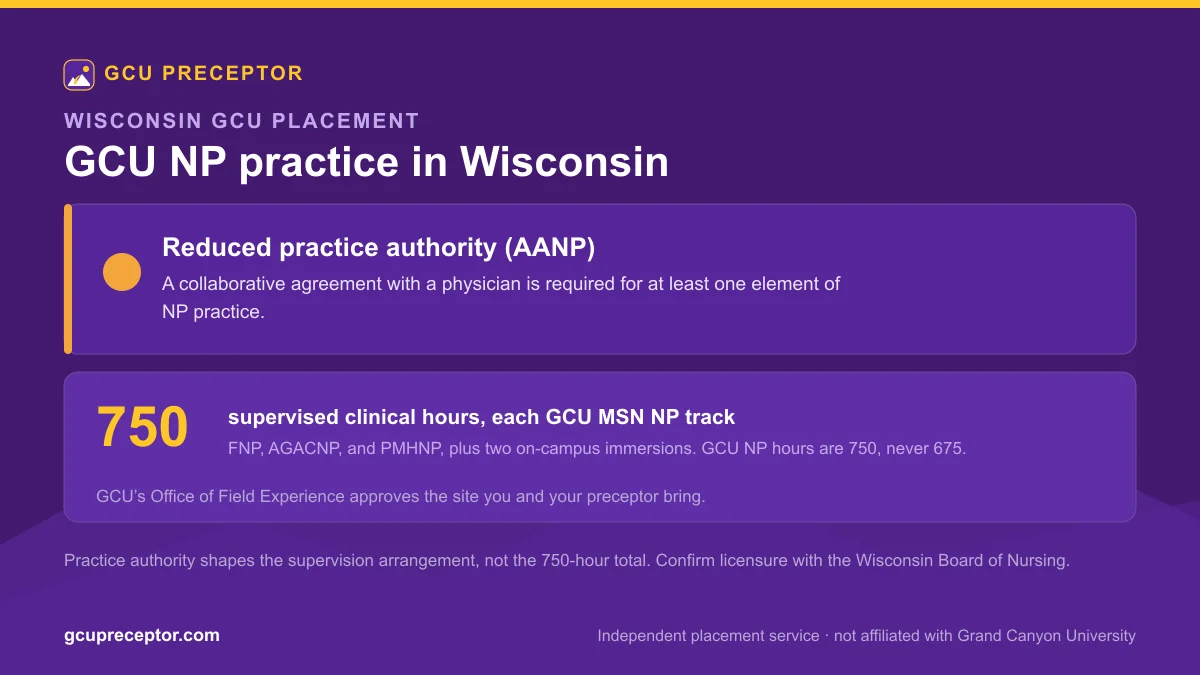
AANP classifies Wisconsin as reduced practice in July 2026, and current rules require advanced practice nurse prescribers to maintain a documented collaborative relationship. State implementation is changing soon, so students should verify the live Board guidance when evaluating a preceptor.
Get matched, free
Wisconsin is reduced practice today, with a change approaching
Under the practice environment in effect in July 2026, AANP lists Wisconsin as reduced practice. The current Board rule requires an Advanced Practice Nurse Prescriber, or APNP, to work in a collaborative relationship with a physician or dentist and document that relationship. Collaboration can include working in each other's presence when necessary, but it is not a statement that the physician must watch every encounter.
Wisconsin's Department of Safety and Professional Services says the APRN Modernization Act takes effect on September 1, 2026 and includes changes related to independent practice. Because this page is being published during the transition, use the live DSPS page for the rule that applies on the date of your rotation. Do not assume either the current collaboration model or the future pathway from an old summary.
For preceptor selection, confirm how the clinician is credentialed and practicing at that time. The state framework supplies context, while GCU separately evaluates the educational value of the site and specialty match.
The Board of Nursing sits within Wisconsin DSPS
Wisconsin's Board of Nursing is administered through the Department of Safety and Professional Services. DSPS publishes the APNP credential page, the nursing rules, application information, and links to credential lookup and disciplinary orders. The state uses the APNP title for advanced practice nurses with prescribing certification under the current system.
Verify a proposed preceptor through the official DSPS credential search. Confirm the active nursing credential, APNP status when prescribing is part of the role, relevant national certification, and any public limitations. A clinic biography is useful for background but is not primary-source verification. After that state check, compare the candidate with GCU's preceptor requirements.
Choose a Wisconsin search area that fits the course
Milwaukee and its surrounding counties offer a wide range of primary care, specialty, behavioral health, and hospital-connected settings. Madison has another deep clinical market, with academic, community, and public-sector care. Both can attract many student requests, so a large number of sites does not guarantee quick acceptance.
Green Bay and the Fox Cities, including Appleton, Neenah, and Oshkosh, create a strong northeastern corridor. Eau Claire, La Crosse, Wausau, and Superior anchor other regions. Students in rural northern or central Wisconsin may need to combine a wider drive radius with flexible weekdays, especially for psychiatric or acute care placements.
Search for the patient population and setting your course requires before sorting by distance. Ask whether the practice accepts students for your dates, who controls onboarding, and how much schedule capacity the preceptor can actually provide. A clinician's interest is only useful if the site can participate too.
Move from a Wisconsin yes to GCU approval
GCU students source their own preceptor. After a Wisconsin clinician agrees, the student enters the proposed site and preceptor in the eDocs Field Experience Site Information Form. The Office of Field Experience supports the process and reviews the student-selected experience, but it does not assign the site.
Submit accurate credential, facility, and contact information and allow time for questions. The state's practice category does not make a licensed NP automatically suitable for your course. GCU still examines specialty alignment, setting, supervision, and other program criteria. Do not begin hours while treating approval as a formality.
Once the site is approved and you begin, record clinical activity in the Lopes Activity Tracker. Your preceptor approves the hours in ThunderTime. A weekly review habit is easier than resolving a full course of unmatched entries at the end.
Organize all 750 hours before the first Wisconsin term
GCU's MSN nurse practitioner tracks each require 750 supervised clinical hours. FNP students need course-aligned care across the lifespan. PMHNP students need psychiatric settings and patient care that meet the objectives. AGACNP students need acute and complex adult experiences rather than a convenient general outpatient substitute.
The NP programs also include two on-campus immersions in Phoenix, so the degree is not 100% online. Put immersion travel, site onboarding, Wisconsin shifts, and course dates on one calendar. One preceptor may meet the next course need without being the right person for the entire 750-hour sequence.
Students seeking a DNP practicum site should describe the Direct Practice Improvement project, IRB process, and course-specific hours. The RN-to-BSN NRS-465 practicum has a 40-hour requirement. A precise request gets a faster answer from a Wisconsin facility.
Confirm virtual care course by course
Telehealth may be part of a Wisconsin practice, especially for psychiatric follow-up or patients far from a regional center. It is not automatically an approved virtual preceptorship. Confirm with your program and OFE whether the course permits telehealth, how much in-person care is required, where patients may be located, and how the student must participate.
In-person access remains important for physical assessment and acute care skills. Describe the proposed balance honestly in eDocs instead of relying on a general statement that the clinic offers virtual visits.
Ask for help while you still have scheduling choices
We are an independent service that sources potential Wisconsin preceptors, confirms interest and basic schedule fit, and provides a match for you to submit to GCU. We work independently of GCU and cannot guarantee a placement date or OFE approval. You are matched first and pay only when a placement is secured.
If your own outreach has stalled, request a free placement review with your track, course, city, travel radius, dates, and weekly availability. We will assess the search under the current Wisconsin environment and point out where flexibility may help.
Frequently asked questions
Is Wisconsin a reduced practice state for NPs?
Yes, as of July 2026 AANP classifies Wisconsin as reduced practice. DSPS says modernization changes, including provisions related to independent practice, take effect September 1, 2026, so verify the current Board guidance for your rotation date.
What is an APNP in Wisconsin?
APNP means Advanced Practice Nurse Prescriber, the credential title used on Wisconsin's current DSPS pages. Verify that credential along with the nurse's license, certification, and public status before submitting a preceptor to GCU.
Does Wisconsin practice authority determine GCU approval?
No. State law governs the clinician's practice. GCU OFE separately decides whether the proposed preceptor, patient population, site, supervision, and course fit meet the program's educational requirements.
Where can I search outside Milwaukee and Madison?
Green Bay, the Fox Cities, Eau Claire, La Crosse, Wausau, and Superior are useful regional markets. Students in rural areas may need a wider travel radius or flexible weekdays for scarce specialties.
Get your GCU clinicals handled.
Tell us your track and term. We’ll map your clinical requirement and start the search, in person or virtual. No payment until you’re matched.