GCU DNP Practicum & DPI Project Support
Grand Canyon University’s Doctor of Nursing Practice is a practice-focused doctorate built around a real improvement project carried out in a real clinical setting. We are an independent service that helps GCU DNP students secure the site access and practice-mentor relationships that project depends on, so the practicum hours never become the thing that stalls your degree.
Get matched, free
What the GCU DNP looks like
GCU’s DNP is a 39-credit, practice-focused doctorate delivered online in 8-week courses that include synchronous activities, live sessions you attend in real time, including your project defenses. It is designed for nurses who already hold a master’s in nursing, so it builds on graduate clinical preparation rather than starting from the beginning. Per GCU’s program pages, the program is institutionally accredited by the Higher Learning Commission, and GCU’s nursing programs carry CCNE accreditation.
Because the coursework is online but the project is hands-on, the DNP is not a purely academic credential. You are expected to do meaningful work inside a practice environment, and that is where many doctoral students hit friction: the writing and the analysis are manageable from home, but the practice setting and the people who support it have to be arranged in the real world. That arrangement is what we exist to help with.
We are an independent, third-party support service. We work independently of GCU, and we do not place, assign, or guarantee any project site or mentor. What we do is help you find qualified options and open doors faster than cold outreach usually allows.
The DPI Project across three phases
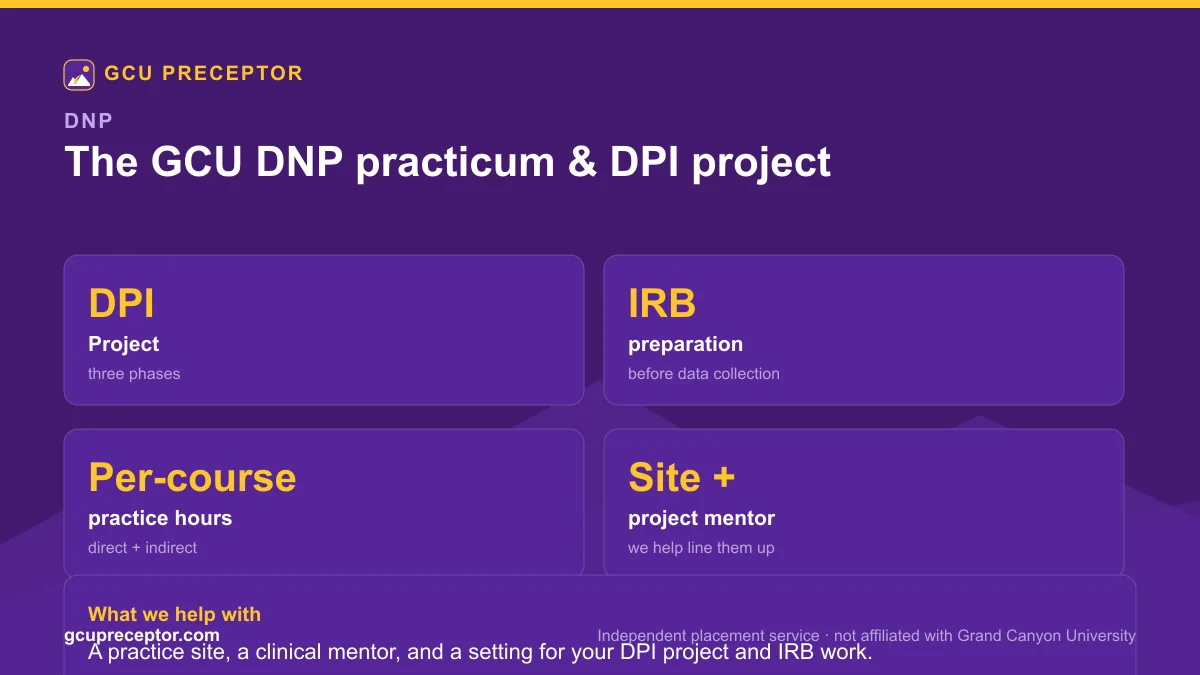
The centerpiece of the GCU DNP is the Direct Practice Improvement (DPI) Project, your capstone. Rather than a traditional dissertation built purely on theory, the DPI Project asks you to identify a practice problem, design an evidence-based intervention, and carry it out where care is actually delivered. GCU structures this work across three phases: development, implementation, and evaluation.
In the development phase you define the problem, ground it in the literature, and prepare the project for execution, including Institutional Review Board (IRB) preparation, the formal ethics review that protects the people involved before any project work begins. In the implementation phase you put the intervention into practice and carry out data collection at your project site. In the evaluation phase you analyze what happened, determine whether the intervention moved your chosen measures, and handle dissemination, sharing your findings, including through your project defenses.
Each of these phases leans on a practice setting and on people inside it who are willing to support the work. A development phase needs a site whose problem you can credibly study; implementation needs cooperation and access on the ground; evaluation needs data you can actually reach. Without those relationships locked in, the DPI Project cannot move from phase to phase on schedule.
Practice and practicum hours
GCU’s DNP courses carry practice and practicum hours of their own, distributed across the program rather than concentrated in a single block. We deliberately do not publish one summed headline total for the doctorate, because the hours are organized per course and the exact requirements belong on GCU’s program pages and in your faculty’s guidance, treat those as your source of record.
What matters practically is that these hours are real, supervised practice time tied to your project work. They need a setting and a mentor relationship behind them, and they need to be logged in a way GCU recognizes. If you want a clearer picture of how clinical and practice time is counted across GCU nursing programs in general, our clinical hours overview walks through the landscape, and GCU’s own Office of Field Experience is the team that supports and approves practice arrangements.
Where we help
Our role is narrow and concrete: we help DNP students gain access to an appropriate project site and to a qualified practice mentor or preceptor who can support the work the DPI Project requires. We focus on the part that most often delays doctoral candidates, finding a willing, suitable setting, so your timeline is governed by your project, not by an open search.
We assist; we do not guarantee. We cannot promise a particular site, a particular mentor, IRB approval, or any academic outcome, and GCU’s Office of Field Experience and your faculty remain the authorities who support and approve your arrangements. For students whose situation points toward a remote or telehealth-oriented setting, we also offer a virtual practicum service as an option to discuss, presented honestly as a service, not as a guarantee that any specific arrangement will be approved.
If you are weighing the doctorate alongside other GCU pathways, you may also want our pages on post-master’s certificates or the broader how it works overview before you commit.
Frequently asked questions
Is the GCU DNP fully online?
The coursework is delivered online in 8-week courses, but those courses include synchronous activities you attend in real time, including your DPI Project defenses. The project itself is hands-on work carried out in a real practice setting, so the degree is online-delivered rather than fully remote.
What is the DPI Project?
The Direct Practice Improvement (DPI) Project is the GCU DNP capstone. You identify a practice problem and carry out an evidence-based intervention across three phases, development (including IRB preparation), implementation with data collection, and evaluation with dissemination. It is practice-focused rather than a traditional theory dissertation.
How many practicum hours does the DNP require?
GCU’s DNP courses carry practice and practicum hours distributed across the program rather than as one combined total. We don’t publish a single summed figure; check GCU’s current program pages and your faculty guidance for the exact per-course requirements.
Do you guarantee a project site or IRB approval?
No. We are an independent service that helps you access a suitable site and a qualified mentor, but we do not guarantee any specific placement, mentor, IRB approval, or academic outcome. GCU’s Office of Field Experience and your faculty support and approve your arrangements. You pay when matched.
Who is the GCU DNP designed for?
It is designed for nurses who already hold a master’s in nursing, building on graduate-level clinical preparation. It is a 39-credit, practice-focused doctorate rather than an entry-level program.
Get your GCU clinicals handled.
Tell us your track and term. We’ll map your clinical requirement and start the search, in person or virtual. No payment until you’re matched.