GCU Preceptor Requirements & Approved Clinical Sites
Before you can log a single clinical hour, two things have to line up: a qualified preceptor willing to supervise you, and a clinical site that GCU’s Office of Field Experience will approve. Here’s what each of those really means, and how we help you secure them.
Get matched, free
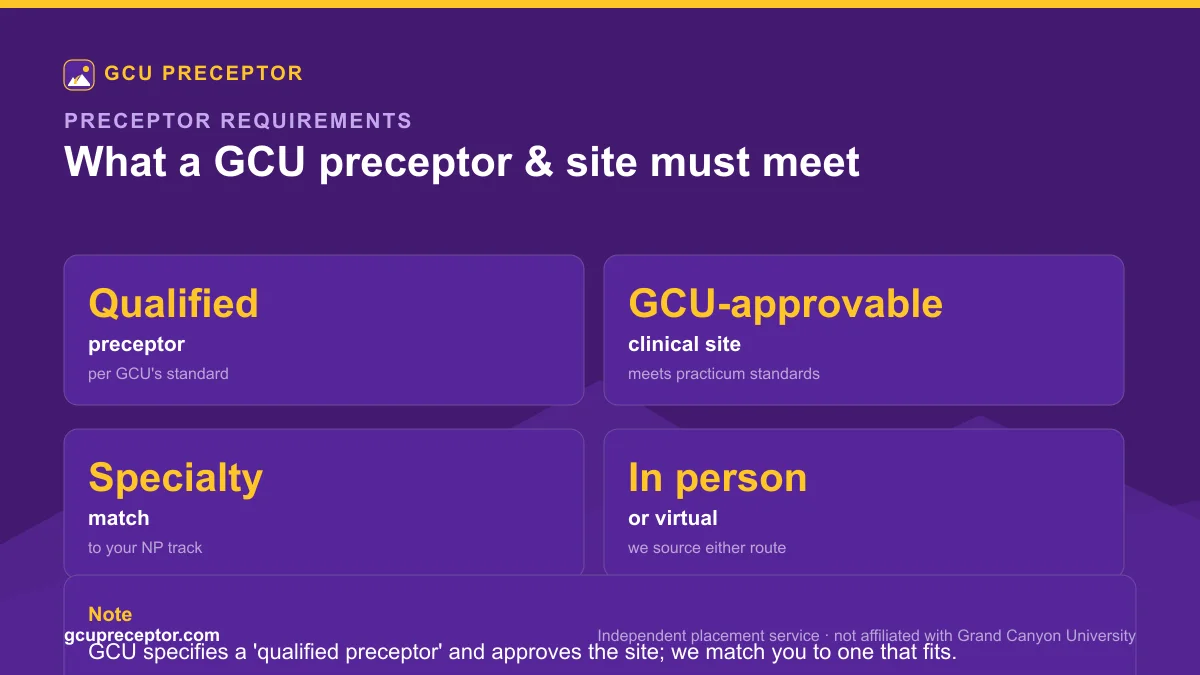
What “qualified preceptor” actually means
A qualified preceptor is an experienced, appropriately licensed clinician who agrees to directly supervise your clinical practice at an approved site. For Grand Canyon University’s MSN nurse-practitioner tracks, that supervision is substantial: the Family NP (FNP), Acute Care NP, Adult-Gerontology (AGACNP), and Psychiatric Mental Health NP (PMHNP) programs each require 750 hours of directly supervised clinical practice with qualified preceptors. The preceptor is the person signing off on those hours and guiding your hands-on learning.
We deliberately say “qualified preceptor” rather than publishing a checklist of credential rules. GCU’s faculty and Office of Field Experience determine whether a given preceptor and the proposed supervision arrangement meet that program’s practicum standards, and those determinations are made case by case in collaboration with your faculty. Anyone who hands you a rigid “preceptor must have X, Y, Z” rule that GCU itself doesn’t publish is guessing. Follow GCU’s instructions for your specific track, and lean on the Office of Field Experience as the authority on what qualifies.
The site has to be approved, not just available
A preceptor alone isn’t enough. The clinical setting itself has to be a GCU-approved site, meaning the location where you’ll practice meets GCU’s practicum standards and is approved by the Office of Field Experience (OFE) for your specific program. A willing clinician at a setting GCU won’t approve doesn’t move you forward.
Fit matters by track. An FNP practicum generally points to a local primary or family-care setting; an AGACNP placement needs an acute-care environment; a PMHNP placement belongs in a psychiatric or mental-health setting. The right site isn’t just “a clinic that said yes”, it’s a setting whose patient population and scope match your program’s learning objectives, which is part of what OFE evaluates when it approves a placement.
How OFE approval works
At GCU, students are generally responsible for identifying their own preceptor and clinical site. You collaborate with faculty to select a local setting, and the Office of Field Experience and its field experience specialists support the setup. They help with the application, confirm health and safety requirements, and ultimately approve the site so it meets practicum standards. Compliance items are handled through a third-party clinical-compliance platform, so follow GCU’s instructions exactly on what to submit and when.
That “you find your own” reality is the real bottleneck. NP students often delay graduation simply because preceptor spots fill up fast and they can’t lock one in before the term starts. OFE supports and approves; it does not place, assign, or secure a preceptor for you, and it does not guarantee that any particular site will be approved. The legwork of finding a qualified preceptor and an approvable site is on the student. That is exactly the gap we exist to fill.
It’s also worth knowing the immersion piece: GCU’s MSN NP tracks include two on-campus immersion experiences (one 3-day and one 2-day), so these programs are not 100% online. Your supervised clinical hours, though, happen at your approved local site with your preceptor.
Requirements vary by program
Hour and field requirements differ across GCU nursing programs, so “preceptor requirements” isn’t one-size-fits-all. The post-master’s APRN certificates (FNP, AGACNP, PMHNP, and Nursing Education) carry their own practicum expectations, the post-MSN FNP certificate, for example, is 37 credits with a 750-hour supervised clinical/practicum. The DNP is built around a Direct Practice Improvement project with practice hours embedded across its phases, while the RN-to-BSN field requirement is a 40-clinical-hour practicum course, arranged locally.
Because the specifics shift by track, confirm your exact requirements on GCU’s program pages and with your faculty. Our clinical hours guide breaks down what each program needs so you know what kind of preceptor and site you’re actually trying to secure.
How we match you with a qualified preceptor
We’re an independent, third-party preceptor and clinical-placement support service for GCU nursing students. We work independently of Grand Canyon University. What we do is the hard part GCU leaves to you: source a qualified preceptor and an approvable clinical site that fits your track, in your area, so you can take it to OFE for approval and stay on schedule.
We offer two ways to help: physical placement matching, the primary route for NP clinical hours, and a virtual practicum service for telehealth or remote settings where applicable. We assist; we do not guarantee placement, outcomes, or that GCU will approve any particular site; that approval always rests with OFE. See exactly how it works, then tell us about your program and we’ll get to work. You pay when you’re matched. And if you are the clinician reading this rather than the student, our network is open: see what precepting a GCU student involves.
Frequently asked questions
Does GCU assign me a preceptor?
No. GCU’s Office of Field Experience supports the setup, confirms requirements, and approves your selected site, but it does not place, assign, secure, or guarantee a preceptor. Students are generally responsible for identifying their own preceptor and site, which is the gap our independent service helps fill.
What makes a preceptor “qualified” at GCU?
A qualified preceptor is an experienced, appropriately licensed clinician who agrees to directly supervise your clinical practice at an approved site. GCU faculty and the Office of Field Experience determine whether a given preceptor meets your program’s practicum standards, so follow GCU’s instructions for your specific track rather than any unpublished credential checklist.
What makes a clinical site “approved”?
An approved site is one that meets GCU’s practicum standards and is approved by the Office of Field Experience for your program, including a patient population and setting that fit your track (primary care for FNP, acute care for AGACNP, mental health for PMHNP). Final approval always rests with OFE.
How many clinical hours need a preceptor?
It depends on the program. GCU’s MSN FNP, AGACNP, and PMHNP tracks each require 750 hours of directly supervised clinical practice with qualified preceptors. Other programs differ, for example, the RN-to-BSN field requirement is a 40-clinical-hour practicum. Check our clinical hours guide and GCU’s program pages for your track.
Are GCU NP programs fully online?
No. GCU’s MSN NP tracks include 750 hours of in-person supervised clinical practice plus two on-campus immersion experiences (one 3-day and one 2-day), so they are not 100% online.
Get your GCU clinicals handled.
Tell us your track and term. We’ll map your clinical requirement and start the search, in person or virtual. No payment until you’re matched.