West Virginia Preceptor Planning for GCU NP Students
West Virginia is a reduced practice state, with the RN Board's current licensing process recognizing prescriptive authority both with and without a collaborative practice agreement. For GCU students, the preceptor's actual license and practice setting matter more than a general label alone.
Get matched, free
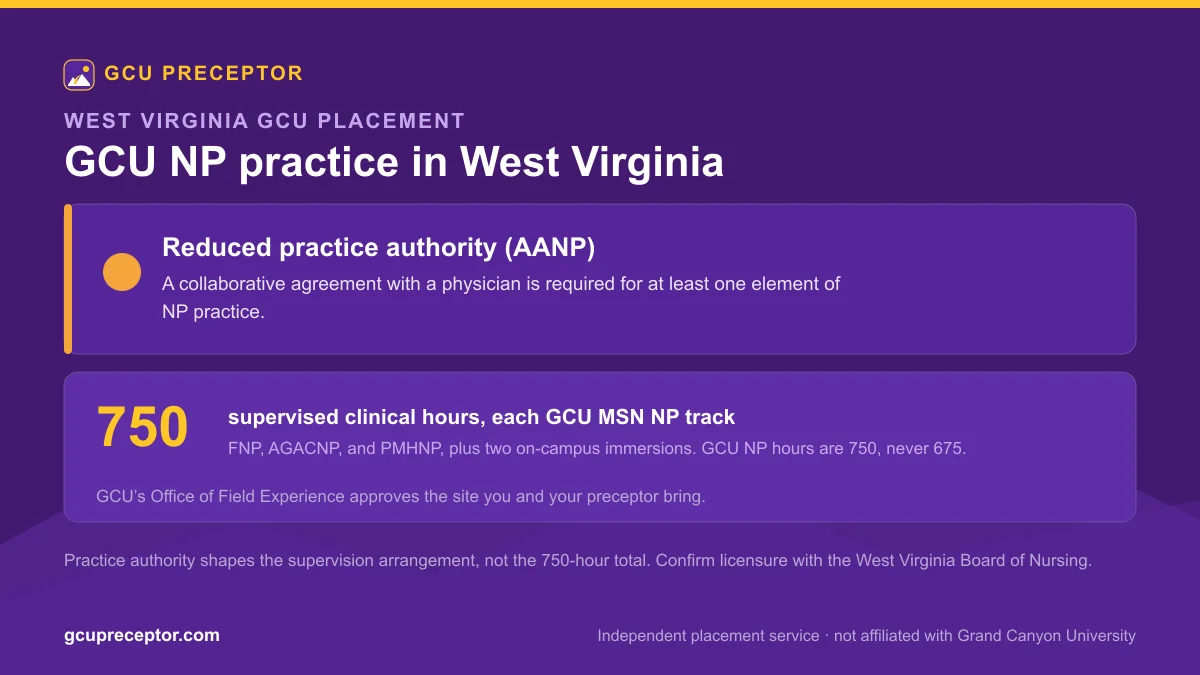
Reduced practice describes a mixed West Virginia framework
AANP classifies West Virginia as reduced practice. The category means state law limits at least one element of NP practice or places a regulated condition on it. The West Virginia RN Board's licensing page includes pathways for an APRN to hold prescriptive authority with a collaborative practice agreement and to change to prescriptive authority without one when applicable.
That creates a practical verification question. Do not assume every West Virginia APRN has the same collaboration status, and do not assume that an APRN without a current collaborative agreement lacks lawful prescriptive authority. Check the live Board record and ask the clinician to describe the arrangement under which the practice operates.
For a student, the state category does not create a separate student agreement with a physician. It describes the regulatory environment in which the potential preceptor delivers care. GCU still reviews whether that individual, specialty, site, and patient population meet the educational requirements for your course.
The West Virginia RN Board is the credential checkpoint
The formal regulator is the West Virginia Board of Examiners for Registered Professional Nurses, commonly presented online as the West Virginia RN Board. It licenses registered nurses and advanced practice registered nurses, administers prescriptive-authority processes, and offers a public license lookup for RN and APRN credentials.
Use the Board before you commit a term to a clinician. Confirm an active APRN license, the relevant population focus, and prescriptive-authority status where it matters to the rotation. Review public license information through the official site rather than relying only on an employer biography. Then compare the candidate with GCU's preceptor requirements. State licensure is necessary, but OFE decides the educational fit.
Search by regional center, then expand along realistic routes
Charleston has the state's largest concentration of government, hospital-connected, primary care, and specialty services. Huntington adds a distinct health market in the west, while Morgantown anchors care in north-central West Virginia. Parkersburg and Wheeling can provide additional regional options, and Beckley is a key starting point for southern counties.
The Eastern Panhandle around Martinsburg and Charles Town connects to a broader multistate region, but a site outside West Virginia introduces another board and another location for GCU to evaluate. Rural mountain communities may have capable NPs with strong patient continuity but fewer clinicians able to take a student. Travel time, winter conditions, and the provider's weekly volume deserve an honest check before you accept.
A narrow search for the closest clinic can miss the best match. Define a drive corridor you can sustain, list the days you are truly available, and search for the population focus your course needs. A nearby provider in the wrong specialty will not protect the start date.
Your placement has two separate approvals to respect
First, the clinician and facility must agree to host you. Second, GCU must approve the student-selected proposal. GCU students source their own preceptor and submit the site and clinician through the eDocs Field Experience Site Information Form. The Office of Field Experience supports and reviews the process, but it does not assign the placement.
Ask the site who handles student paperwork and whether it can accommodate your complete date range. Gather accurate legal names, addresses, contacts, and credential details for eDocs. Do not begin early in hopes that pending hours will later be accepted.
After approval and site onboarding, record activity in the Lopes Activity Tracker. The preceptor approves the hours in ThunderTime, so a weekly check prevents a busy rural practice from facing a large approval backlog at the end.
Map the 750 hours to West Virginia specialty access
GCU requires 750 supervised clinical hours in each MSN NP track. The FNP pathway can draw on family and community settings across the lifespan. PMHNP students need psychiatric care that meets course objectives, which may require a wider statewide search. AGACNP students should focus on acute and complex adult care in appropriate hospital and specialty settings.
The three NP tracks also require two on-campus immersions in Phoenix. The travel makes clear that the programs are not 100% online, and immersion dates should be protected when you arrange West Virginia shifts. Treat the 750 hours as a sequence of approved specialty experiences, not a promise that one preceptor will cover every course.
A GCU DNP experience is different: it centers on the Direct Practice Improvement project and IRB with hours assigned by course. The RN-to-BSN NRS-465 practicum requires 40 hours. State the correct program when you approach a potential mentor or site.
Virtual care can support access, but confirmation comes first
Telehealth can connect patients and clinicians across West Virginia's long travel distances, especially in behavioral health and follow-up care. Whether a virtual encounter counts for your GCU rotation still depends on the course, patient location, program rules, and OFE approval.
Ask for written confirmation before building the schedule around remote visits. Hands-on assessment and acute care competencies may require in-person work even when the practice itself uses telehealth.
Use a placement review when local options run thin
We source potential West Virginia preceptors, check interest and scheduling fit, and provide the match for you to submit to GCU. We are independent of GCU, and final approval always belongs to OFE. We do not guarantee timing or approval. You are matched first and pay only when a placement is secured.
Send your course, specialty, home area, travel corridor, dates, and available days through a free placement review. We will assess the realistic regional options without pretending that every rural search has an instant answer.
Frequently asked questions
Is West Virginia a full practice state?
No. AANP currently classifies West Virginia as reduced practice. The RN Board's licensing process distinguishes prescriptive authority with a collaborative practice agreement from authority without one when the APRN meets the applicable pathway.
How do I verify a West Virginia APRN preceptor?
Use the West Virginia RN Board's official license lookup and advanced-practice resources. Confirm the active APRN credential, relevant population focus, and practice status, then submit the proposed preceptor for GCU OFE review.
Can I use a preceptor across the state line?
A site in a neighboring state may be possible only if the clinician, patient location, program requirements, and state rules align. Present the exact proposal to OFE and the applicable board rather than assuming proximity makes it a West Virginia placement.
Does GCU find West Virginia preceptors for students?
Students source their own preceptors. OFE reviews the site and clinician the student submits through the eDocs Field Experience Site Information Form. Our independent service can run the sourcing, but GCU keeps final approval authority.
Get your GCU clinicals handled.
Tell us your track and term. We’ll map your clinical requirement and start the search, in person or virtual. No payment until you’re matched.