Washington Clinical Preceptors for GCU Nurse Practitioner Students
Washington is a full practice state, so nurse practitioners practice under the Washington State Board of Nursing without a state-mandated physician agreement. GCU approval remains a separate educational review for every student-selected preceptor and site.
Get matched, free
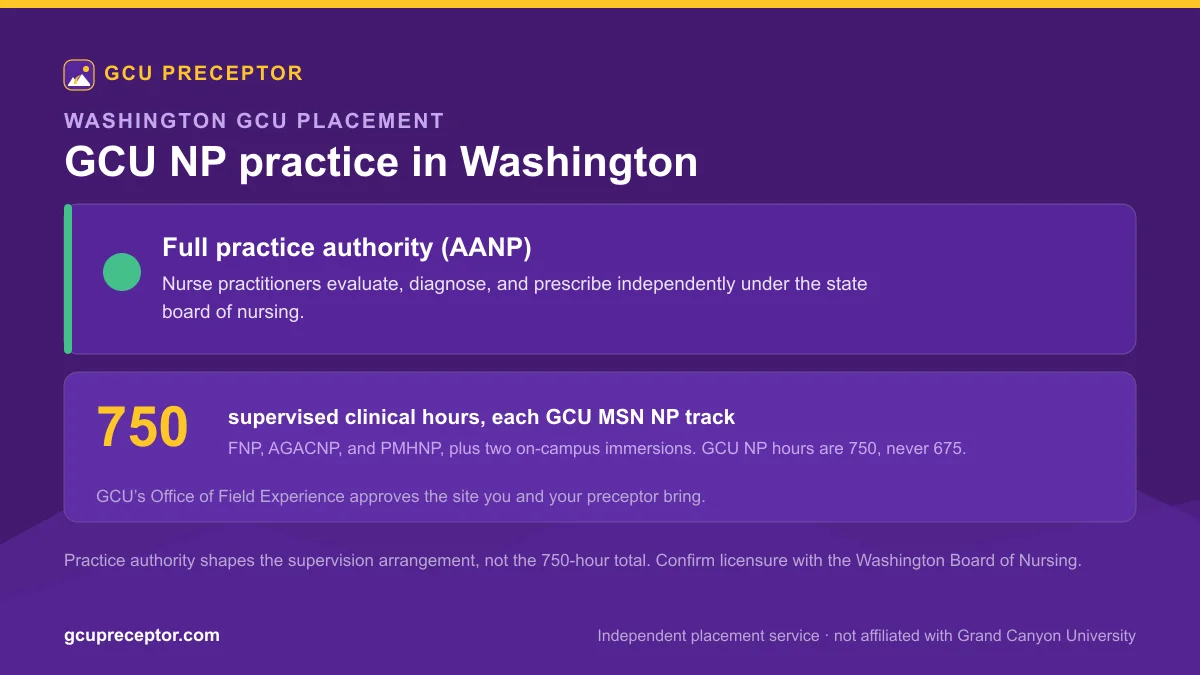
Full practice authority is the Washington baseline
AANP classifies Washington as full practice. State law permits nurse practitioners to evaluate patients, diagnose, order and interpret tests, and initiate and manage treatment, including prescribing, under nursing board authority. A physician collaboration or supervision contract is not the general condition that defines Washington NP practice.
For a student, that can make independent and NP-led practices part of the search rather than limiting outreach to physician-owned clinics. It does not erase organizational rules. Hospitals, health systems, and group practices set credentialing, student capacity, and onboarding requirements that can be stricter than the minimum state practice framework.
Full practice also does not broaden a clinician beyond education, certification, and population focus. A family NP, psychiatric mental health NP, and adult-gerontology acute care NP remain different potential preceptors. Course alignment matters even in a state with broad NP authority.
Use the Washington State Board of Nursing as the source of record
Washington licenses advanced practice clinicians under the Advanced Registered Nurse Practitioner, or ARNP, title. The Washington State Board of Nursing publishes ARNP licensure requirements, including the underlying RN license and national certification expectations, and directs the public to the state's provider credential search for primary-source verification.
Before depending on a preceptor, confirm the active credential and the NP designation that matches your course. Review any public status information through the official tool rather than accepting a profile page as proof. The Board regulates the license; GCU's Office of Field Experience separately reviews whether the clinician and facility meet educational requirements.
Washington geography changes how a search should run
Seattle, Bellevue, and the wider Puget Sound region contain a large and varied clinical market, but high site volume also brings many competing student requests and layered health-system onboarding. Tacoma and the South Sound may open a different set of community clinics, behavioral health practices, and hospital-connected settings without requiring a student to rely only on central Seattle.
Spokane is the main clinical center for Eastern Washington. Vancouver connects to a large cross-river health market, but any Oregon-based component would raise separate state and GCU questions. The Tri-Cities, Yakima, Wenatchee, Bellingham, and Olympia each have regional networks worth searching. On the Olympic Peninsula, the coast, and in central or northeastern rural areas, a wider driving plan may be necessary.
Set the travel radius using the schedule you can repeat for an entire course, including winter road conditions where relevant. One attractive site that is not realistically reachable for every shift is not a durable placement plan.
GCU students bring the site, then OFE reviews it
GCU expects the student to source a preceptor. Once a Washington clinician agrees, the student nominates the site and preceptor through the eDocs Field Experience Site Information Form. OFE reviews the student-selected experience against GCU's preceptor requirements. A full practice state does not create automatic university approval.
Prepare accurate site and credential details while the clinician confirms dates. Identify the practice contact who can answer onboarding or agreement questions, and ask what the site's student process requires. Do not begin clinical time on the assumption that approval will be retroactive.
When the approved experience starts, record activity in the Lopes Activity Tracker. Your preceptor approves the time in ThunderTime, so agree on a regular review rhythm before busy clinic weeks begin.
See the 750 hours as a Washington portfolio
Each GCU MSN NP track requires 750 supervised clinical hours. An FNP student needs experiences aligned with family practice and care across the lifespan, a PMHNP student needs appropriate psychiatric care, and an AGACNP student needs acute and complex adult care. A single site may contribute to the plan without meeting every later course need.
Two on-campus immersions in Phoenix are also part of the NP programs, which is why they are not 100% online. Keep immersion travel separate from the Washington clinical-hour total and plan site shifts around those dates. If you are in a post-master's certificate, confirm the requirements for that certificate rather than borrowing a schedule from an MSN student.
DNP and RN-to-BSN students should describe a different need when approaching sites. The DNP uses a Direct Practice Improvement project with IRB and course-specific hours, while NRS-465 in the RN-to-BSN pathway includes a 40-hour practicum.
Virtual encounters need the same careful approval
Washington clinicians may use telehealth, particularly when serving patients far from major centers. Whether virtual encounters count for your GCU course depends on the program, the course, the patient location, and OFE approval. Confirm the allowed format before selecting a site because full state practice authority is not the same as university acceptance of virtual hours.
Hands-on assessment and acute care objectives still call for in-person access. If a site blends both formats, document the expected mix and ask your program how each encounter should be logged.
A focused review can shorten a wide Washington search
We source potential preceptors, confirm interest and schedule fit, and introduce the match for you to submit through GCU's process. Our service is independent of GCU. We do not guarantee placement timing or OFE approval, and you pay only when a placement is secured.
Tell us your track, course, city, travel radius, dates, and available days in a free placement review. We will look at both metro and regional options and give you a direct view of what is practical.
Frequently asked questions
Is Washington a full practice state for NPs?
Yes. AANP classifies Washington as full practice, with NP evaluation, diagnosis, testing, treatment, and prescribing under the Board of Nursing's authority rather than a general physician agreement requirement.
What does Washington call a licensed nurse practitioner?
The current Board licensure page uses Advanced Registered Nurse Practitioner, or ARNP. Verify the active Washington credential and the relevant NP designation through the state's official provider credential system.
Can a Washington independent practice host my GCU rotation?
Potentially. Full practice authority allows NP-led settings to be considered, but the clinician, patient population, facility, supervision, and course objectives must still meet GCU requirements, and OFE makes the approval decision.
Where are Washington placements most available?
Puget Sound has the broadest concentration, while Spokane, Vancouver, the Tri-Cities, Yakima, Wenatchee, Bellingham, and Olympia offer important regional markets. Availability still depends on specialty, term dates, and site student capacity.
Get your GCU clinicals handled.
Tell us your track and term. We’ll map your clinical requirement and start the search, in person or virtual. No payment until you’re matched.