Finding a Virginia Preceptor for Your GCU NP Clinicals
Virginia is a restricted practice state, although experienced nurse practitioners can apply for an autonomous practice designation. That two-stage structure affects how a potential preceptor practices, while GCU separately decides whether the clinician and site fit your course.
Get matched, free
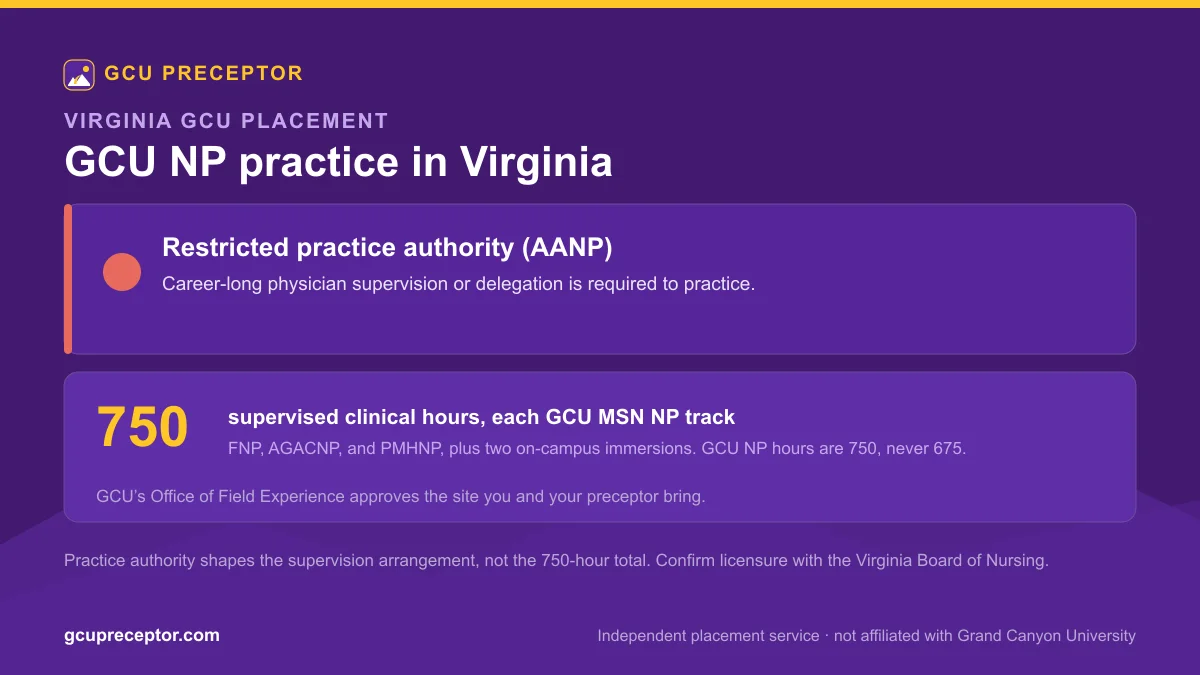
Virginia combines restricted practice with an autonomous pathway
The American Association of Nurse Practitioners classifies Virginia as restricted practice. The Virginia Board of Nursing explains that NPs with fewer than three years or 5,400 clinical practice hours must practice through an agreement with a patient care team physician. After reaching the experience threshold, an eligible NP can apply for the autonomous practice designation and practice without that agreement.
Day to day, this means two Virginia NPs in similar clinics may operate under different regulatory arrangements. One may have autonomous status, while another works through a current practice agreement. The distinction does not decide whether either clinician can precept a student. It is a credential and practice-context detail to verify before GCU reviews the proposed experience.
Restricted practice also does not mean a physician stands beside the NP for every patient encounter. The state framework addresses management, leadership, and the practice agreement for NPs who do not hold the autonomous designation. Facility policies, clinical privileges, and the NP's population focus still shape the work inside a particular site.
The Virginia Board of Nursing shares APRN oversight
Virginia licenses the NP role under the advanced practice registered nurse, or APRN, title. The Board of Nursing states that APRNs are jointly regulated by the Boards of Nursing and Medicine. Its advanced practice page explains the NP practice agreement and autonomous practice pathways, while the Department of Health Professions provides license information and practitioner resources.
When reviewing a potential preceptor, verify the clinician's current Virginia license, specialty or population focus, and any public disciplinary information through the official state system. Ask whether the clinician practices under an agreement or holds the autonomous designation, but do not treat that question as a substitute for GCU's preceptor requirements. OFE evaluates the educational fit, and the state boards regulate professional practice.
Build the search around Virginia's separate clinical markets
Northern Virginia offers a dense mix of primary care, specialty offices, behavioral health, and hospital-connected practices around Arlington, Alexandria, Fairfax, and Loudoun County. Richmond and the surrounding counties form another broad clinical market. Hampton Roads, including Norfolk, Virginia Beach, Chesapeake, Hampton, and Newport News, adds large health systems and community practices with different onboarding routes.
Outside those metros, Charlottesville and Roanoke support academic and regional referral care, while Winchester and the Shenandoah Valley, Lynchburg, Danville, and Southwest Virginia require a more local approach. A student near Bristol or Abingdon may find a strong specialty match but face longer drives and fewer backup sites. Search by the course's patient population first, then set a travel radius you can maintain for the full rotation.
GCU students source their own preceptor. The Office of Field Experience supports and approves the student-selected site rather than assigning one. After a clinician agrees, the student submits the site and preceptor through the eDocs Field Experience Site Information Form. A firm yes is valuable, but no clinical time should be treated as approved until the required GCU process is complete.
Plan 750 hours as a sequence of specialty matches
GCU's MSN FNP, AGACNP, and PMHNP tracks each require 750 supervised clinical hours. From Virginia, that means building a series of approved experiences that support the correct specialty and course objectives. The convenient family practice down the road may work for an FNP course but not for acute care or psychiatric objectives.
The programs also include two on-campus immersions in Phoenix, so they are not 100% online. Put those travel dates on the same calendar as Virginia site onboarding and clinical shifts. Once an approved rotation begins, students record clinical activity in the Lopes Activity Tracker, and preceptors approve the time in ThunderTime. Discuss approval cadence early so records do not accumulate at the end of a course.
Other GCU experiences follow their own designs. The DNP practicum centers on a Direct Practice Improvement project and IRB with hours assigned by course, while the RN-to-BSN practicum is a 40-hour NRS-465 experience. Identify the program and course clearly before approaching a Virginia clinician.
Treat telehealth as a proposed format, not an assumed shortcut
Telehealth may appear in Virginia primary care and behavioral health settings, but its presence at a clinic does not automatically make virtual encounters count for a GCU course. Confirm with the program and OFE whether the activity, patient location, supervision, and virtual-to-in-person mix are acceptable before planning around it.
In-person experience remains important for hands-on assessment and acute care competencies. If a potential preceptor uses both formats, describe the expected split accurately in the site submission and ask how each kind of encounter should be recorded.
Get help before the Virginia calendar closes
We independently source potential preceptors across Virginia, confirm interest and practical availability, and provide the match for you to present to GCU. We work independently of GCU, and we cannot guarantee placement timing or OFE approval. You are matched first and pay only when a placement is secured.
If cold outreach is producing no qualified options, send your track, course, dates, schedule, and travel radius through a free placement review. We will assess the Virginia search directly and explain what we can reasonably pursue.
Frequently asked questions
Is Virginia a full practice state for nurse practitioners?
AANP classifies Virginia as restricted practice. The state offers an autonomous practice designation to eligible NPs after three years or 5,400 clinical practice hours, while NPs below that threshold use a practice agreement with a patient care team physician.
Can a Virginia NP without autonomous status precept me?
Their practice agreement does not automatically prevent precepting. The clinician must be properly licensed and practice within the relevant focus, and GCU's OFE must decide whether the preceptor and site meet the course requirements.
Does GCU assign Virginia preceptors?
GCU students source their own preceptors. OFE reviews the student-selected site and preceptor submitted through the eDocs Field Experience Site Information Form, but it does not function as a placement service.
Where should I search for a Virginia preceptor?
Northern Virginia, Richmond, and Hampton Roads offer the broadest mix of settings. Charlottesville, Roanoke, Winchester, Lynchburg, and Southwest Virginia can also support strong placements, but specialty supply and travel time vary by course.
Get your GCU clinicals handled.
Tell us your track and term. We’ll map your clinical requirement and start the search, in person or virtual. No payment until you’re matched.