Vermont Preceptor Planning for GCU Nursing Students
Vermont is a full practice state for nurse practitioners, although newer APRNs complete a defined transition to practice with a collaborating provider. GCU students should account for that credential detail while finding their own preceptor and preparing the site for Office of Field Experience review.
Get matched, free
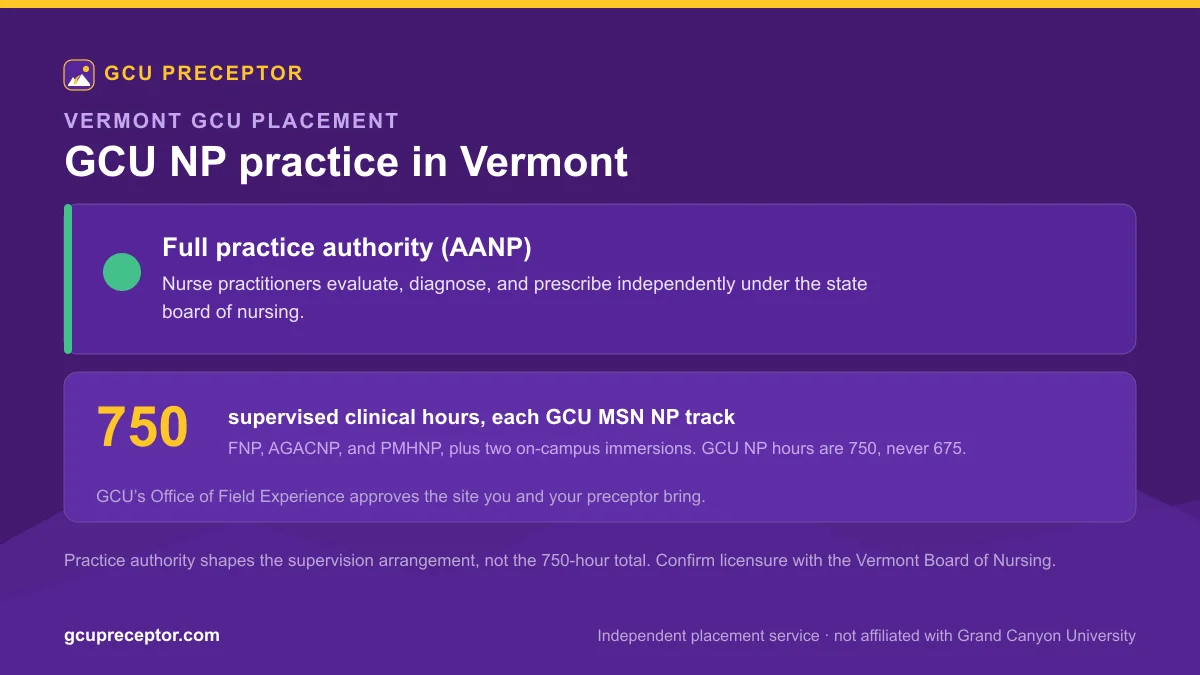
Full practice after a defined Vermont transition
The American Association of Nurse Practitioners classifies Vermont as a full practice state. Vermont NPs can evaluate patients, diagnose, and prescribe medications and therapeutic measures under nursing board authority. The state does not require every NP to maintain a physician agreement for an entire career.
Vermont does require APRNs with less than 24 months and 2,400 hours of active practice to use a collaborative provider agreement during a transition to practice. Board rules allow a qualified Vermont APRN or physician with relevant experience to serve in that role. When the transition is completed and documented, the ongoing agreement is no longer the condition of practice that it would be in a restricted state.
This nuance matters when a GCU student considers a newer NP as a preceptor. The clinician may have the correct certification and excellent experience while still practicing within a formal transition. Describe the arrangement accurately and let OFE determine whether the preceptor satisfies the educational criteria. Full practice authority should never be used as a shortcut around credential review.
The Vermont Board of Nursing sets the credential rules
The Vermont Board of Nursing, within the Secretary of State's Office of Professional Regulation, oversees nursing licensure and practice. Its nursing site provides applications, statutes and rules, board information, policies, and links to professional license lookup. APRN application guidance calls for graduate education and current national certification in the role and population focus.
Use Vermont's official professional lookup to confirm a prospective preceptor's active license. Ask for the national certification and resume needed for the GCU file, and verify that the person's everyday practice aligns with the course. The state license answers whether the clinician is authorized to practice; it does not by itself establish that the clinician has the patients, setting, availability, or teaching experience your rotation needs.
A transition agreement is part of the clinician's professional record. If a candidate is in transition, ask OFE what documentation is necessary. The preceptor requirements are the starting checklist.
Think in regions, not just towns
Vermont's small population does not mean every clinical site is close. Burlington and nearby communities in Chittenden County have the densest mix of hospital, specialty, primary care, and behavioral health services. That area also receives frequent student requests. Montpelier and Barre form a central cluster, while Rutland serves much of the southwest and Brattleboro supports the southeast.
St. Albans, Middlebury, Bennington, Newport, and St. Johnsbury add options, but specialty coverage differs. A winter mountain commute may work once a week and fail three times a week. Ask about clinical days before accepting a distant site.
Course fit remains the filter. FNP students often seek family medicine, internal medicine, community health, pediatrics, or other primary care experiences appropriate to the course. PMHNP students need psychiatric care with suitable assessment and treatment exposure. AGACNP students need adult acute and complex care, which narrows the search toward hospitals and specialty services.
How a Vermont site reaches the GCU review queue
GCU asks the student to source the preceptor. The Office of Field Experience supports field experience and evaluates the clinician and site the student identifies, but it does not assign a preceptor. After a Vermont clinician agrees in principle, nominate that person and location using the Field Experience Site Information Form in the eDocs app.
Complete the form accurately, follow any requests for documents, and allow time for GCU and site onboarding. A small independent practice may have a simpler internal decision than a hospital system, but both must still satisfy the educational review. Do not begin seeing patients or recording time until you have the approvals needed to start.
During the rotation, enter hours in the Lopes Activity Tracker, or LAT. The preceptor approves them in ThunderTime. Review the approved total frequently. In a course with limited clinic days, even one unconfirmed shift can represent a meaningful gap, and early follow-up is easier for both student and preceptor.
Plan the 750 hours from a small-state reality
GCU's MSN FNP, AGACNP, and PMHNP tracks each require 750 supervised clinical hours. The hours must be completed through course-appropriate experiences with specialty-matched preceptors. Vermont students may need different sites across the sequence, especially when moving from broad primary care to a narrower specialty or acute setting.
The tracks also include two on-campus immersions in Phoenix, so they are not 100% online. Travel from Vermont can require a connection and a full day in each direction. Place immersion travel on the calendar before committing to a preceptor's weekly schedule, and leave enough margin for seasonal weather disruptions. Our clinical hours guide can help organize the requirements in one view.
Telehealth is useful when patients and specialists are separated by distance, and it may appear in Vermont behavioral health or follow-up care. Whether those encounters count is determined by GCU program and course expectations and OFE approval. Confirm before planning a virtual-heavy rotation. Unless you have specific approval, use in-person clinical time as the base schedule.
When the local network has no opening
A complete request should identify your track, course, dates, weekly availability, required population, and GCU's approval process. In a close professional community, communicate carefully and avoid asking several people at the same practice without knowing they work together.
If you need wider sourcing, request a free placement review. We are independent of GCU. We search for a suitable Vermont clinician and match you before payment is due. Payment occurs only when a placement is secured. We do not guarantee placement or GCU approval, and OFE makes the final decision. Service pricing is listed at cost.
Frequently asked questions
Is Vermont a full practice state for NPs?
Yes. AANP classifies Vermont as full practice. APRNs with less than 24 months and 2,400 hours of active practice complete a transition under a collaborative provider agreement, but Vermont does not impose that agreement for an NP's whole career.
Does the Vermont Board of Nursing approve my GCU clinical site?
No. The board regulates professional licenses and practice. GCU's Office of Field Experience makes the educational site and preceptor decision after the student submits the proposed arrangement through the eDocs Field Experience Site Information Form.
Does GCU source Vermont preceptors for students?
No. GCU students are responsible for finding their own preceptor. OFE supports and reviews the placement. Students who use an independent sourcing service still must submit the candidate to GCU, and approval cannot be guaranteed.
How many hours and immersions are in the GCU MSN NP tracks?
The MSN FNP, AGACNP, and PMHNP tracks each require 750 supervised clinical hours and two on-campus immersions in Phoenix. Those in-person immersions mean the programs are not completed entirely online from Vermont.
Are telehealth hours acceptable in a Vermont GCU rotation?
They may be in some approved experiences, but acceptability varies by program and course. Confirm the patient encounter format and supervision plan with your program and OFE before relying on virtual hours. Plan for in-person care unless told otherwise.
Get your GCU clinicals handled.
Tell us your track and term. We’ll map your clinical requirement and start the search, in person or virtual. No payment until you’re matched.