Utah Clinical Placement Guidance for GCU NP Students
Utah is a full practice state for nurse practitioners, so state law does not impose a career-long physician contract on NP practice. That professional independence can broaden the preceptor pool, but GCU students still have to find their own clinician and secure Office of Field Experience approval.
Get matched, free
Start with Utah's full practice environment
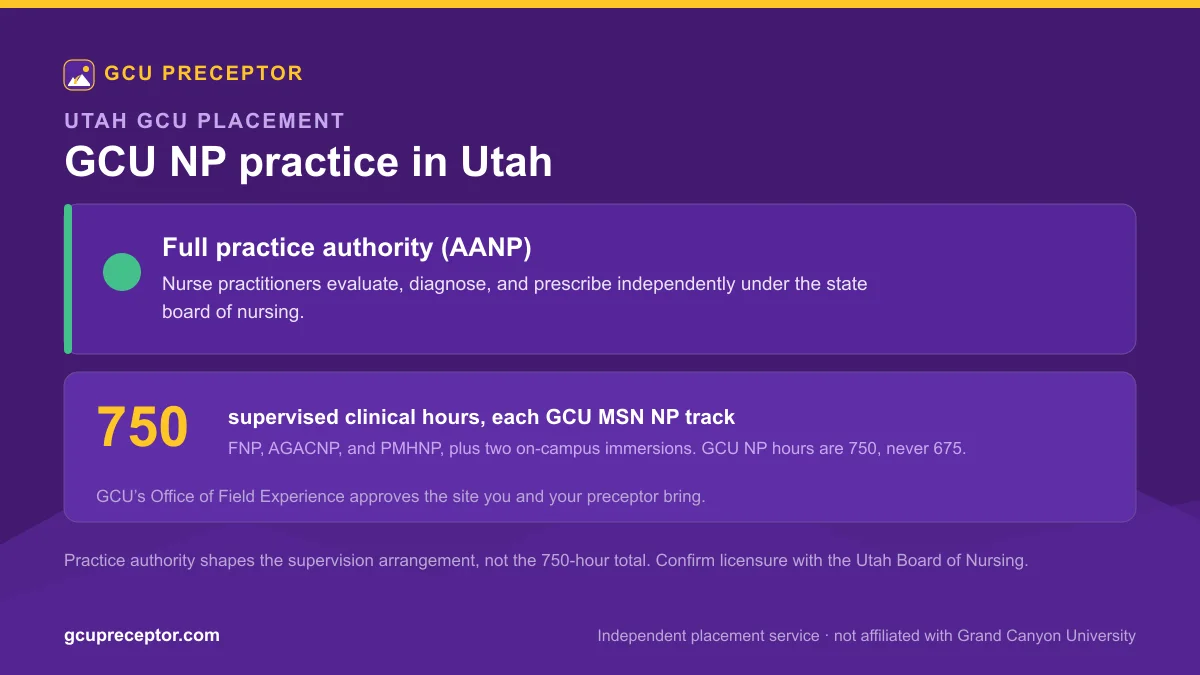
The American Association of Nurse Practitioners includes Utah among full practice jurisdictions. In AANP's framework, NPs may evaluate patients, diagnose, order and interpret diagnostic tests, and initiate and manage treatment, including prescribing, under the exclusive licensure authority of the state nursing regulator. Utah does not require a career-long physician supervision agreement as a condition of those core NP functions.
Full practice does not mean practice without boundaries. Every APRN remains responsible for education, national certification, population focus, competence, facility policy, and applicable prescribing rules. Consultation and referral happen because good patient care demands them, not because every NP must maintain a standing physician contract.
For a GCU learner, this can make the decision path at an independent clinic more direct. An experienced NP owner may be able to consider a student without first changing a regulated collaboration agreement. Hospitals and large groups still have their own student, credentialing, and education policies, so full practice authority does not turn an informal yes into an approved rotation.
Who regulates APRNs in Utah
Nursing licenses are administered by the Utah Division of Professional Licensing, or DOPL, within the Department of Commerce, with the Board of Nursing and Certified Nurse Midwives serving the profession. DOPL's nursing pages connect applicants and licensees to licensing, verification, laws, rules, and scope resources. Its APRN application guidance identifies graduate education, relevant advanced coursework, and current national certification among the materials used in licensure.
Check a prospective preceptor in Utah's official license verification system. Confirm the APRN classification and compare the clinician's national certification and practice population with the course you need. A provider's employer biography can help you understand experience, but the state record is the credential checkpoint.
GCU conducts a separate educational review. An active Utah APRN license establishes professional authority; it does not prove that a setting has the patient volume, specialty mix, or supervision plan required for your course. Use the preceptor requirements to prepare for that second layer.
Follow the Wasatch Front, then look beyond it
Salt Lake City and the surrounding Wasatch Front have Utah's largest concentration of hospitals, outpatient groups, behavioral health practices, and specialty services. Searches often extend south through Murray, Sandy, Draper, Lehi, and Provo, or north toward Bountiful, Layton, and Ogden. The corridor creates options, but it also serves many students from local universities and distance programs.
Southern Utah has a different scale. St. George is the main clinical center in the southwest, and Cedar City supports a smaller regional network. Logan serves Cache Valley. Students near Vernal, Price, Moab, or other rural communities may need to combine local outreach with a wider travel radius, especially for acute care or a narrow psychiatric population.
Let the rotation define the list. FNP students can consider family medicine, primary care, pediatrics, women's health, and other settings when they match course objectives. PMHNP students need psychiatric assessment and treatment experience. AGACNP students require adult acute and complex care, which is usually concentrated in hospital and specialty environments along the Wasatch Front.
Separate sourcing from approval
GCU expects students to source their own preceptors. The Office of Field Experience supports the process and approves the person and site the student identifies; it does not assign a Utah rotation. The Field Experience Site Information Form in the eDocs app is the route for nominating the proposed site and preceptor.
Before submission, make sure the clinician agrees to the dates, schedule, and learning role, and ask whether the organization has a separate student application. Provide complete eDocs information, respond to requests, and wait until all required GCU and facility steps are finished before starting clinical care.
Once approved, enter time in the Lopes Activity Tracker, or LAT. The preceptor reviews and approves hours through ThunderTime. Utah rotations can include long clinical days and commuting, but only properly documented and approved time belongs in the record. Check the system every week rather than relying on a private calendar until the end.
750 hours, two Phoenix immersions, one realistic calendar
The GCU MSN FNP, AGACNP, and PMHNP tracks each require 750 supervised clinical hours. The total is completed through specialty-aligned clinical courses, not as undifferentiated observation. Your preceptor's population focus and the site's patient encounters must support the objectives for the specific course.
Each track also includes two on-campus immersions in Phoenix, which is why the programs are not 100% online. Utah students may choose to drive or fly, but either plan requires time away from the clinical schedule. Reserve those dates early and do not promise the clinic attendance that conflicts with an immersion or its travel days. Our clinical hours page brings the major requirements together.
Telehealth can expand access across Utah's long distances, and some behavioral health or follow-up care may be virtual. Whether those encounters can count depends on GCU's program and course rules and OFE's approval of the experience. Confirm the proposed virtual component before committing to the site. Build around in-person hours unless GCU gives you a clear basis for another format.
A focused next step when outreach stalls
Improve the request before expanding it. Include your GCU track, course, population needs, exact date window, days available, and expected paperwork. Utah clinicians are more likely to answer a defined proposal than an open-ended request for any precepting opportunity.
You can also request a free placement review. We are an independent service, separate from GCU. We handle targeted sourcing and present a potential Utah match; you pay only when a placement is secured. We cannot guarantee placement or OFE approval, and GCU makes the final site decision. Current service pricing is on the cost page.
Frequently asked questions
Is Utah a full practice state for nurse practitioners?
Yes. AANP includes Utah in the full practice category. Licensed NPs can perform the core elements of NP care under nursing licensure authority without a career-long physician supervision agreement, while remaining responsible for scope, competence, and other applicable rules.
Does GCU arrange Utah preceptors for NP students?
No. Students source their own preceptors. The Office of Field Experience reviews and approves the site and clinician nominated through the Field Experience Site Information Form in eDocs. That approval is separate from Utah professional licensure.
Where are Utah AGACNP placements most likely?
Adult acute care opportunities tend to cluster around hospitals and specialty services along the Wasatch Front, especially the Salt Lake City and Provo areas. Suitability depends on the course, patient population, preceptor credentials, and OFE approval, not geography alone.
Can I complete the GCU NP program entirely in Utah?
You may complete approved clinical hours at Utah sites, but the program is not entirely remote. GCU's MSN FNP, AGACNP, and PMHNP tracks each require 750 clinical hours plus two on-campus immersions in Phoenix.
Can telehealth count toward a GCU rotation in Utah?
It may be acceptable in some approved experiences, but rules vary by program and course. Confirm the format with your program and OFE before relying on virtual encounters. A clinic's normal use of telehealth does not by itself establish that the hours will count.
Get your GCU clinicals handled.
Tell us your track and term. We’ll map your clinical requirement and start the search, in person or virtual. No payment until you’re matched.