Texas Preceptor Search Help for GCU NP Students
Texas is a restricted practice state for nurse practitioners, with physician delegation and supervision embedded in the practice framework. GCU students must separately source their own specialty-matched preceptor and obtain Office of Field Experience approval for the proposed Texas site.
Get matched, free
Texas practice authority in direct terms
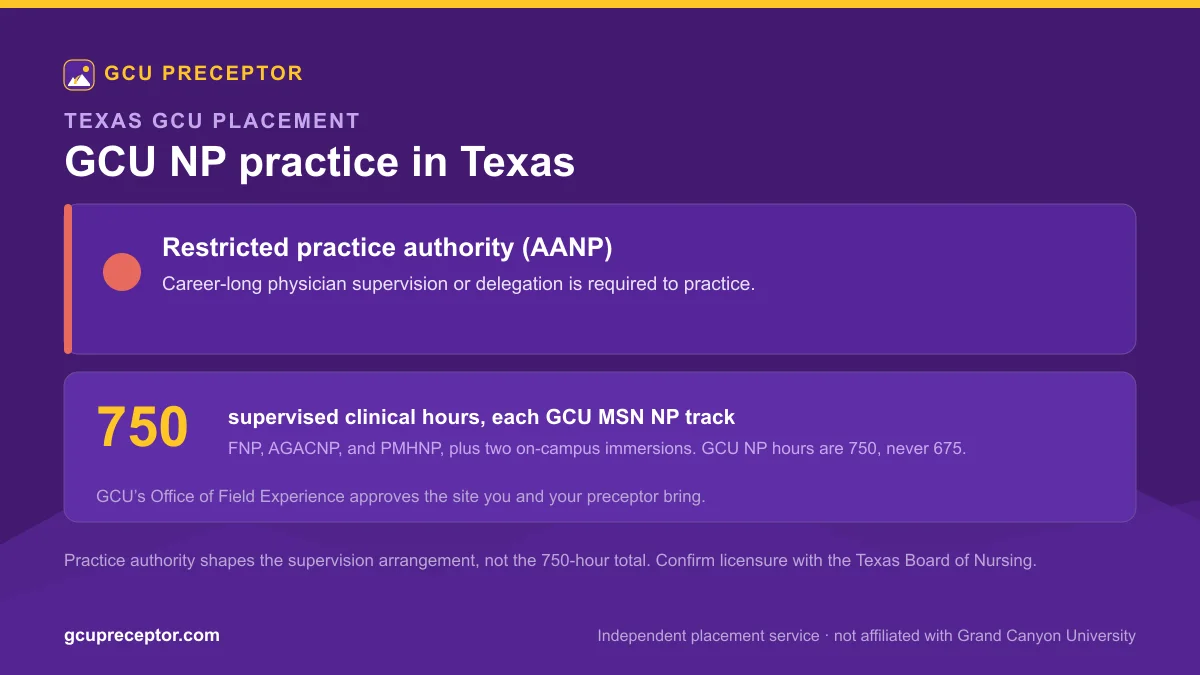
The American Association of Nurse Practitioners classifies Texas as a restricted practice state. AANP's Texas policy information describes physician delegation and supervision, along with career-long written protocols, as conditions that limit NP practice. Prescriptive authority also operates within state delegation requirements, and additional limits may apply to some controlled substances and settings.
Texas NPs assess, make clinical decisions, and manage patients within their authorized role and population focus. At least one element of practice depends on a continuing regulated physician relationship, so clinics build prescribing and compliance processes around that structure.
A student is supervised by a preceptor no matter where the rotation occurs. What Texas changes is the office-level decision. An NP may be willing to teach, but the physician delegate, practice owner, hospital education team, or compliance department may also need to approve the arrangement. Ask about that process early instead of treating the preceptor's personal yes as the final site commitment.
The Texas Board of Nursing and your preceptor check
The Texas Board of Nursing licenses qualified registered nurses as APRNs in roles that include nurse practitioners, nurse anesthetists, clinical nurse specialists, and nurse midwives. Its advanced practice pages cover applications, renewal, education, scope questions, and prescriptive authority. The board also offers public license information that should be checked before a proposed match is submitted.
Confirm the active Texas APRN license, role, and population focus. Then look at the actual clinical setting and patient mix. An FNP in an outpatient family clinic may be a strong fit for one course, while an adult-gerontology acute care NP in a hospital service fits a very different objective. Titles on commercial directories are sometimes shortened, so use the official record and obtain documentation rather than inferring a certification.
Board authorization does not equal GCU acceptance. The board determines whether the clinician may practice in Texas. GCU decides whether the person and site meet learning and supervision expectations. Review the preceptor requirements before requesting documents.
Texas is not one placement market
Dallas and Fort Worth together offer large hospital networks, suburban specialty clinics, primary care, and behavioral health practices. Houston has an enormous clinical footprint, but institutional onboarding can be formal and capacity is not unlimited. San Antonio and Austin each have strong outpatient and hospital markets, and both attract students from numerous local and online programs.
Other regions deserve attention. El Paso is its own border health market. Corpus Christi serves the Coastal Bend, while McAllen, Edinburg, Harlingen, and Brownsville anchor the Rio Grande Valley. Lubbock and Amarillo cover broad western areas, and Tyler supports East Texas. College Station, Waco, Midland, Odessa, and Abilene can also work depending on specialty.
Use the track to narrow the geography. FNP placement often centers on family medicine, primary care, community health, pediatrics, or women's health where course objectives permit. PMHNP placement needs psychiatric care and an appropriate behavioral health population. AGACNP placement calls for adult acute and complex care, so it usually points toward hospital and specialty environments. Texas has many clinicians, but distance, system policies, and specialty fit can still make a search difficult.
What GCU requires after a clinician agrees
GCU requires nursing students to source their own preceptor. The Office of Field Experience supports students and approves the site and preceptor they bring, but OFE is not a placement office. Once a Texas clinician is willing, the student nominates the proposed site and preceptor using the Field Experience Site Information Form in the eDocs app.
Large organizations may have an affiliation review, application window, or separate onboarding. Start early for both the facility process and GCU review. Do not see patients or count hours until all approvals are in place. If information changes, notify GCU and the site rather than assuming clearance carries over.
During the approved rotation, log hours in the Lopes Activity Tracker, usually called LAT. Your preceptor approves those records in ThunderTime. Enter time consistently and compare completed, logged, and approved hours every week. That simple routine exposes discrepancies while the preceptor still remembers the clinical day.
Make room for 750 hours and Phoenix travel
Each GCU MSN NP track, FNP, AGACNP, and PMHNP, includes 750 supervised clinical hours with preceptors and settings suited to the specialty. The statewide choice of facilities does not make the hours generic. Course objectives determine whether a Dallas urgent care, a Houston psychiatric practice, or a San Antonio hospital service is an appropriate experience.
The programs also require two on-campus immersions in Phoenix, so they are not 100% online. Texas students should block both trips before agreeing to weekly clinical dates. Even with direct flights from some cities, travel time, airport distance, and schedule changes can consume more than the immersion dates themselves. See clinical hours for a broader planning view.
Telehealth is present across Texas, especially in behavioral health and services reaching rural communities. Whether virtual encounters satisfy a GCU course is a program and OFE question, not something the clinic can decide alone. Confirm the approved format before depending on telehealth hours. Plan on in-person patient care unless your program and OFE authorize a different mix.
Get specific before you widen the search
Give offices your track, course, population focus, date range, weekly schedule, and required documentation. Be realistic about commute radius, especially in metros where a short map distance can mean a long drive.
If your own outreach has stalled, ask for a free placement review. We are an independent service that works separately from GCU. We source potential Texas preceptors, match first, and collect payment only when a placement is secured. We never guarantee placement or GCU approval; OFE decides whether the proposed site meets GCU requirements. Pricing is available at cost.
Frequently asked questions
Is Texas a full practice state for nurse practitioners?
No. AANP classifies Texas as restricted practice. Physician delegation, supervision, and written protocols remain part of the state's NP practice structure. Consult the Texas Board of Nursing for current requirements relevant to a particular APRN and setting.
Does OFE place GCU students with Texas preceptors?
No. The student sources the preceptor. GCU's Office of Field Experience reviews the clinician and site proposed through the Field Experience Site Information Form in eDocs and makes the educational approval decision.
How many supervised clinical hours are required for GCU NP tracks?
The GCU MSN FNP, AGACNP, and PMHNP tracks each require 750 supervised clinical hours. The experience must align with the track and course objectives. Students also attend two on-campus immersions in Phoenix.
Can I use an out-of-state NP as a preceptor at a Texas site?
Do not assume an out-of-state credential is enough. A clinician practicing and precepting patients in Texas must have the authority appropriate to that practice. Verify credentials with the Texas Board of Nursing and ask OFE to confirm educational eligibility before submitting the arrangement.
Will GCU accept a fully virtual Texas preceptorship?
Acceptance depends on the program, course, proposed supervision, and OFE review. Confirm directly with your GCU program and OFE before relying on telehealth. In-person care should remain the planning baseline unless the approved experience says otherwise.
Get your GCU clinicals handled.
Tell us your track and term. We’ll map your clinical requirement and start the search, in person or virtual. No payment until you’re matched.