Tennessee Clinical Preceptors for GCU Nursing Students
Tennessee has a restricted nurse practitioner practice environment, including a required supervisory or collaborative physician relationship for APRNs who prescribe. That rule shapes clinic operations, while GCU's separate process requires you to source a preceptor and obtain Office of Field Experience approval.
Get matched, free
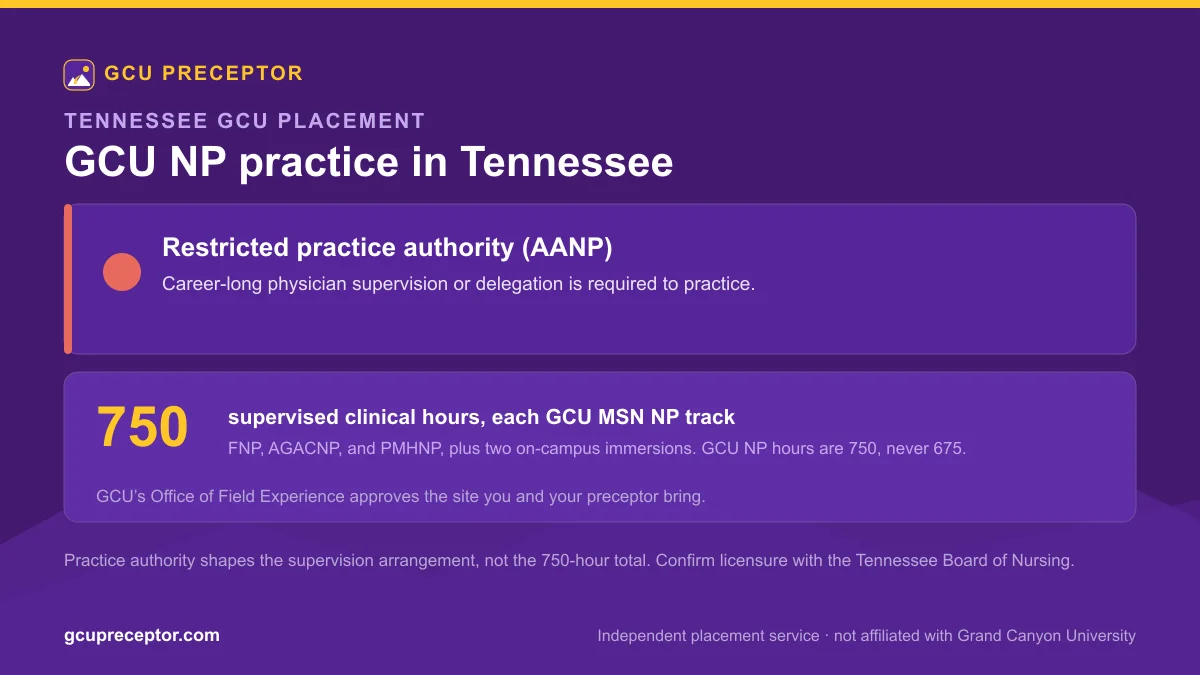
The short answer on Tennessee practice authority
The American Association of Nurse Practitioners classifies Tennessee as a restricted practice state. AANP uses that label when state law requires career-long supervision, delegation, or team management by another health provider for at least one element of NP practice. Tennessee's Board of Nursing says APRNs who prescribe must have a supervisory or collaborative physician and keep that relationship current.
The restriction is part of the preceptor's professional practice, not a separate burden placed on a GCU student. You will be supervised as a learner in any state. Yet it can affect whether an NP can host you. An office may need agreement from the physician, compliance staff, and management before adding a student to the existing workflow. A precise request is more useful than a general question about shadowing.
Day to day, Tennessee NPs assess and manage patients in primary care, specialty, acute care, and behavioral health settings within their education, certification, state authority, and practice arrangements. Do not treat the word restricted as a verdict on clinical quality. Treat it as a signal to check how a specific practice is organized before submitting it to GCU.
What to verify with the Tennessee Board of Nursing
The Tennessee Board of Nursing, part of the Department of Health, regulates licensure, education, and nursing practice. It issues APRN certificates in the recognized advanced practice roles and publishes applications, renewal information, rules, position statements, and license verification links. The board distinguishes an APRN certificate from authority to prescribe, so review the credential that is relevant to the proposed clinical work.
The board's public guidance states that APRNs who prescribe must maintain a supervisory or collaborative physician relationship and update changes. For a student, the main action is simpler: verify the prospective preceptor's current license and credentials using the official resources, then compare the clinician's role and population with the course. A PMHNP credential is not a substitute for an acute care population focus, and a primary care setting does not become acute care because its schedule is busy.
GCU makes the educational approval decision. The state board governs professional authority and discipline. Both matter, but they answer different questions. The preceptor requirements page can help you organize what GCU will need after the license check.
Choose Tennessee markets by rotation type
Nashville has the state's widest mix of health systems, specialty groups, private practices, and behavioral health programs. It also has many nursing learners seeking rotations. Memphis offers extensive adult acute care, community health, primary care, and psychiatric services. Knoxville supports eastern Tennessee, and Chattanooga serves the southeast with hospital and outpatient options.
Smaller cities can broaden the list. Clarksville and Murfreesboro have growing outpatient markets. Jackson is a regional center for western Tennessee outside Memphis, while Johnson City and the Tri-Cities connect students with care in the northeast. Rural practices may offer close preceptor involvement, although staffing and patient volume can limit the days they accept students.
Search according to educational fit. A GCU FNP preceptor should support the age groups and primary care objectives in the course. PMHNP placement calls for psychiatric assessment and management in an appropriate setting. AGACNP placement depends on adult acute and complex care, which usually narrows the field toward hospitals and specialty services.
The paperwork trail from eDocs to ThunderTime
At GCU, the student is responsible for sourcing a preceptor. The Office of Field Experience supports the field experience and decides whether the site and preceptor you identify are acceptable. It does not select a Tennessee clinic for you. When a qualified clinician agrees, use the Field Experience Site Information Form in the eDocs app to nominate the proposed arrangement.
Submit complete information and keep the rotation tentative until the required reviews are finished. Health systems may add their own onboarding, background, training, or scheduling steps. Do not log patient care before GCU and the site have cleared you to begin.
During the rotation, record hours in the Lopes Activity Tracker, or LAT. The preceptor uses ThunderTime to review and approve them. Enter hours while each clinical day is fresh, and check approvals regularly. Good records will not fix a site that lacks approval, but they will keep an approved experience from becoming an avoidable documentation problem.
750 supervised hours plus two trips west
GCU's MSN FNP, AGACNP, and PMHNP tracks each require 750 supervised clinical hours. Clinical courses divide that work into experiences appropriate to the track, so the total should be planned as a sequence rather than one generic block. A student in Cookeville may need to travel toward Nashville for a specialized rotation even if earlier primary care hours were completed locally.
Each of the three MSN NP programs also includes two on-campus immersions in Phoenix. The programs are not 100% online. Reserve travel days before confirming clinic attendance, and account for the time difference between Tennessee and Arizona when arranging flights or remote meetings. The clinical hours guide gives a single place to review the major GCU field requirements.
Telehealth may be part of a Tennessee practice, particularly for mental health follow-up, but clinical acceptance is not automatic. GCU program, course, and OFE expectations control whether virtual encounters can count and under what conditions. Confirm the proposed mix before agreeing to it. Unless your program and OFE approve otherwise, build the schedule around in-person care.
Turn a broad search into a reviewable match
A useful outreach message identifies the exact course, track, requested dates, days available, and patient population. It should also make clear that GCU will review the site through OFE. That level of preparation respects the clinician's time and helps the office identify internal approval needs early.
If you need sourcing help, send a free placement review. We are independent of GCU. We contact potential Tennessee preceptors and present a match for your submission; you pay only when a placement is secured. We cannot guarantee a placement or GCU approval, and OFE retains the final approval role. See cost for service pricing.
Frequently asked questions
Is Tennessee a restricted practice state for nurse practitioners?
Yes. AANP classifies Tennessee as restricted practice. The Tennessee Board of Nursing states that APRNs who prescribe must maintain a supervisory or collaborative physician relationship and report changes to that relationship.
Will the GCU Office of Field Experience find a Tennessee site for me?
No. GCU requires the student to source a preceptor. OFE supports the process and reviews the site and preceptor submitted through the eDocs Field Experience Site Information Form. Approval must come before the clinical experience begins.
Do GCU MSN NP students complete 750 hours in Tennessee?
They can complete approved supervised clinical hours in Tennessee. The FNP, AGACNP, and PMHNP tracks each require 750 hours, with settings and preceptors aligned to course objectives. Students also travel to Phoenix for two required on-campus immersions.
Can telehealth visits count toward a Tennessee GCU rotation?
They may in some circumstances, but acceptability varies by program and course and must fit the approved plan. Confirm with your GCU program and OFE before relying on virtual encounters. Do not assume that a clinic's use of telehealth makes every virtual visit count.
Get your GCU clinicals handled.
Tell us your track and term. We’ll map your clinical requirement and start the search, in person or virtual. No payment until you’re matched.