Find a South Dakota Preceptor for Your GCU Rotation
South Dakota is a full practice state for nurse practitioners, with a transition requirement for clinicians who have not yet accumulated the state's required licensed practice experience. GCU students still need a specialty-matched preceptor, a student-sourced site, and Office of Field Experience approval before clinical work begins.
Get matched, free
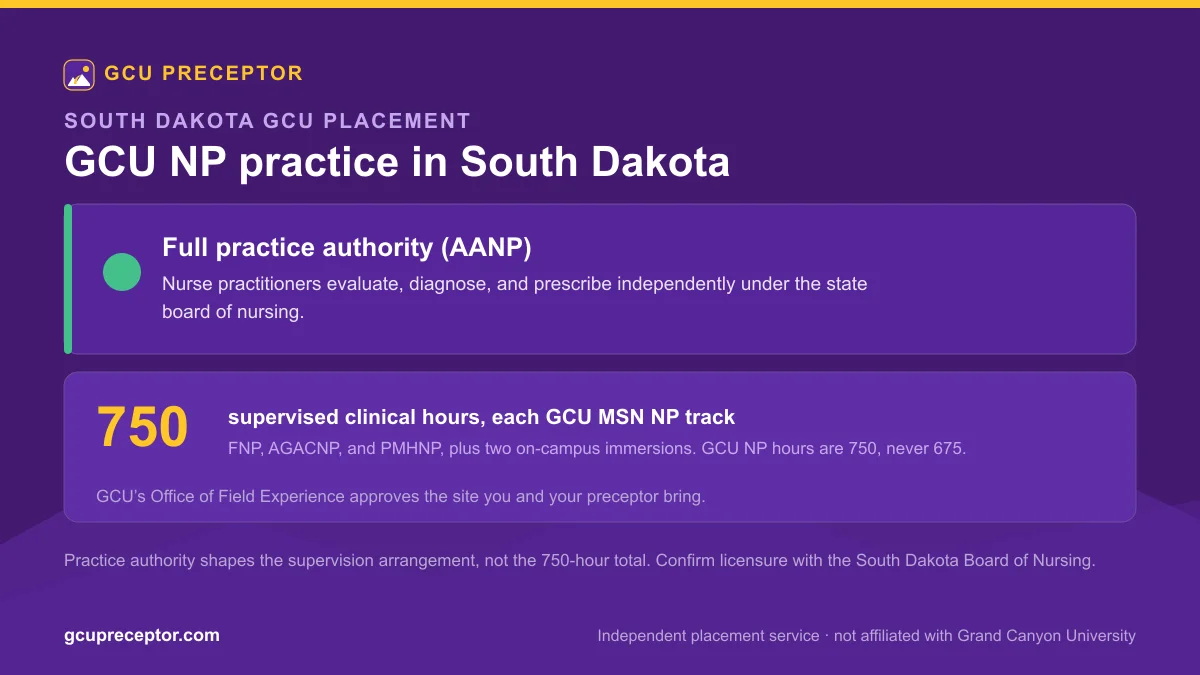
Full practice authority with an early-career checkpoint
The American Association of Nurse Practitioners places South Dakota in its full practice category. Experienced certified nurse practitioners can assess patients, order and interpret diagnostic procedures, establish diagnoses, and manage treatment within their role and population focus under nursing board authority, rather than through a career-long physician agreement.
South Dakota does require a transition for a newer CNP who cannot verify at least 1,040 hours of licensed NP practice. The South Dakota Board of Nursing instructs that clinician to use a board-approved collaborative agreement with a South Dakota physician or CNP who meets its experience and specialty criteria. After the practice threshold is documented, the agreement can be retired. That initial requirement does not change AANP's full practice classification because it is not career-long.
For students, the distinction is useful when screening a potential preceptor. A newer NP may be fully qualified clinically but still be completing the state's transition process. An experienced CNP may practice independently while consulting or referring based on the patient's needs. Either situation needs accurate disclosure in the GCU submission so OFE can evaluate the preceptor and site as they actually operate.
What the South Dakota Board of Nursing controls
The South Dakota Board of Nursing regulates CNP licensure and nursing practice. Its materials explain licensure by examination or endorsement, certification verification, the early-practice collaborative agreement, and public license verification. It also points clinicians to the state statutes and administrative rules governing their role.
Use the board's official resources to verify a prospective preceptor's active South Dakota license and population focus. The credential should make sense for your course. National certification and state authority are important, but they are only part of the educational review. GCU can also consider experience, patient mix, setting, and the preceptor's ability to provide the required supervision.
Registered nurse compact participation does not create automatic advanced practice authority. APRN practice has its own state requirements. Use the license lookup and GCU preceptor requirements instead of relying on a clinic biography.
A placement map that is bigger than Sioux Falls
Sioux Falls has the state's deepest concentration of hospitals, specialty groups, primary care practices, and behavioral health services. It is the natural first search area for many AGACNP students because adult acute care rotations need hospital or comparable high-acuity settings. Competition is real, however, and large organizations often have formal student intake calendars.
Rapid City is the main clinical center for western South Dakota. Pierre, Aberdeen, Brookings, Watertown, Mitchell, and Yankton have smaller networks with community practices and regional services. Rural options may offer valuable primary care exposure, but a thin clinician pool, winter travel, and long distances complicate scheduling.
Match the search to the track. FNP students need care across the lifespan and often look to family medicine, community health, and primary care. PMHNP students need psychiatric assessment and treatment in an appropriate behavioral health environment. AGACNP learners need adult acute and complex care. A convenient site with the wrong population will not solve the placement requirement.
GCU's student-sourced process in four moves
First, identify a clinician and setting that fit the course dates, specialty, and supervision expectations. The student is responsible for sourcing the preceptor. GCU's Office of Field Experience supports and approves field experiences, but OFE does not assign a South Dakota preceptor to you.
Second, nominate the proposed site and preceptor through the Field Experience Site Information Form in the eDocs app. Provide complete, accurate information and allow time for review or follow-up. A verbal commitment from a clinician is encouraging, but it is not permission to begin hours.
Third, complete any facility onboarding after the site gives instructions and wait for the required GCU clearance. Fourth, once the rotation starts, record your hours in the Lopes Activity Tracker, known as LAT. Your preceptor approves those entries in ThunderTime. A weekly review of logged and approved time is far easier than repairing an incomplete record after the course closes.
How 750 hours look from the Plains
GCU's MSN FNP, AGACNP, and PMHNP tracks each require 750 supervised clinical hours. Those hours are not interchangeable across specialties. The course objectives and population focus determine what site and preceptor are suitable, so students sometimes need more than one South Dakota setting over the full sequence.
The three NP tracks also include two on-campus immersions in Phoenix. This means they are not 100% online. From Sioux Falls or Rapid City, air schedules and connections may be less forgiving than they are from a major hub, so block the immersion travel before finalizing clinic dates. Plan enough flexibility that a delayed return does not create an immediate attendance problem.
A virtual component may be possible in a state where patients live far from specialty services, particularly in behavioral health. Still, telehealth acceptability varies by GCU program and course. Confirm any virtual plan with your program and OFE before counting on it, and make sure the proposed preceptor can supervise the encounters in the manner GCU expects.
When local outreach has reached its limit
Give each request your track, rotation window, weekly availability, patient population, and GCU documentation. In a smaller market, follow up respectfully and avoid repeated messages to the same office through different contacts.
For help beyond your own list, submit a free placement review. We are an independent preceptor sourcing service, not part of GCU. We look for a suitable South Dakota match, and you pay only when a placement is secured. We do not promise placement or GCU approval, and OFE makes the final decision on every site you submit. The cost page contains service pricing.
Frequently asked questions
Is South Dakota a full practice state for nurse practitioners?
Yes. AANP classifies South Dakota as full practice. A newer CNP who cannot verify 1,040 hours of licensed NP practice uses a board-approved collaborative agreement during the transition. Once the required practice is verified, that agreement can be retired.
Who finds and approves my South Dakota preceptor?
The GCU student finds the preceptor. The Office of Field Experience reviews the site and clinician you nominate using the Field Experience Site Information Form in eDocs. OFE approval is required before the placement can proceed.
Can all 750 hours be completed with one South Dakota preceptor?
Do not assume that one person or site will satisfy every course. Each MSN NP track requires 750 supervised hours, but course objectives, patient populations, and specialty alignment determine which experiences count. Ask your program and OFE to confirm the plan.
Are virtual clinical hours allowed for GCU students in South Dakota?
Possibly, but the answer depends on the program, course, supervision plan, and OFE review. Confirm before relying on telehealth encounters. A rotation should not be presented as virtual if the approved experience or course expectations require in-person care.
How do I confirm a South Dakota NP preceptor's license?
Use the South Dakota Board of Nursing's public verification resources and compare the result with the clinician's stated role and population focus. Then check the educational criteria with GCU, because an active state license alone does not ensure course fit.
Get your GCU clinicals handled.
Tell us your track and term. We’ll map your clinical requirement and start the search, in person or virtual. No payment until you’re matched.