South Carolina Preceptor Support for GCU Students
South Carolina is a restricted practice state for nurse practitioners, so physician practice agreements remain part of the clinical setting. For a GCU student, understanding that structure helps you approach the right preceptors and prepare a site that the Office of Field Experience can review.
Get matched, free
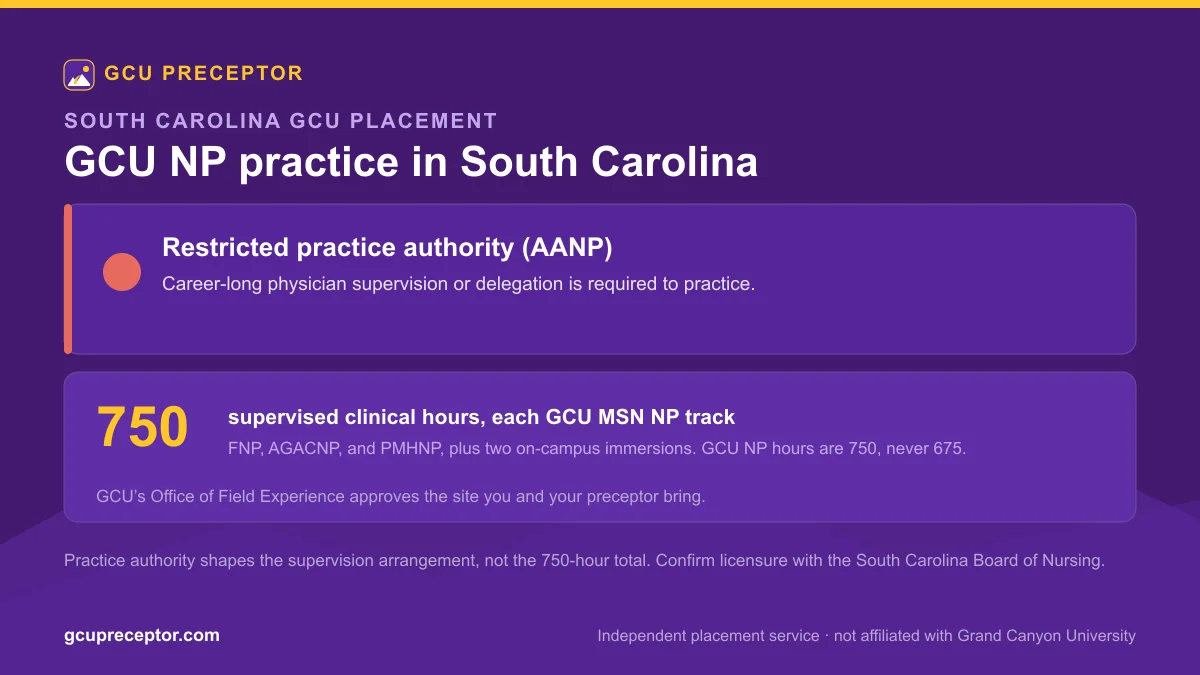
South Carolina restricted practice, answered first
The American Association of Nurse Practitioners classifies South Carolina as a restricted practice state. In practical terms, an NP's authority is not based only on the nursing license. Nurse practitioners who perform specified medical acts work under a written practice agreement developed with a physician or qualifying medical staff, and prescriptive authority is tied to that regulated framework.
The agreement addresses the medical aspects of care the NP will provide, including prescribing, and sets mechanisms for consultation, quality, and patient safety. That does not mean an NP has a physician standing in every exam room. It does mean the legal and operational relationship matters when the NP joins a practice, changes a site, or accepts responsibility for a student. The State Board of Nursing for South Carolina and the Board of Medical Examiners each have rules that can affect the arrangement.
A GCU learner remains a supervised student regardless of the state's authority category. Still, an NP preceptor may need a practice manager and collaborating physician to agree before the clinic can host you. A clear schedule and specialty fit make that conversation easier.
The state board is your credential checkpoint
The State Board of Nursing for South Carolina, housed within the Department of Labor, Licensing and Regulation, licenses nurses and APRNs and publishes practice guidance. Its APRN pages separate basic licensure from prescriptive authority and provide forms for practice changes. Use the board for current scope and credential questions.
Before nominating a preceptor, verify that the clinician has an active license in the role and specialty represented to you. An FNP, PMHNP, or acute care NP should have credentials that match the patient population and experience your course requires. A clean license check is necessary, but it does not replace GCU's own review. Use the board information together with GCU's preceptor requirements and ask OFE when a clinician's role or setting is not an obvious match.
The board regulates the license, while GCU decides whether a proposed person and site satisfy the educational placement. A licensed clinician is not automatically eligible for every rotation.
Where a South Carolina search tends to lead
Charleston offers hospital, specialty, primary care, and behavioral health options, but also attracts many learners. Columbia has a broad Midlands market, while Greenville and Spartanburg anchor the Upstate. Myrtle Beach and the Grand Strand add urgent care and family practice. Florence serves the Pee Dee, and Rock Hill offers access near the Charlotte metro.
Your track should drive the list, not just the distance from home. FNP preceptor candidates commonly work in family medicine, community health, internal medicine, pediatrics, women's health, or urgent care when the course objectives allow. PMHNP preceptor searches focus on psychiatric practices and behavioral health programs. AGACNP preceptor rotations require the adult acute care environment and are more likely to concentrate around hospitals and specialty services.
Independent clinics may decide faster than large systems, but each site has its own capacity and onboarding. Include both in the search, and allow for a commute when the nearest qualified clinician is unavailable.
From a willing clinician to an OFE decision
GCU students source their own preceptor. The Office of Field Experience supports the field experience and approves the site and preceptor the student brings, but it does not place the student. Once you have a willing clinician, the Field Experience Site Information Form in the eDocs app is used to nominate the proposed site and preceptor for review.
Do not begin counting visits because someone said yes by phone. Wait for the required GCU approval and complete any site onboarding. During the rotation, enter clinical time in the Lopes Activity Tracker, or LAT. The preceptor reviews and approves those hours in ThunderTime. Regular entries help you catch a missing approval or schedule gap before it threatens the end of a course.
Our role is sourcing, not academic approval. We contact suitable South Carolina clinicians, assess their interest and schedule, and present a potential match for your GCU submission. OFE retains the final decision, and no independent service can guarantee that decision.
Build the 750 hours around specialty and travel
Each GCU MSN NP track, FNP, AGACNP, and PMHNP, requires 750 supervised clinical hours. The hours are completed through the clinical courses with preceptors and settings aligned to the track. A busy family clinic in Summerville may be useful for an FNP course but not an AGACNP requirement. A Columbia psychiatric office may fit PMHNP objectives but cannot substitute for a different population focus simply because it has availability.
The MSN NP programs also include two on-campus immersions in Phoenix. They are therefore not 100% online. Add those trips to your calendar before agreeing to a South Carolina rotation schedule, especially if you will fly from Charleston, Columbia, or Greenville. Our clinical hours overview can help you see how placement planning and the on-campus components fit together.
Virtual care may appear in some South Carolina practices, particularly behavioral health. Whether telehealth encounters are acceptable and how they may count depends on the program, course, and OFE review. Confirm the plan with your GCU program and OFE before relying on virtual visits. An approved in-person base is the safer planning assumption unless GCU tells you otherwise.
A practical way to restart a stalled search
If calls go unanswered, state your track, dates, weekly availability, and required patient population. Have your resume and GCU requirements ready so a clinician can judge the fit quickly.
If you would rather have the outreach handled, request a free placement review. We are an independent service that works separately from GCU. We match first, and you pay only when a placement is secured. GCU approval is never guaranteed, and OFE remains the authority on the proposed site. Service pricing is kept on the cost page so this state guide can stay focused on placement planning.
Frequently asked questions
Is South Carolina a full practice state for nurse practitioners?
No. AANP classifies South Carolina as restricted practice. NPs performing specified medical acts use a written practice agreement within the state's regulatory structure. Students still practice under their approved preceptor, but the clinic's physician relationship can affect whether it accepts a learner.
Does GCU find my South Carolina preceptor?
No. The student sources the preceptor. GCU's Office of Field Experience reviews the site and clinician submitted through the Field Experience Site Information Form in eDocs. An independent sourcing service can help you locate a candidate, but OFE makes the approval decision.
How many clinical hours do GCU NP students complete?
The GCU MSN FNP, AGACNP, and PMHNP tracks each require 750 supervised clinical hours with appropriate preceptors. They also include two on-campus immersions in Phoenix, so the full program cannot be completed entirely from South Carolina.
Can a South Carolina rotation be fully virtual?
Do not assume so. Telehealth acceptability varies by course and program, and OFE must approve the proposed experience. Confirm the expected mix with your program and OFE before committing to a virtual schedule, and plan for in-person patient care unless you receive different guidance.
Get your GCU clinicals handled.
Tell us your track and term. We’ll map your clinical requirement and start the search, in person or virtual. No payment until you’re matched.