Rhode Island Clinical Placements for GCU NP Students
Rhode Island grants nurse practitioners full practice authority, but its small geography does not make a student placement automatic. GCU students still need to find a specialty-matched preceptor and earn OFE approval before clinical work begins.
Get matched, free
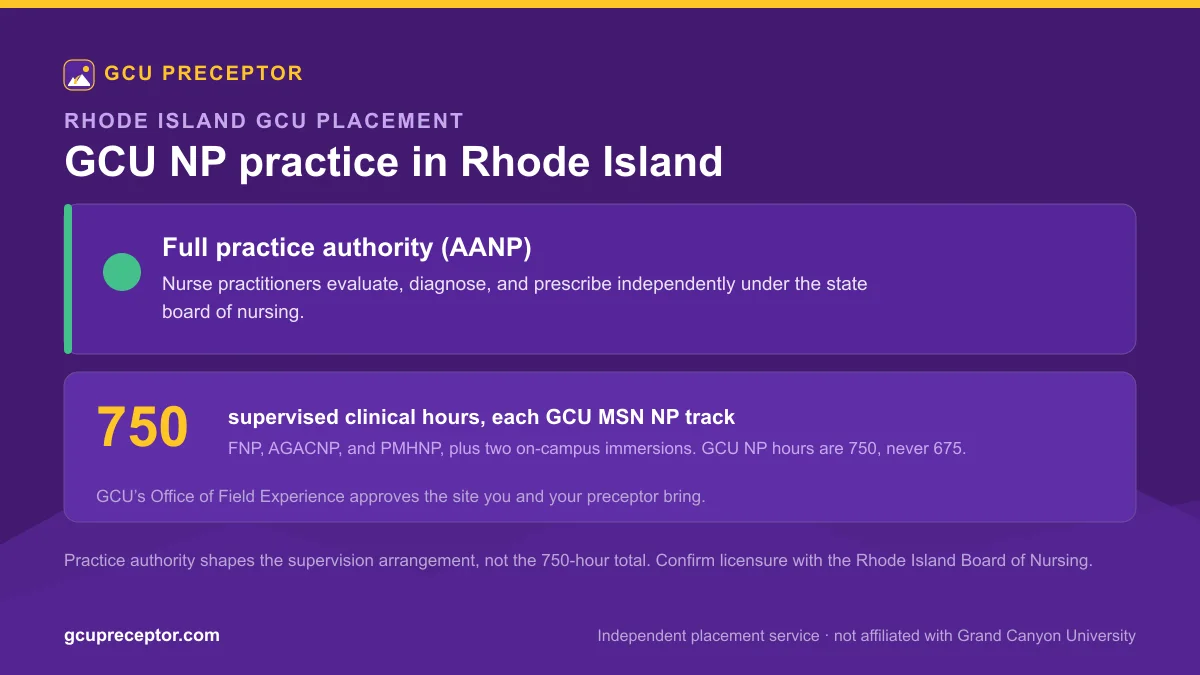
Rhode Island gives licensed NPs full practice authority
The American Association of Nurse Practitioners lists Rhode Island as a full practice state. A licensed nurse practitioner may evaluate patients, diagnose conditions, order and interpret tests, and manage treatment, including prescribing, under the state's nursing authority. Rhode Island does not require a physician collaboration or supervision agreement as a permanent condition of NP practice.
In practical terms, an NP preceptor may manage an independent patient panel, coordinate referrals, prescribe within the provider's authority, and make decisions for the full episode of care. The provider still practices within the licensed role, population focus, education, and competence. Full practice is not isolation from other professionals, and consultation remains part of responsible care when a patient's needs exceed one clinician's scope.
A GCU student does not inherit that independent authority by training in Rhode Island. Students provide care under an approved preceptor and within the course plan, site policy, and supervision available during each shift. Full practice describes the licensed NP's regulatory environment. Supervised clinical education describes the student's role until graduation, certification, and licensure.
Know the Rhode Island nursing regulator
Nursing is overseen by the Rhode Island Board of Nurse Registration and Nursing Education within the Rhode Island Department of Health. The Department's nursing pages cover initial and renewal licensing for registered nurses and APRNs, public license verification, education information, and current notices affecting practice. An APRN license builds on RN licensure, graduate preparation in the role, and national certification.
Before submitting a preceptor, use the Department of Health verification system to confirm an active credential and the relevant APRN role. Check that the provider's certification and actual patient panel align with your course. If the proposed preceptor is a physician or physician assistant, verify that license through the appropriate Rhode Island health-professions record as well.
The state license answers whether a provider is authorized to practice. GCU still answers whether that provider and site are suitable for your field experience. Review the school's preceptor requirements before requesting documents, and take any unresolved state-scope question to the official Department pages rather than relying on a neighboring state's rules.
A compact state still has distinct placement markets
GCU students are responsible for sourcing their preceptors. The Office of Field Experience supports and reviews the site a student selects, but it does not conduct the search. Submit the provider and practice through the Field Experience Site Information Form in the eDocs app. Even when a clinic is ready to schedule you, wait for OFE approval before performing or recording clinical hours.
Providence and the nearby communities of Cranston, East Providence, Pawtucket, North Providence, and Johnston have the state's largest concentration of primary care, psychiatric, specialty, and hospital services. Warwick and Kent County offer another strong outpatient corridor. Because these areas are close together, a search should follow the provider fit rather than stop at a municipal boundary.
Northern Rhode Island searches can include Woonsocket, Cumberland, Lincoln, and Smithfield. Newport, Middletown, and Portsmouth cover much of Aquidneck Island, while South County options may appear in Wakefield, Narragansett, North Kingstown, and Westerly. A student can often consider several regions without relocating, but bridge traffic, seasonal travel, and clinic shift times still matter when evaluating the commute.
Rhode Island's limited number of large health systems can be both helpful and restrictive. One organization may offer several specialties, yet a centralized student office can fill its calendar far in advance. Independent practices and community clinics may decide more quickly. Every site still goes through eDocs and OFE. After the start date, log hours in the Lopes Activity Tracker, and ask the preceptor to approve them in ThunderTime throughout the rotation instead of waiting until the final week.
Make each portion of the 750 hours serve the track
GCU's MSN FNP, AGACNP, and PMHNP tracks each require 750 supervised clinical hours. FNP students need family care across the lifespan. AGACNP students need acute and complex adult-gerontology experiences. PMHNP students need psychiatric mental health assessment and treatment. The same total supports three different clinical plans.
In a small state, a strong early match should not tempt you to assume one site can satisfy every later course. A family practice may provide varied ages but no acute inpatient work. An outpatient psychiatric office may be a good PMHNP setting but have a limited patient mix for a particular term. Review upcoming requirements, confirm the provider's actual weekly schedule, and allow time for more than one OFE submission if your sequence needs different experiences.
The three MSN NP programs also include two on-campus immersions in Phoenix. Those required in-person sessions mean the tracks are not 100% online. Rhode Island students should plan airfare and travel days as soon as dates are posted, then keep the immersion weeks clear when agreeing to clinic shifts. Clinical rotations may remain in Rhode Island when approved, but the Phoenix component does not move online.
Other GCU field experiences follow their own rules. A post-master's certificate uses the relevant certificate plan, including the 750-hour FNP certificate. DNP students complete per-course hours around a Direct Practice Improvement project and the IRB process, with no single universal total. RN-to-BSN students complete 40 hours in NRS-465 Applied EBP Project and Practicum.
Decide what virtual care can actually contribute
Rhode Island practices may include telehealth in behavioral health, follow-up care, and some specialty services. Whether a virtual encounter counts toward GCU clinical requirements depends on the program and course as well as the approved site plan. Confirm the format with your program and OFE before committing to it. In-person experience remains necessary when a skill, physical examination, or patient interaction cannot be completed remotely.
If the same small pool of clinics is already booked, our independent placement service can widen and manage the outreach. We work independently of GCU, do not guarantee a match or university approval, and leave the final OFE submission with the student. You review the provider match before payment and pay only once a placement is secured. Share your track, start date, and commute limits through a free placement review, and we will assess options across the state.
Frequently asked questions
Is Rhode Island a full practice state for nurse practitioners?
Yes. AANP classifies Rhode Island as full practice. Licensed NPs may evaluate, diagnose, order tests, and manage treatment under nursing-board authority without a required physician collaboration or supervision agreement.
Does GCU provide my Rhode Island preceptor?
No. The student finds the site and preceptor. GCU's Office of Field Experience reviews the student-selected arrangement submitted in the eDocs Field Experience Site Information Form and must approve it before hours start.
Can I use one Rhode Island site for all 750 hours?
Only if that approved site and its preceptors meet the population, specialty, and setting requirements across your course sequence. Many students need more than one clinical arrangement, especially when later courses call for a different type of care.
Are the GCU MSN NP tracks completely online from Rhode Island?
No. The FNP, AGACNP, and PMHNP tracks each require 750 supervised clinical hours and two on-campus immersions in Phoenix. The immersions require travel even when all approved clinical sites are in Rhode Island.
Get your GCU clinicals handled.
Tell us your track and term. We’ll map your clinical requirement and start the search, in person or virtual. No payment until you’re matched.