Pennsylvania Preceptors for GCU Nursing Clinicals
Pennsylvania is a reduced practice state where certified registered nurse practitioners work in collaboration with physicians. For a GCU student, that legal structure can add decision-makers to a placement even though the student's own work is already supervised by a preceptor.
Get matched, free
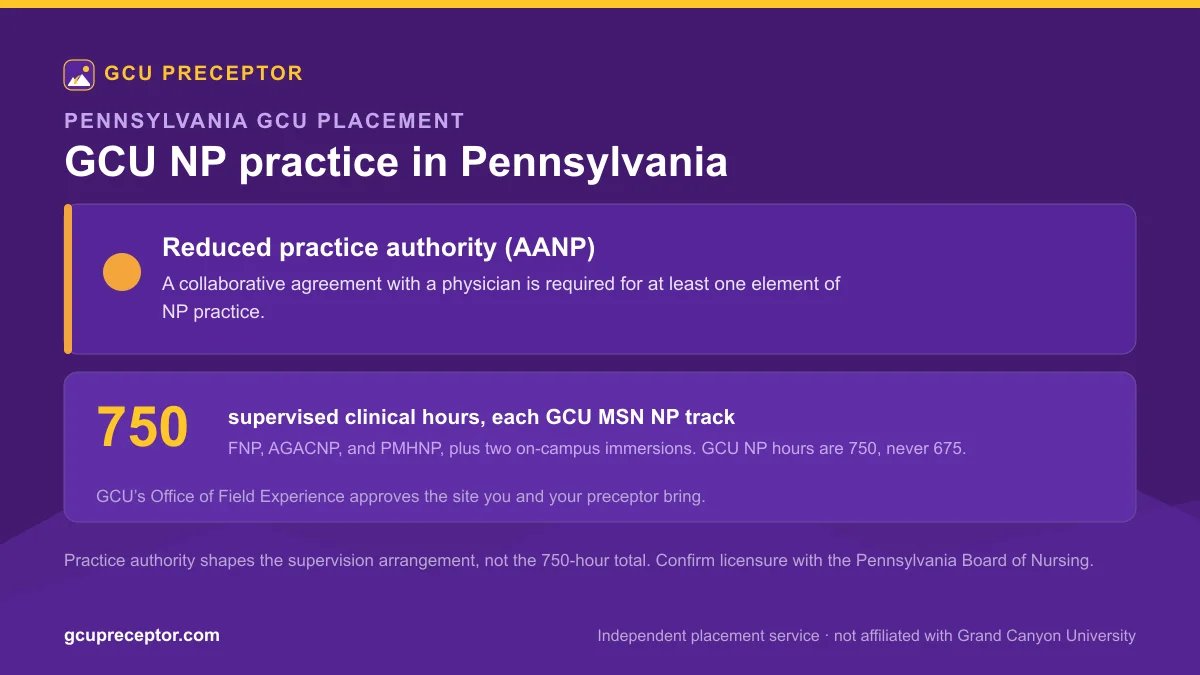
Pennsylvania keeps a career-long collaboration requirement
The American Association of Nurse Practitioners categorizes Pennsylvania as reduced practice. Certified registered nurse practitioners, known in the state as CRNPs, diagnose and provide therapeutic or corrective care in collaboration with a licensed physician. Current AANP practice information says Pennsylvania NPs maintain a career-long written agreement with one or more physicians.
Prescribing adds another formal layer. A CRNP with current prescriptive-authority approval uses a prescriptive authority collaborative agreement with at least two physicians. The written arrangement defines the professional relationship and supports consultation and referral. It does not mean that a physician must stand beside the NP for each patient visit, but it does keep physician collaboration tied to the NP's legal practice.
That matters during a preceptor search because an experienced CRNP may still need approval from collaborating physicians, an employer, or clinical leadership before accepting a student. GCU students do not sign the provider's collaborative agreement. They practice as supervised learners under the approved preceptor and site. Ask who controls student access at the first conversation so a verbal yes does not stall later.
The State Board of Nursing is the credential checkpoint
The Pennsylvania State Board of Nursing licenses and regulates registered nurses, practical nurses, CRNPs, and clinical nurse specialists. It also approves nursing education programs, maintains professional standards, and handles disciplinary matters. A Pennsylvania CRNP holds the required nursing credential in a specialty, and the proposed clinical work should align with that specialty and current practice.
Use the Pennsylvania Licensing System, called PALS, to verify a prospective preceptor. Confirm the license or certificate is active and review the public record before spending time on site paperwork. Physicians and other licensed health professionals can also be checked through Pennsylvania's professional verification system under their respective boards.
Licensure confirms that the provider may practice. It does not prove that the provider's patient panel will meet your course or that the organization accepts students. GCU applies a separate academic test through the preceptor requirements and OFE review. When a collaboration or prescribing question arises, use the Board's CRNP application and regulation pages rather than relying on a practice's outdated form.
Pennsylvania placements vary sharply by region
GCU expects the student to source the site and preceptor. The Office of Field Experience reviews the student-selected option and supports the approval process, but OFE does not perform the provider search. The Field Experience Site Information Form in the eDocs app is where you nominate the practice and clinician. No clinical time should begin until approval is complete.
Philadelphia and its surrounding counties hold a dense mix of hospital services, family practices, outpatient psychiatry, and specialty offices. Searches can extend through Montgomery, Bucks, Chester, and Delaware counties when a city placement is full. The Lehigh Valley around Allentown, Bethlehem, and Easton provides another substantial outpatient and hospital market, while Reading and Lancaster connect students with practices across southeastern and south-central Pennsylvania.
Pittsburgh anchors western Pennsylvania, with additional possibilities in Monroeville, Cranberry Township, Washington, and Greensburg. Harrisburg, Hershey, York, and Carlisle form a useful central corridor. Erie, Scranton, Wilkes-Barre, Williamsport, and State College can support well-matched experiences, but specialty depth may be narrower, so AGACNP or PMHNP students should start early and consider a larger radius.
Large Pennsylvania systems often manage students through centralized education offices, affiliation agreements, fixed application cycles, and compliance onboarding. Independent practices may answer locally and move faster, although their CRNP's physician collaborators may still need to agree. Once OFE clears the rotation, record hours in the Lopes Activity Tracker and have the preceptor approve them through ThunderTime. A regular approval routine prevents a documentation backlog near the course end.
Build the 750 hours around specialty, not convenience
GCU requires 750 supervised clinical hours in each of its three MSN NP tracks. FNP students need family-focused experiences across the lifespan. AGACNP students need acute and complex adult-gerontology care. PMHNP students need psychiatric mental health encounters appropriate to the course. One provider rarely fits every purpose, so map later requirements while arranging the current rotation.
Pennsylvania's large academic centers can offer specialty exposure, but their student calendars and affiliation steps may close well before a course begins. Community hospitals, outpatient networks, and independent practices can be equally useful when the preceptor and patient population match. Evaluate the real work the student will do, not the name recognition of the institution. OFE approves the individual site and preceptor arrangement you submit.
Two on-campus immersions in Phoenix accompany the 750 clinical hours in every GCU MSN NP track. Those required sessions add an in-person component to each program. From Pennsylvania, reserve travel days and avoid promising clinic coverage on immersion dates. Tell the site before the schedule is finalized so the hours can be spread across available weeks.
Post-master's certificate students use their program plan, including the 750-hour FNP certificate. DNP students complete course-specific practice hours tied to a Direct Practice Improvement project and IRB process, so there is no single universal DNP total. The RN-to-BSN pathway includes the 40-hour NRS-465 Applied EBP Project and Practicum.
Confirm virtual encounters, then protect your timeline
Pennsylvania clinics may use telehealth for primary care follow-up, specialty consultation, and psychiatric treatment. Its presence in a practice does not guarantee that virtual encounters satisfy a GCU course. Ask your program and OFE about the proposed format before relying on those hours. Keep an in-person component when required examinations, procedures, or interpersonal skills cannot be assessed remotely.
If a physician collaboration structure or crowded system calendar is slowing the search, our independent placement team can source Pennsylvania providers for your course and region. We work independently of GCU and do not guarantee placement or OFE approval. You review the match first and pay only after a placement is secured. Request a free placement review with your specialty, start window, and travel radius, and we will assess the practical options before beginning outreach.
Frequently asked questions
Is Pennsylvania a full practice state for NPs?
No. AANP classifies Pennsylvania as reduced practice. CRNPs maintain a written collaborative relationship with physicians, and prescriptive authority has its own collaborative-agreement requirements under the State Board of Nursing.
Can a Pennsylvania CRNP precept a GCU student?
Potentially, if the CRNP's active credential, specialty, patient population, and setting meet the course requirements and OFE approves the arrangement. The practice and collaborating physicians may also have to authorize the student.
How do I submit my Pennsylvania placement to GCU?
Enter the site and preceptor through the Field Experience Site Information Form in the eDocs app. The Office of Field Experience reviews the submission, and you should wait for written approval before counting any clinical time.
Do the Phoenix immersions replace any of the 750 clinical hours?
Treat the requirements separately. The FNP, AGACNP, and PMHNP tracks each require 750 supervised clinical hours and two on-campus immersions in Phoenix. Follow your program schedule for how each component is completed.
Get your GCU clinicals handled.
Tell us your track and term. We’ll map your clinical requirement and start the search, in person or virtual. No payment until you’re matched.