Oregon Clinical Preceptors for GCU Nursing Students
Oregon is a full practice authority state where licensed nurse practitioners may diagnose illness and prescribe treatment independently within their preparation and competence. GCU students still need a supervised, specialty-matched clinical experience approved by the Office of Field Experience.
Get matched, free
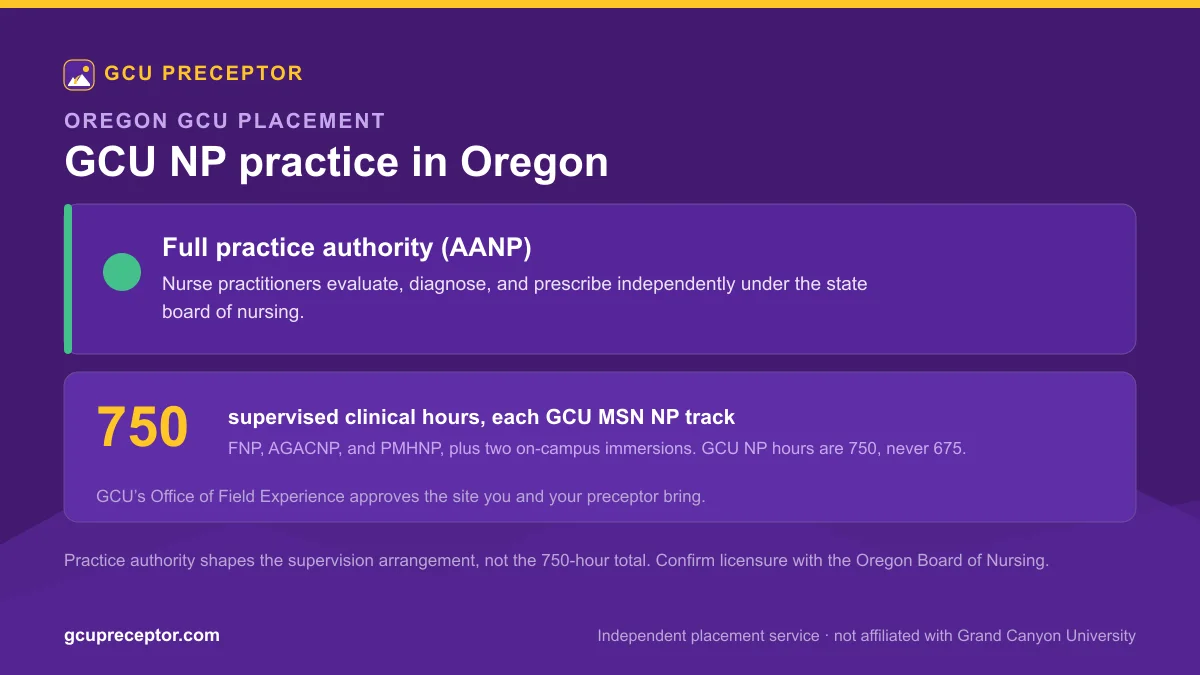
Full practice authority is the everyday Oregon model
AANP places Oregon in the full practice category. The Oregon State Board of Nursing describes the NP license as authority to independently diagnose illness and independently prescribe treatment within the parameters of the provider's license type, education, and practice competence. Oregon does not require a nurse practitioner to maintain a physician collaborative practice agreement.
That independence is visible in many settings. Oregon NPs may manage patient panels in primary care, lead behavioral health treatment, work on specialty teams, or practice as an independent provider. Full authority does not mean practicing beyond one's population focus or competence. It also does not remove consultation and referral when a patient's condition calls for another clinician's expertise.
For a GCU student, the distinction is simple: you can learn from an independently practicing Oregon NP, but you cannot practice independently yourself. Your patient care remains supervised by the approved preceptor, and your activities are limited by the course, site policy, and academic plan. A provider's autonomy after licensure and a student's supervision during training are separate questions.
Oregon State Board of Nursing checks that protect the plan
The Oregon State Board of Nursing, often called OSBN, licenses registered nurses and advanced practice registered nurses, interprets the Oregon Nurse Practice Act, approves nursing programs, investigates complaints, and maintains public licensing information. Oregon identifies NPs within the APRN framework and expects current national certification relevant to the provider's specialty, subject to the Board's rules.
Verify a prospective preceptor through the OSBN license search before asking GCU to review the match. Confirm that the license is active, the NP role and specialty fit the planned course, and the provider is working with the patient population you need. If a physician or physician assistant will precept, use the appropriate Oregon regulatory board for that license.
OSBN's APRN guidance is also useful when a clinic describes its provider as autonomous. The official scope depends on the license, educational preparation, and individual competence, not simply on an employer's job title. Academic suitability is a second layer. Compare the candidate with GCU's preceptor requirements and remember that GCU, not OSBN, decides whether the learning experience meets a course.
Search along Oregon's care corridors, not just downtown Portland
GCU requires students to source their own site and preceptor. The Office of Field Experience supports and approves the site a student brings but does not locate the clinician. The formal nomination goes through the Field Experience Site Information Form in the eDocs app. Do not begin clinical hours until OFE has approved both parts of the arrangement.
Portland has the state's deepest mix of primary care, mental health, specialty, and hospital-based practice. A Portland search should also include Beaverton, Hillsboro, Gresham, Tigard, and Oregon City because a cross-metro commute may uncover a better specialty match. Salem and the mid-Willamette Valley offer another active outpatient market, and Eugene-Springfield and Corvallis support family, behavioral, and specialty services farther south.
Central and southern Oregon require a more deliberate radius. Bend and Redmond anchor much of Central Oregon, while Medford, Central Point, Grants Pass, and Ashland form the main southern corridor. Along the coast, Astoria, Lincoln City, Newport, Coos Bay, and Brookings have smaller provider pools. Eastern Oregon students may need to consider Pendleton, Hermiston, La Grande, or a longer commute, depending on specialty and course timing.
A willing provider is only the first checkpoint. Ask whether the organization accepts outside NP students, has an existing school affiliation process, and can support the required patient encounters. Health systems may use fixed deadlines and extensive onboarding. An independent clinic may make a quicker decision but still needs OFE approval. When clinical work begins, enter hours in the Lopes Activity Tracker, and have the preceptor approve the entries in ThunderTime on a regular schedule.
The Oregon view of GCU's 750-hour requirement
GCU's MSN FNP, AGACNP, and PMHNP tracks each require 750 supervised clinical hours. The number is consistent, but the rotations have different purposes. FNP students need family-focused care across age groups. AGACNP students need acute and complex adult-gerontology encounters. PMHNP students need psychiatric evaluation and treatment within the mental health specialty.
Oregon's full practice environment can expose students to independent NP decision-making, but independence alone does not make a provider the right preceptor. Match the course to the provider's license type, certification, patient panel, setting, and schedule. A family clinic may not supply acute-care experiences, while a hospital service may not provide the continuity an FNP course needs. Plan the 750 hours as a sequence of approved experiences rather than one generic requirement.
Two on-campus immersions in Phoenix are also required in each MSN NP track. Those in-person sessions are why the programs are not 100% online. Oregon students should plan flights and time away from clinic as soon as immersion dates are available. Make the dates part of the preceptor conversation so they are treated as planned absences, not missed shifts.
Different rules apply outside the MSN NP tracks. A post-master's certificate uses its own course plan, including the 750-hour FNP certificate. GCU DNP students complete per-course practice hours connected to the Direct Practice Improvement project and IRB work, without one universal total. The RN-to-BSN NRS-465 Applied EBP Project and Practicum requires 40 hours.
Virtual care can supplement, but approval comes first
Oregon providers use telehealth across behavioral health, primary care follow-up, and outreach to communities far from larger medical centers. A virtual visit may offer valuable observation and participation, yet it does not automatically satisfy a GCU clinical requirement. Acceptance varies by program and course. Confirm the proposed mix with your program and OFE before relying on remote hours, and preserve in-person time for examinations and skills that require direct patient contact.
If geography or repeated declines are blocking the search, our independent placement service can contact Oregon providers who fit the course and travel radius. We work independently of GCU and cannot guarantee placement or OFE approval. You see the match before payment and pay only when a placement is secured. Send a free placement review with your track, city, start date, and willingness to commute, and we will tell you whether the search area is workable.
Frequently asked questions
Is Oregon a full practice state for nurse practitioners?
Yes. AANP classifies Oregon as full practice. OSBN states that Oregon-licensed NPs may independently diagnose illness and prescribe treatment within their license type, education, and competence, without a required physician collaborative agreement.
Who approves my Oregon preceptor for GCU?
GCU's Office of Field Experience makes the academic approval decision. You source the provider and site, submit them through the Field Experience Site Information Form in eDocs, and wait for approval before starting clinical hours.
Can I do the 750 GCU hours near Portland?
Potentially, if approved Portland-area sites and specialty-matched preceptors provide the patient populations required across your courses. The 750 hours may involve more than one site, and the two on-campus immersions still require travel to Phoenix.
Where does an Oregon preceptor approve my hours?
You enter hours in the Lopes Activity Tracker, and the preceptor reviews and approves them in ThunderTime. Agree on a routine for approvals so missing entries are found while the rotation is still active.
Get your GCU clinicals handled.
Tell us your track and term. We’ll map your clinical requirement and start the search, in person or virtual. No payment until you’re matched.