Oklahoma Preceptor Search Guide for GCU NP Students
Oklahoma remains a restricted practice state in AANP's current classification, even as the Board of Nursing now publishes both supervised and independent prescriptive-authority pathways. That combination makes current official guidance important when screening a GCU clinical preceptor.
Get matched, free
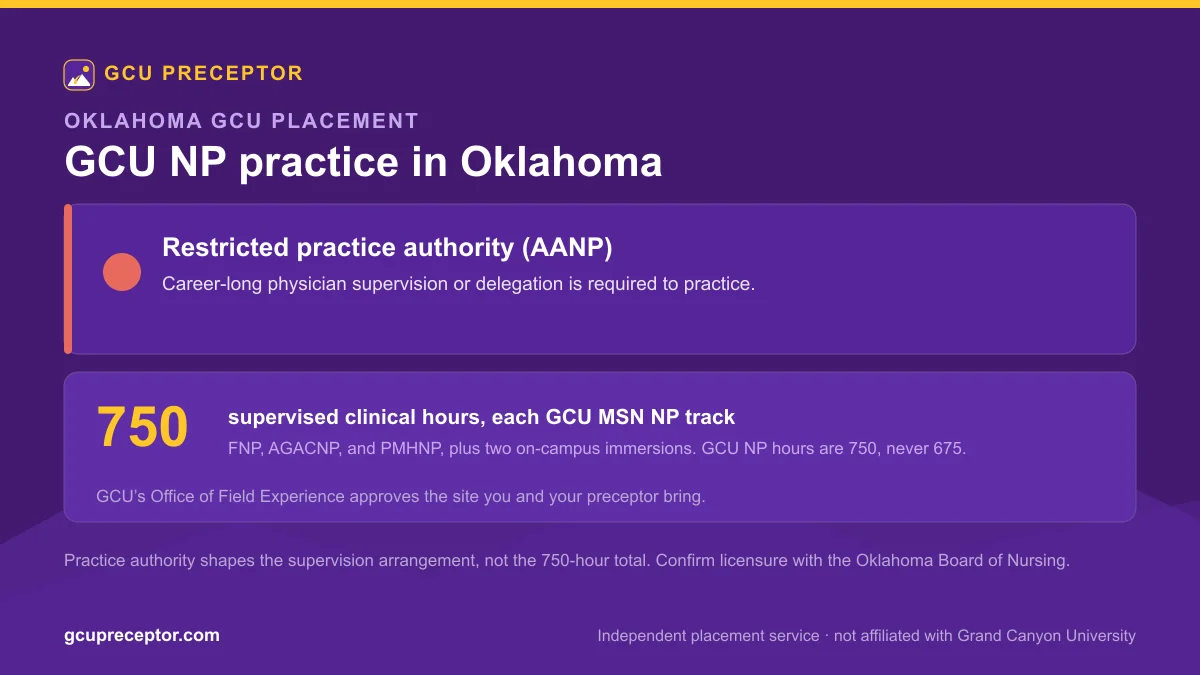
Oklahoma remains restricted practice
The American Association of Nurse Practitioners classifies Oklahoma as a restricted practice state. NPs provide assessment, diagnosis, and treatment within their role and population focus, but Oklahoma law has placed physician supervision conditions on prescriptive authority and limits at least one element of NP practice. That continuing legal constraint is why the state does not appear in AANP's reduced or full practice categories.
The details are changing in a focused way. The Oklahoma Board of Nursing currently publishes separate instructions for initial supervised prescriptive authority and for initial independent prescriptive authority for eligible APRN-CNPs, APRN-CNSs, and APRN-CNMs. The Board also directs practitioners to report changes in a supervising physician when supervised prescriptive authority applies. A student should not try to decide a provider's authority from the job title alone. Check the current Board record and ask the practice which authority the NP holds.
In daily clinical work, an Oklahoma NP may still manage visits, formulate diagnoses, order care, and coordinate treatment. The legal prescribing structure sits behind that work and can bring a supervising physician and practice administrator into the decision to accept a student. GCU students remain supervised learners in every state, so neither supervised nor independent prescriptive authority lets a student practice without the assigned, approved preceptor.
What to confirm with the Oklahoma Board of Nursing
The Oklahoma Board of Nursing regulates registered nursing, practical nursing, and advanced practice nursing. Its work includes issuing and renewing licenses, recognizing APRN roles, maintaining practice guidance, regulating nursing education, and handling discipline. Nurse practitioners appear under the certified nurse practitioner APRN role, with licensure and prescriptive authority handled through Board processes.
Use the Board's online Nurse Portal and verification resources before you submit a preceptor. Confirm an active APRN license, the certified role and population focus, and any prescriptive-authority information relevant to the provider's practice. If the candidate is a physician or physician assistant, use the official regulator for that profession. License verification is especially useful when a provider practices at more than one location or recently changed a supervisory relationship.
The Board's Practice and Advanced Practice page is the right reference for current application instructions, formularies, and supervision notices. Avoid making a legal conclusion based on an older clinic document because the independent prescriptive-authority pathway is new. For the academic side, the provider must also meet the GCU preceptor requirements for the specific course, and OFE retains approval authority.
Where an Oklahoma search can gain traction
At GCU, the student sources the preceptor and site. The Office of Field Experience supports the process and evaluates the student-selected arrangement, but it is not a placement office. You nominate the site and preceptor through the Field Experience Site Information Form in the eDocs app. Clinical activity should wait until OFE has approved what you submitted.
Oklahoma City and its nearby communities, including Edmond, Moore, Norman, and Yukon, form the state's largest cluster of primary care, behavioral health, specialty, and hospital services. Tulsa offers another broad market, with options extending into Broken Arrow, Owasso, and Muskogee. Both metros also attract learners from local nursing programs, so a familiar organization may already have a full student calendar.
A wider search can reach Lawton, Stillwater, Enid, Shawnee, Ardmore, and McAlester. Smaller communities may have fewer potential preceptors, but their family practices and community clinics can provide continuity across a varied patient panel. Distance matters in a state where a second-choice city may be a long drive, so calculate the commute for the full rotation rather than for one introductory meeting.
Ask about organizational permission before collecting documents. Health systems and tribal or community organizations may have affiliation, credentialing, or student-onboarding steps beyond GCU's review. Independent practices may answer sooner, but the same eDocs and OFE requirements apply. After approval, log completed hours in the Lopes Activity Tracker, and make sure the preceptor knows that ThunderTime is where those entries are approved.
Turn 750 hours into specialty-specific rotations
Each GCU MSN NP pathway requires 750 supervised clinical hours, whether the student is in FNP, AGACNP, or PMHNP. The equal totals do not make the placements interchangeable. Family care across the lifespan, acute adult-gerontology care, and psychiatric mental health care each require a preceptor and patient setting aligned with that specialty.
Oklahoma City and Tulsa may offer the widest acute-care and specialty choice for AGACNP rotations. FNP candidates can also consider community and independent primary care settings beyond the metros. PMHNP searches may include outpatient psychiatry and community mental health in several regions. In every case, verify that the actual patient encounters can support the course instead of relying on the clinic's general service description.
The programs also include two on-campus immersions in Phoenix, which means GCU's MSN NP tracks are not 100% online. Build the travel dates into your Oklahoma clinical calendar before shifts are finalized. A preceptor who understands the immersion schedule from the start can plan around it, while a last-minute absence may be difficult to replace in a tightly scheduled practice.
GCU's other nursing field experiences have their own designs. A post-master's APRN certificate follows the certificate plan, including the 750-hour FNP certificate. DNP students complete per-course hours related to the Direct Practice Improvement project and IRB process, with no single published total. RN-to-BSN students complete the 40-hour NRS-465 Applied EBP Project and Practicum.
Be precise about virtual care and outside placement help
Telehealth may be part of an Oklahoma clinic's ordinary schedule, particularly in psychiatric care or when patients live far from a provider. Whether those encounters count is a GCU program and OFE question. Confirm the proposed format before accepting the site, and do not plan the entire rotation around remote visits unless your course team has approved that structure. Skills that require direct examination generally call for in-person experience.
If your calls are not producing a course-ready option, our independent service can conduct the Oklahoma sourcing work. We are not part of GCU, cannot guarantee a match or OFE approval, and submit no site in place of the student. We screen providers for location and specialty, present the match first, and charge only after a placement is secured. Use the free placement review to share the track, course timing, and driving radius so we can assess the search before you commit.
Frequently asked questions
Is Oklahoma a restricted practice state for NPs?
Yes. AANP currently classifies Oklahoma as restricted practice. The Board of Nursing now publishes an independent prescriptive-authority pathway for eligible applicants, but Oklahoma still limits at least one element of NP practice under AANP's framework.
Does GCU find an Oklahoma preceptor for the student?
No. The student sources the site and preceptor. GCU's Office of Field Experience reviews the candidate submitted through the eDocs Field Experience Site Information Form and decides whether the arrangement can be approved.
How many supervised hours does a GCU NP student complete?
The GCU MSN FNP, AGACNP, and PMHNP tracks each require 750 supervised clinical hours with specialty-matched preceptors. They also include two on-campus immersions in Phoenix, so students should plan travel separately from Oklahoma clinic time.
Can an Oklahoma telehealth practice serve as my site?
Possibly, but acceptance varies by course and program. Ask your GCU program and OFE whether the planned virtual patient encounters meet the learning requirements before you submit or depend on the placement.
Get your GCU clinicals handled.
Tell us your track and term. We’ll map your clinical requirement and start the search, in person or virtual. No payment until you’re matched.