Ohio Clinical Placements for GCU Nursing Students
Ohio gives nurse practitioners broad clinical responsibilities but keeps a required collaboration structure in place, so AANP classifies it as reduced practice. GCU students should understand that structure without confusing licensed NP rules with student supervision.
Get matched, free
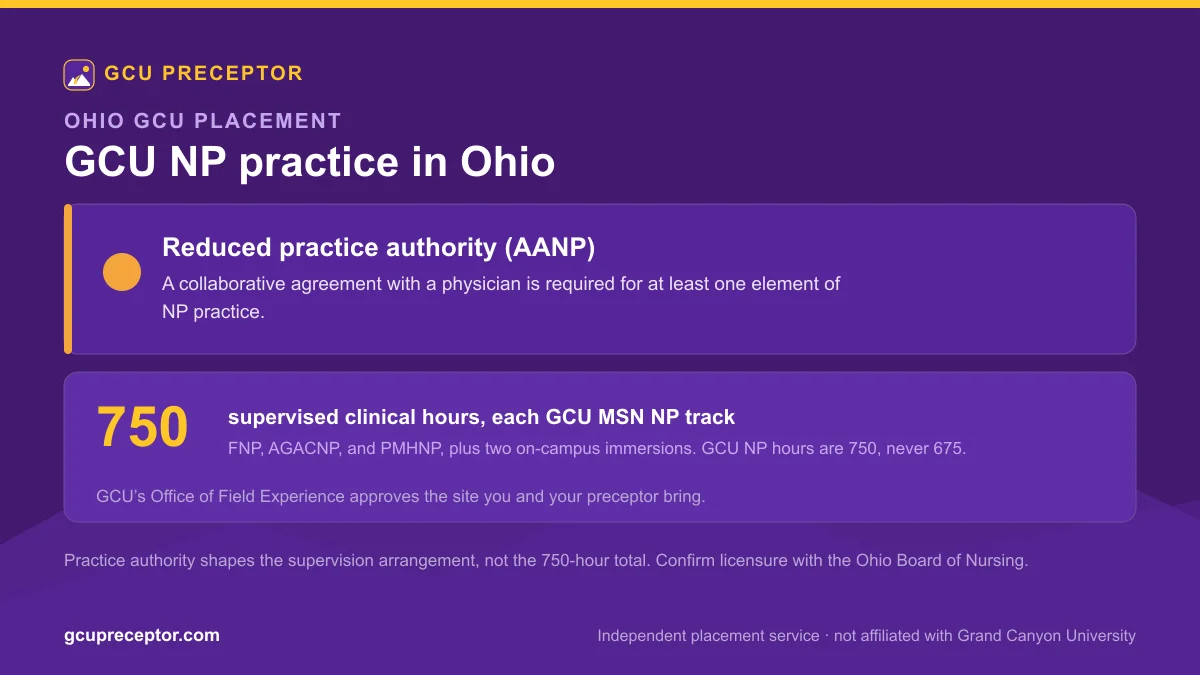
Ohio is a reduced practice state
The American Association of Nurse Practitioners places Ohio in the reduced practice category. Ohio certified nurse practitioners assess patients, make diagnoses, order tests, and prescribe within their education and certification, but state law requires them to practice under a standard care arrangement with a collaborating physician or podiatrist. For psychiatric mental health practice, the collaborator must be a physician in an appropriate specialty.
A standard care arrangement is not bedside supervision. It is a written framework covering collaboration, consultation, referral, prescribing, and plans for care when the collaborating professional is unavailable. A clinic keeps the arrangement on file, and the Ohio Board of Nursing may review it. Day to day, an experienced NP may manage a full patient schedule and make clinical decisions while still practicing inside this required legal relationship.
Students do not enter their own standard care arrangements. Your authority comes from the approved learning experience and direct oversight of your preceptor. The Ohio rule still affects your search because a willing NP may need an employer, medical director, or collaborating clinician to agree before accepting a student. Ask early who must authorize learners at the site instead of assuming the preceptor can decide alone.
Use the Ohio Board of Nursing before you submit a name
The Ohio Board of Nursing licenses RNs and advanced practice registered nurses, administers nursing rules, and takes disciplinary action when licensees violate the Nurse Practice Act. Ohio APRN licenses identify a role such as certified nurse practitioner, and the provider's national certification and practice focus should fit the patients and skills in the proposed rotation.
Ohio uses the statewide eLicense system for public verification. Look up a prospective nurse practitioner and confirm an active, current credential. If the proposed preceptor is a physician or podiatrist, use the same portal and select the relevant licensing board. A clean verification is a starting point, not the entire academic decision. GCU still reviews the provider's credentials, specialty, site, and planned experience.
The Board website and current Ohio nursing rules should answer questions about standard care arrangements and APRN practice. Rules can be revised, so screen with the official sources rather than copying the arrangement used by a different clinic. For the school side of the decision, compare the candidate with GCU's preceptor requirements before approaching the practice manager.
A city-by-city Ohio search is more productive than a statewide list
The student handles the first sourcing step. You find a site and preceptor, then GCU's Office of Field Experience reviews the candidate you bring. The Field Experience Site Information Form in the eDocs app collects the site and provider information. OFE approval must arrive before you count any time as clinical experience.
Columbus has a wide range of family medicine, pediatric, psychiatric, and specialty clinics, but it also draws students from several local programs. In northeast Ohio, Cleveland, Akron, Canton, and Youngstown form a broad hospital and outpatient corridor. Cleveland may offer specialty depth for acute care, while smaller practices outside the central medical districts can be more accessible for family or behavioral health rotations.
Cincinnati and Dayton support major health networks plus independent offices throughout southwest Ohio. Toledo is the natural anchor for the northwest. Students in southeast Ohio can widen the search through Athens, Marietta, Zanesville, and communities along the Appalachian region, where distance between sites makes scheduling especially important. A reasonable driving radius often opens more possibilities than repeated calls within one ZIP code.
Ask each site about both clinical fit and onboarding. A large system may require an affiliation review, background documentation, health records, training modules, or a fixed student application window. A smaller office may move faster but still needs eDocs submission and OFE approval. When the rotation starts, record hours in the Lopes Activity Tracker. Your preceptor approves the entries through ThunderTime, so confirm that expectation before the first shift.
Fit the Ohio site to the full 750-hour plan
GCU's FNP, AGACNP, and PMHNP MSN tracks each require 750 supervised clinical hours with preceptors and patient experiences that match the specialty. The total is the same across the three tracks, but the clinical setting is not interchangeable. An FNP student needs family-focused care across age groups, an AGACNP student needs acute and complex adult-gerontology experiences, and a PMHNP student needs appropriate psychiatric care.
Work backward from the course, not from the first person willing to sign. Confirm the required population and skills, then make sure the Ohio provider's license, certification, patient panel, and schedule can support them. A placement can be excellent clinically and still fail to meet a particular course need. The clinical hours guide helps organize the program-level distinctions, while OFE makes the final site decision.
The NP tracks also require two on-campus immersions in Phoenix, adding required in-person travel to every program. Ohio students should reserve travel time before agreeing to clinic dates and tell the preceptor about any schedule interruption. Approved clinical hours may be completed in Ohio, but the immersions remain a separate Phoenix obligation.
Post-master's students follow their certificate plan, including the 750-hour FNP certificate. GCU DNP students complete course-based hours connected with the Direct Practice Improvement project and IRB process, rather than one universal total. RN-to-BSN students complete 40 hours in NRS-465 Applied EBP Project and Practicum.
Telehealth, timing, and placement help
Ohio practices may combine in-person visits with telehealth, especially in behavioral health and follow-up care. Whether a virtual encounter can count depends on the course, program expectations, the type of patient contact, and OFE approval. Confirm a proposed virtual or hybrid plan with your GCU program and OFE before relying on it. In-person experience remains important for skills that cannot be demonstrated remotely.
If clinic outreach is producing no workable option, our independent placement service can run a targeted Ohio search. We work independently of GCU and cannot promise placement or university approval. We screen for specialty and location, present a match before payment, and you pay only when a placement is secured. Submit a free placement review near the start of your planning window so there is time for provider outreach and the eDocs review that follows.
Frequently asked questions
Is Ohio a full practice state for nurse practitioners?
No. AANP classifies Ohio as reduced practice because certified nurse practitioners use a required standard care arrangement with a collaborating physician or podiatrist. The arrangement applies to licensed APRN practice, while students remain under an approved preceptor.
Does an Ohio NP preceptor need a standard care arrangement?
An Ohio certified nurse practitioner practices under a standard care arrangement as required by state law. The student does not create that agreement, but the existing relationship and the provider's employer may affect whether the NP can accept a learner.
What does GCU require before I start at an Ohio site?
Submit the site and preceptor through the Field Experience Site Information Form in eDocs and wait for Office of Field Experience approval. Once cleared, log clinical hours in LAT and have the preceptor approve them in ThunderTime.
Can all 750 NP hours be virtual in Ohio?
Do not assume so. Telehealth acceptability varies by program and course, and some required skills call for in-person patient contact. Confirm any virtual or hybrid plan with your GCU program and OFE before accepting the placement.
Get your GCU clinicals handled.
Tell us your track and term. We’ll map your clinical requirement and start the search, in person or virtual. No payment until you’re matched.