Finding a GCU Preceptor in North Dakota
North Dakota is a full practice state, and that changes the math on your clinical search in your favor. Here is how GCU students from Fargo to Williston line up preceptors, clear OFE approval, and log all 750 hours close to home, with only two Phoenix immersions requiring travel.
Get matched, free
What full practice authority means for your search
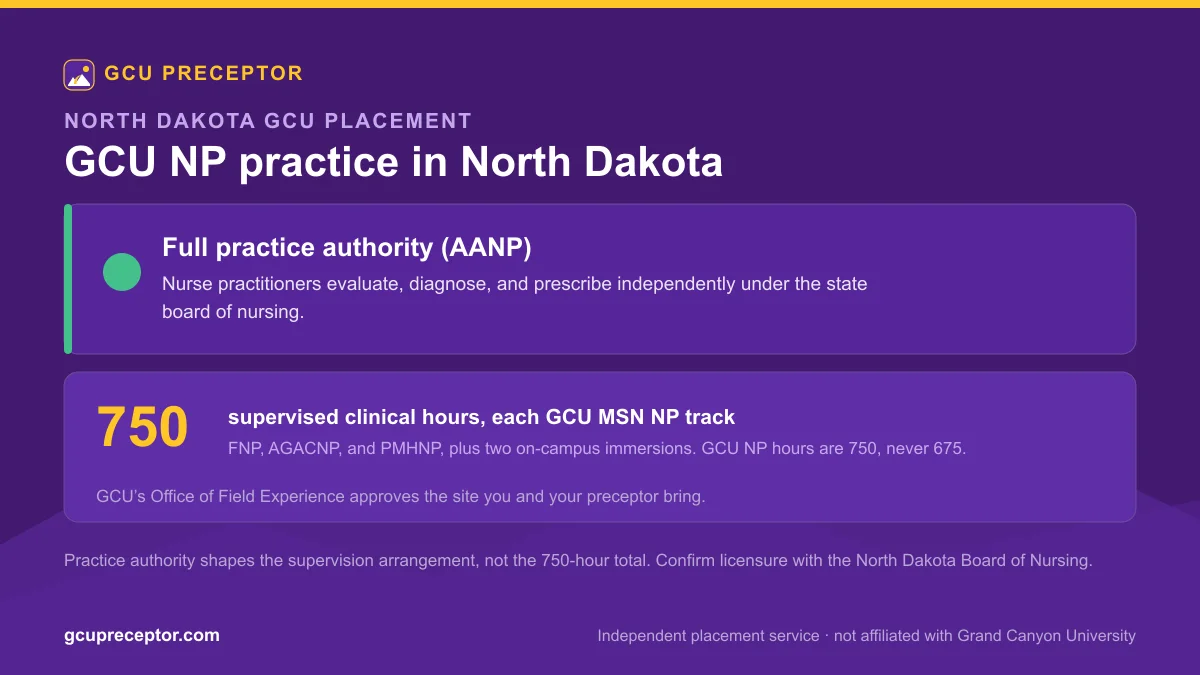
AANP places North Dakota in its full practice category. State licensure law lets NPs evaluate patients, diagnose, order and interpret diagnostic tests, and initiate and manage treatment, including prescribing controlled substances, under the sole authority of the state board of nursing. There is no required collaborative agreement with a physician and no medical board oversight of NP licenses.
Day to day, that looks like NP-owned clinics in Fargo and Bismarck, nurse practitioners covering rural and critical access sites on their own in the western half of the state, and prescriptive authority granted directly by the board. For a student, the practical upside is a wider preceptor pool: an experienced NP practicing independently can agree to precept you without first asking a supervising physician to sign off, because no such supervisor exists.
The North Dakota Board of Nursing, in brief
The North Dakota Board of Nursing licenses RNs and APRNs statewide and follows the APRN Consensus Model: a graduate nursing degree in a defined role and population focus, national certification, and a separate board application for prescriptive authority.
For your clinical paperwork the board matters in one specific way: every preceptor you nominate must hold an active, unencumbered license. Check it through the board's public license lookup before you submit anything to GCU, because a lapsed or encumbered license discovered late can unwind weeks of scheduling.
Quick board pointers
- Official site: ndbon.org, the board's hub for APRN licensure and practice questions
- License verification runs through the board's online Nurse Portal lookup
- North Dakota participates in the Nurse Licensure Compact for RN licensure; ask the board directly about current APRN compact status
How placement works when you are a GCU student
GCU does not place you. You source your own preceptor, and the Office of Field Experience reviews and approves the site and preceptor you bring. The nomination goes in through the Field Experience Site Information Form in the eDocs app; once approved, you log hours in the Lopes Activity Tracker and your preceptor signs off on them in ThunderTime.
Approval is not automatic. Your preceptor has to match your track's population focus and meet GCU's preceptor requirements, and the site has to support your course objectives. Build review time into your calendar, especially if you change sites midprogram. Our find a preceptor guide walks through the whole sequence step by step.
Where the preceptors are in North Dakota
The state's clinical gravity sits in four anchors: Fargo, the largest city, with the deepest bench of family practice and behavioral health providers; Bismarck and Mandan in the center; Grand Forks in the northeast; and Minot in the north central region. Larger systems such as Sanford Health, Essentia Health, Altru, and Trinity Health concentrate the acute care settings that matter most if you are on the AGACNP track.
West of the Missouri River the map thins out fast. Williston and Dickinson serve wide rural catchments, and many towns rely on critical access hospitals and NP-led clinics. That is workable territory for FNP students, since rural primary care preceptors are often the most welcoming, but plan longer lead times. PMHNP students face the tightest market statewide; psychiatric preceptors are scarce outside Fargo and Bismarck, so start that search earliest of all.
750 hours, counted from the prairie
Every GCU MSN NP track, whether FNP, AGACNP, or PMHNP, requires 750 supervised clinical hours with specialty-matched preceptors, spread across your clinical courses. Two on-campus immersions in Phoenix are the only travel GCU requires; every other hour can be earned in North Dakota. Post-master's students follow the same sourcing path, including the 750-hour FNP certificate; see the post-master's certificate page.
DNP students complete practicum hours course by course, tied to the Direct Practice Improvement project and its IRB approval, and RN-to-BSN students complete a 40-hour practicum in NRS-465. The clinical hours guide breaks down pacing for each program.
Virtual visits, in-person hours, and your next step
Telehealth is a genuine part of care delivery in a state this rural, and some rotations may include virtual visits. Whether telehealth hours count toward a specific course varies, so confirm with your program and the OFE before you build a schedule around them. In-person remains the default assumption for most rotations.
If the search itself is the obstacle, that is the piece we take off your plate. We source and vet North Dakota preceptors matched to your GCU track, you are matched before you owe anything, and you pay only when a placement is secured. Start with a free placement review or the form on this page, then see how it works and what it costs.
Frequently asked questions
Does my North Dakota preceptor need a physician collaborator?
No. North Dakota grants nurse practitioners full practice authority, so an NP preceptor there practices under the Board of Nursing alone, with no collaborative agreement required. Your preceptor still has to meet GCU's specialty match and licensure requirements, which the OFE verifies when it approves your site.
Can I complete all my GCU clinical hours in North Dakota?
Yes. The 750 supervised hours for the FNP, AGACNP, and PMHNP tracks are completed at approved sites near you, anywhere from Grand Forks to Dickinson. The two required immersions happen on campus in Phoenix, which is why the NP programs are not 100% online.
How far ahead should I start looking for a preceptor here?
At least one semester, and earlier for psychiatric rotations or if you live west of Bismarck. Rural sites are willing but few, and OFE review of the eDocs site form takes time after you find someone. A free placement review will tell you quickly whether your timeline is realistic.
What does placement help cost for North Dakota students?
You are matched first and pay only once a placement is secured; full details are on the cost page. Placement is never guaranteed, by us or by GCU, but you owe nothing unless it happens.
Get your GCU clinicals handled.
Tell us your track and term. We’ll map your clinical requirement and start the search, in person or virtual. No payment until you’re matched.