North Carolina Preceptor Help for GCU Nursing Students
North Carolina is listed as a restricted practice state for nurse practitioners, and that shapes everything from who can precept you to how clinics say yes. This guide walks GCU students through the practice rules, the board, and the fastest route to an approved site anywhere from Asheville to Wilmington.
Get matched, free
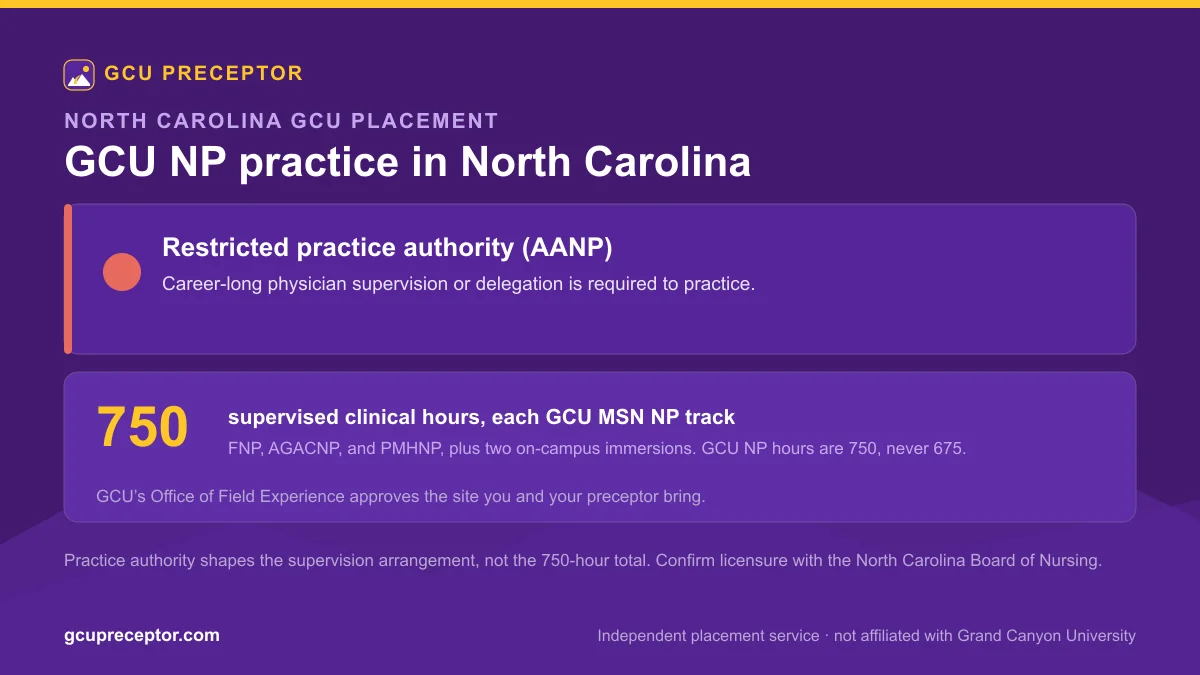
Restricted practice, in plain terms
The American Association of Nurse Practitioners classifies North Carolina as a restricted practice state, its most regulated category. A nurse practitioner here cannot simply hang a shingle after certification. Before seeing patients, an NP must obtain approval to practice and enter a collaborative practice agreement with a primary supervising physician licensed in the state.
Day to day, the agreement matters more than the label. It spells out which medications the NP may prescribe, how the supervising physician stays continuously available for consultation and referral, and how care gets evaluated. The document lives at each practice site and must be reviewed at least yearly, with both signatures dated. A back-up supervising physician can be named to cover absences.
For a GCU student, none of this limits your training directly. Students learn under preceptor supervision regardless of the state's practice model. What it does change is the preceptor pool: every NP preceptor you approach in North Carolina practices under a physician agreement, so their decision to take a student is often a conversation involving the wider practice, not just one clinician.
Two boards share the file in North Carolina
North Carolina regulates nurse practitioners jointly. The North Carolina Board of Nursing and the North Carolina Medical Board together approve NPs to practice, an arrangement few states use. The Board of Nursing handles RN licensure, NP approval records, and discipline on the nursing side, while the medical board registers the supervising physicians those NPs work with.
Two practical takeaways for students. First, North Carolina belongs to the Nurse Licensure Compact at the RN level, but NP approval to practice is state specific, so a prospective NP preceptor should hold current North Carolina approval, which you can verify through the North Carolina Board of Nursing](https://www.ncbon.com/nurse-practitioner). Second, physician preceptors are verified through the medical board instead. Checking credentials before you submit paperwork saves weeks, and our [preceptor requirements page lists what GCU expects a preceptor to show.
Where GCU students actually find preceptors here
The Research Triangle, meaning Raleigh, Durham, and Chapel Hill, is thick with academic health systems and their own cohorts of NP students, so preceptors there field constant requests. Charlotte, the state's largest metro, offers a broad mix of health system clinics and independent practices. The Triad cities of Greensboro, Winston-Salem, and High Point sit somewhere in between.
The overlooked opportunity is rural North Carolina. Much of the east from Rocky Mount toward the coast, and the mountain counties around Asheville and Boone, are shortage areas where family practices, community health centers, and behavioral health clinics genuinely need extra hands and often welcome students. FNP students tend to land in family medicine, urgent care, and community clinics; PMHNP students in outpatient psychiatry and counseling practices; AGACNP students need hospital and acute care settings, which concentrates them in the metros.
The GCU approval path, step by step
GCU does not place students. You source your own preceptor, and the Office of Field Experience supports the search and approves the site you bring. The sequence is consistent: identify a willing preceptor, nominate the site and preceptor through the Field Experience Site Information Form in the eDocs app, then wait for OFE approval before logging a single hour. Our overview of how OFE works covers the details.
Once approved, you log hours in the Lopes Activity Tracker and your preceptor confirms them in ThunderTime. Keep both current from week one; clean records make progress reviews painless and protect you if a site changes mid course.
Planning 750 hours from North Carolina
Each of GCU's three MSN NP tracks, FNP, AGACNP, and PMHNP, requires 750 supervised clinical hours with specialty-matched preceptors, spread across multiple courses. Those hours happen in your own community, whether that is a Fayetteville family practice or a Wilmington psychiatric clinic. The programs also include two on-campus immersions in Phoenix, so they are not 100% online; students flying out of Raleigh-Durham or Charlotte should budget for those trips early.
Other GCU programs carry their own field requirements. The post-master's FNP certificate also runs 750 hours, the DNP practicum builds hours course by course around the Direct Practice Improvement project, and the RN-to-BSN practicum is a 40 hour applied evidence-based practice project. Our clinical hours guide shows how the totals map onto courses.
Telehealth hours and a word on timing
Telehealth is well established in North Carolina, especially in psychiatry and in rural counties, so some rotations may include virtual visits. Whether telehealth hours count toward your requirement varies by program and course. Confirm with your GCU program and OFE before building a schedule around them; in-person hours remain the safest planning assumption.
If you are staring down a start date without a confirmed site, ask for a free placement review. We match you with a vetted North Carolina preceptor first, you pay only when the placement is secured, and OFE keeps final approval of every site, exactly as it should. Pricing details live on our cost page.
Frequently asked questions
Is North Carolina a full practice state for nurse practitioners?
No. The AANP classifies North Carolina as restricted practice. NPs must hold approval to practice and maintain a collaborative practice agreement with a supervising physician, reviewed at least yearly. As a student this does not restrict your training, but it does shape how practices decide to host students.
Who approves my North Carolina clinical site, the state or GCU?
GCU. The state boards govern licensure of practicing clinicians, not student placements. Your site and preceptor are nominated through the Field Experience Site Information Form in eDocs and approved by the Office of Field Experience. Confirm your preceptor holds current, verifiable licensure and meets the criteria on our preceptor requirements page before submitting.
Can I count telehealth hours toward my GCU requirement in North Carolina?
Sometimes. Telehealth acceptability varies by program and course, so confirm with your program and OFE before you rely on virtual visits for required hours. Treat in-person hours as the default when you plan.
Do you guarantee a placement or GCU approval?
No, and no honest service can. We match you with a specialty-matched preceptor first and you pay only when the placement is secured, but OFE always makes the final call on approving a site. Read how it works for the full process.
Get your GCU clinicals handled.
Tell us your track and term. We’ll map your clinical requirement and start the search, in person or virtual. No payment until you’re matched.