Finding a GCU Nursing Preceptor in New York
New York is a full practice state for nurse practitioners, with an experience-based transition before a newly licensed NP may practice without a written physician agreement. For GCU students, that distinction shapes the provider market, while site approval and supervised training remain required.
Get matched, free
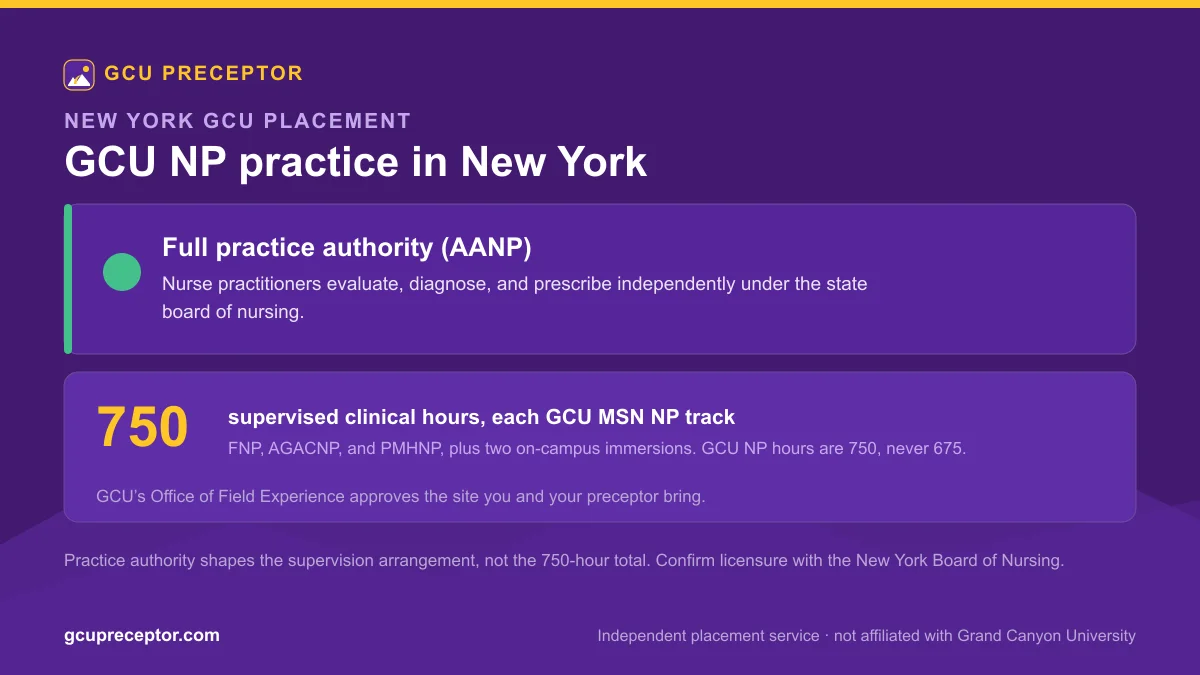
New York is full practice, with a transition for newer NPs
The American Association of Nurse Practitioners classifies New York as a full practice state. An experienced New York NP may diagnose illness, order and interpret tests, treat patients, and prescribe within the specialty area on the NP certificate without physician supervision. The state holds NPs independently responsible for their clinical decisions rather than placing their work under a physician's license.
New York applies an important experience rule at the beginning of practice. The New York State Education Department says an NP must use written practice protocols and a written collaborative practice agreement with a qualified physician until the NP has completed 3,600 hours of licensed or certified NP experience. After more than 3,600 hours, the agreement and protocols are no longer required. Consultation and referral still remain part of sound care when a patient's needs call for another professional.
That graduated structure explains what students may see day to day. One preceptor may be early in practice and working under a formal agreement, while another may manage an independent panel or own a clinic. Both can provide meaningful instruction if the provider's specialty, active credentials, and planned patient encounters meet the course requirements. Full practice authority never removes student supervision. You are practicing under an approved preceptor until you graduate, become certified, and obtain state credentials of your own.
The New York regulator and the checks to make first
Nursing is regulated through the New York State Education Department Office of the Professions, with the State Board for Nursing advising the Board of Regents. New York uses the title nurse practitioner certification and registers NPs in named specialty areas, including family health, acute care, and psychiatry. An NP must also maintain New York RN licensure and current registration to practice.
Before putting a name on GCU paperwork, check the Office of the Professions online verification system. Confirm the provider's registration is current and that the certified specialty aligns with your rotation. For a physician or another licensed clinician, verify that professional credential through the same official system. A provider can be highly qualified yet still be the wrong population or specialty match for a particular course.
The regulator's practice pages are also the best place to confirm whether a prospective NP is still subject to the written agreement requirement. Do not ask a clinic to interpret rules from a student forum. Licensure details can change, and the official record and current New York guidance should control your screening. GCU's preceptor requirements add a separate academic review to the state licensing check.
Building a placement search from the city outward
GCU students source their own preceptor. The Office of Field Experience supports the field experience and decides whether the student-selected site and provider are acceptable, but OFE does not conduct the search. You nominate the candidate through the Field Experience Site Information Form in the eDocs app. Wait for approval before beginning hours, even if the clinic has already welcomed you.
New York City offers the widest selection of primary care, behavioral health, specialty, and hospital services, but Manhattan is only one market. Brooklyn, Queens, the Bronx, and Staten Island each have community practices and outpatient networks with distinct patient populations. Long Island students can work through Nassau and Suffolk County practices. In the Hudson Valley, look around White Plains, Yonkers, Poughkeepsie, and Middletown rather than relying on one hospital system.
Upstate searches benefit from a regional approach. Albany and the Capital Region support family and specialty practices, while Syracuse, Rochester, and Buffalo have both academic systems and independent clinics. Binghamton, Utica, Watertown, and Plattsburgh may have fewer providers, but they also receive fewer requests than the largest metros. Large organizations often require affiliation review, employee health clearance, or their own onboarding. Smaller practices may decide faster, although OFE approval is still mandatory.
Once a rotation begins, you enter hours in the Lopes Activity Tracker, or LAT. The preceptor reviews and approves those hours in ThunderTime. Explain that workflow during the first conversation so a willing provider understands the small but recurring administrative role.
Planning 750 hours while living in New York
Each GCU MSN nurse practitioner track requires 750 supervised clinical hours. The FNP track needs experiences that support family care across the lifespan. AGACNP students need acute and complex adult-gerontology care, which makes hospital and specialty access especially important. PMHNP students need psychiatric assessment and treatment experiences with an appropriately matched clinician.
Do not treat 750 as one interchangeable block. Courses may require particular populations, settings, or skills, so a primary care match that works for one term may not satisfy the next. Review the course need before accepting a provider, leave time for eDocs review, and keep each approved schedule visible in LAT. Students in a post-master's certificate follow their certificate plan, including the 750-hour FNP certificate.
GCU's NP tracks also include two on-campus immersions in Phoenix. Those trips are the on-campus component, so the programs are not 100% online. New York students should protect those dates before committing to clinic shifts and account for travel from their nearest airport. The clinical placements can stay in New York when the sites and preceptors satisfy the program and OFE.
Other GCU nursing pathways use different structures. The DNP practicum connects course-specific hours with a Direct Practice Improvement project and IRB process, without one universal published hour total. The RN-to-BSN practicum is the 40-hour NRS-465 Applied EBP Project and Practicum.
Virtual visits and a practical next step
Telehealth is common across New York, particularly in behavioral health and for patients who live far from a specialty center. A virtual encounter is not automatically an approved clinical hour. Acceptability varies by program, course, patient activity, and site arrangement. Ask your program and OFE before committing to a virtual or hybrid rotation, and expect some skills and assessments to require in-person participation.
If the search is consuming the time you need for class, our independent service can contact and screen New York providers for you. We work independently of GCU, cannot guarantee a placement or OFE approval, and structure every proposed match for university review. You are matched first and pay only when a placement is secured. Request a free placement review with your track, location, and deadline, and we will identify a realistic search radius before outreach begins.
Frequently asked questions
Is New York a full practice authority state for nurse practitioners?
Yes. AANP lists New York as full practice. New York still requires written practice protocols and a collaborative physician agreement for NPs with 3,600 or fewer hours of licensed or certified NP experience. After more than 3,600 hours, the NP may practice without that agreement.
Does GCU assign New York preceptors?
No. The student finds the preceptor and site. GCU's Office of Field Experience reviews what the student submits through the Field Experience Site Information Form in eDocs and must approve the arrangement before clinical hours begin.
Can I complete GCU NP clinical hours in New York?
You can complete supervised clinical hours at approved New York sites when the preceptor, specialty, population, and setting meet your course requirements. The two required on-campus immersions take place in Phoenix and require separate travel.
How are my New York clinical hours documented?
You record each approved clinical experience in the Lopes Activity Tracker. Your preceptor uses ThunderTime to review and approve the hours. Resolve any access or approval issue early so your record stays current throughout the course.
Get your GCU clinicals handled.
Tell us your track and term. We’ll map your clinical requirement and start the search, in person or virtual. No payment until you’re matched.