New Mexico Clinical Preceptors for GCU Nursing Students
New Mexico is a full practice authority state where nurse practitioners work under Board of Nursing licensure without a required physician contract. The bigger challenge for a GCU student is geographic: matching the right specialty and patient population across a large, often rural state.
Get matched, free
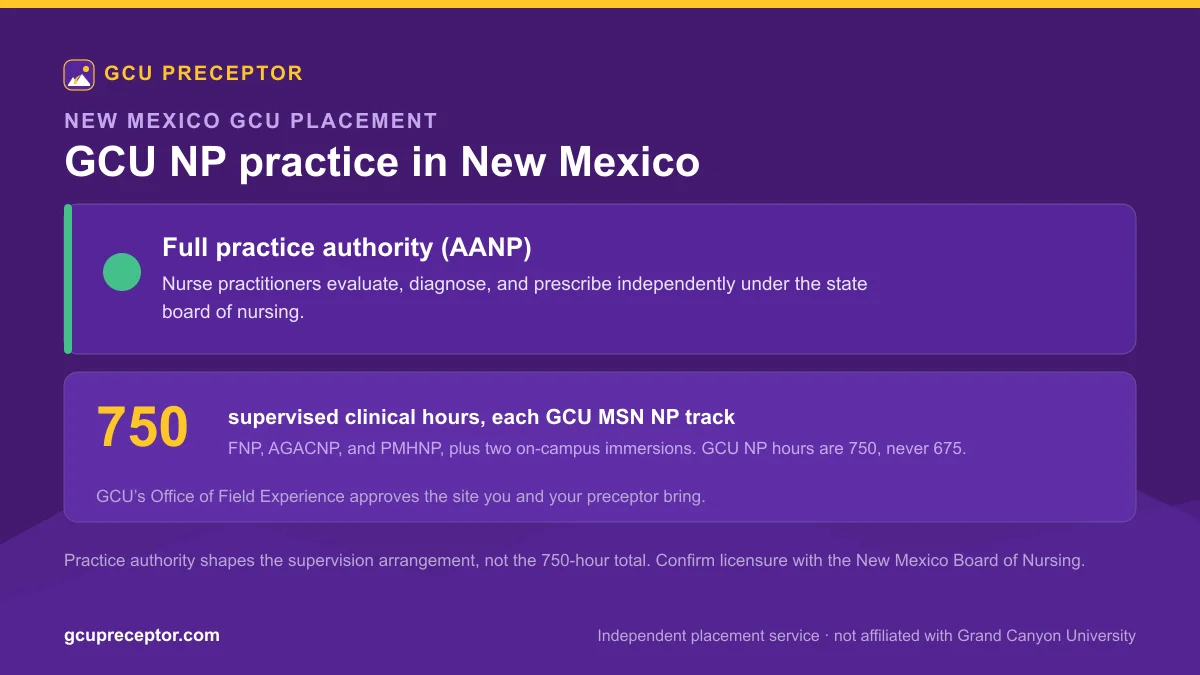
New Mexico gives NPs full practice authority
The American Association of Nurse Practitioners classifies New Mexico as a full practice state. In this model, nurse practitioners may evaluate patients, diagnose, order and interpret diagnostic tests, initiate and manage treatments, and prescribe under the exclusive licensure authority of the state nursing board. A career-long physician supervision or collaboration contract is not a condition of NP practice.
That independence is compatible with team care. New Mexico NPs consult physicians, pharmacists, therapists, social workers, and other professionals when a patient's needs call for their expertise. The difference is that consultation is a clinical judgment and professional responsibility, not a standing contract that controls the NP license.
For GCU students, full practice authority can create opportunities in NP-led primary care, community clinics, behavioral health practices, specialty offices, and health system services. It does not make every NP an eligible preceptor for every course. Certification, population focus, current practice, supervision capacity, and the approved learning activities must match the rotation.
Start with the New Mexico Board of Nursing
The New Mexico Board of Nursing licenses certified nurse practitioners and provides separate application resources for APRN CNPs and prescriptive authority. Its official site links to the nurse portal, laws and rules, Board documents, and license or certification verification. That verification portal is the appropriate place to confirm that a proposed preceptor's credential is current.
Read the license record together with the clinician's national certification and actual practice. A CNP who is properly licensed for one population focus may not see the patients or conditions required for another track. Ask about the weekly panel, common visit types, student supervision, and whether the site can complete GCU field-experience requirements. State licensure establishes authority to practice; OFE decides whether the site and preceptor fit the academic course.
The Board publishes the rules and maintains authority over nursing scope and discipline. Use those official materials for questions about New Mexico practice or prescriptive authority. A practice manager can explain local operations, but should not be the only source for interpreting a clinician's license.
Distance changes how the New Mexico search should work
Albuquerque has the state's largest concentration of hospitals, outpatient groups, specialty care, and psychiatric services. Rio Rancho adds a nearby market, while Santa Fe supports state government, community, independent, and health system practices. These cities offer range, but they also receive repeated requests from local and online students. A search works better when it includes both large organizations and smaller offices instead of depending on a single hospital education department.
Las Cruces anchors southern New Mexico, Roswell and Hobbs serve southeast communities, Farmington supports the Four Corners area, and Clovis covers the eastern side of the state. Gallup and smaller communities can offer important rural and cross-cultural care experiences, but student capacity may be limited and travel distances can be substantial. Check road time, weather, shift start times, and lodging needs before agreeing to a distant site.
GCU expects each student to source a preceptor. The Office of Field Experience supports and approves the site selected by the student, but it does not conduct the search. The Field Experience Site Information Form in the eDocs app is used to nominate the clinician and site. OFE reviews the submission under the course and GCU's preceptor requirements. We can perform targeted sourcing across New Mexico, but GCU retains the final approval decision.
Build a realistic New Mexico plan for 750 hours
Each GCU MSN NP track requires 750 supervised clinical hours with specialty-matched preceptors. The FNP track needs primary care across the lifespan, the AGACNP track requires adult and older adult acute or complex care, and the PMHNP track requires psychiatric mental health experiences. A rural family practice may provide excellent breadth for FNP work, while an AGACNP rotation usually calls for a site with the appropriate acuity and population.
New Mexico students are closer to Phoenix than many GCU students, but travel is still required. Each MSN NP track includes two on-campus immersions in Phoenix, so the programs are not 100% online. Keep the immersion dates separate from the 750 clinical-hour schedule and communicate any planned absence to a preceptor before the rotation calendar is set.
At approved sites, students record their hours in the Lopes Activity Tracker, called LAT, and preceptors approve the entries in ThunderTime. In a busy rural clinic, a regular review schedule can prevent approval work from accumulating at the end of the term. Program totals outside the MSN tracks differ: the post-master's FNP certificate includes 750 hours, DNP students complete per-course practice hours tied to the Direct Practice Improvement project and IRB, and RN-to-BSN students complete 40 hours in the NRS-465 practicum.
Virtual care can help, but confirm academic acceptance
Telehealth can connect New Mexico patients with psychiatric, specialty, and follow-up care when travel is difficult. It may also appear naturally during a rotation. Whether a virtual encounter counts toward a specific GCU requirement depends on the program, course, supervision model, and OFE's site review. Confirm acceptability before relying on remote hours, and preserve in-person experience when the course calls for direct physical assessment or hands-on care.
If geography or a limited specialty pool has stalled your search, send your details for a free placement review. We will consider your track, course, dates, home region, and workable travel radius, then source a match for OFE review. Our service is independent of GCU. We never guarantee placement or GCU approval, and you pay only after a placement is secured.
Frequently asked questions
Do New Mexico nurse practitioners need a collaborating physician?
No career-long physician collaboration contract is required for NP practice. AANP lists New Mexico as full practice, with NP practice under Board of Nursing authority. NPs still consult or refer to other clinicians whenever patient needs and professional judgment call for it.
Can a rural New Mexico CNP precept my GCU rotation?
Potentially. Rural location does not disqualify a site. The clinician's license, national certification, patient population, supervision capacity, and available experiences must fit the course, and OFE must approve the eDocs nomination before the student starts hours.
How are my New Mexico clinical hours documented?
After OFE approves the site and the rotation begins, you log hours in LAT and your preceptor reviews and approves them in ThunderTime. Enter time consistently and address discrepancies during the term rather than waiting until the final week.
Do New Mexico students have to attend the Phoenix immersions?
Yes. GCU's MSN FNP, AGACNP, and PMHNP tracks each include two on-campus immersions in Phoenix in addition to 750 supervised clinical hours. Living in New Mexico does not remove the campus requirement.
Get your GCU clinicals handled.
Tell us your track and term. We’ll map your clinical requirement and start the search, in person or virtual. No payment until you’re matched.