GCU Nursing Preceptors and Clinical Sites in New Jersey
AANP classifies New Jersey as a reduced practice state, while a 2026 law allows certain experienced APNs to prescribe independently if they meet its requirements. That changing framework makes current Board verification especially important when a GCU student evaluates a potential preceptor.
Get matched, free
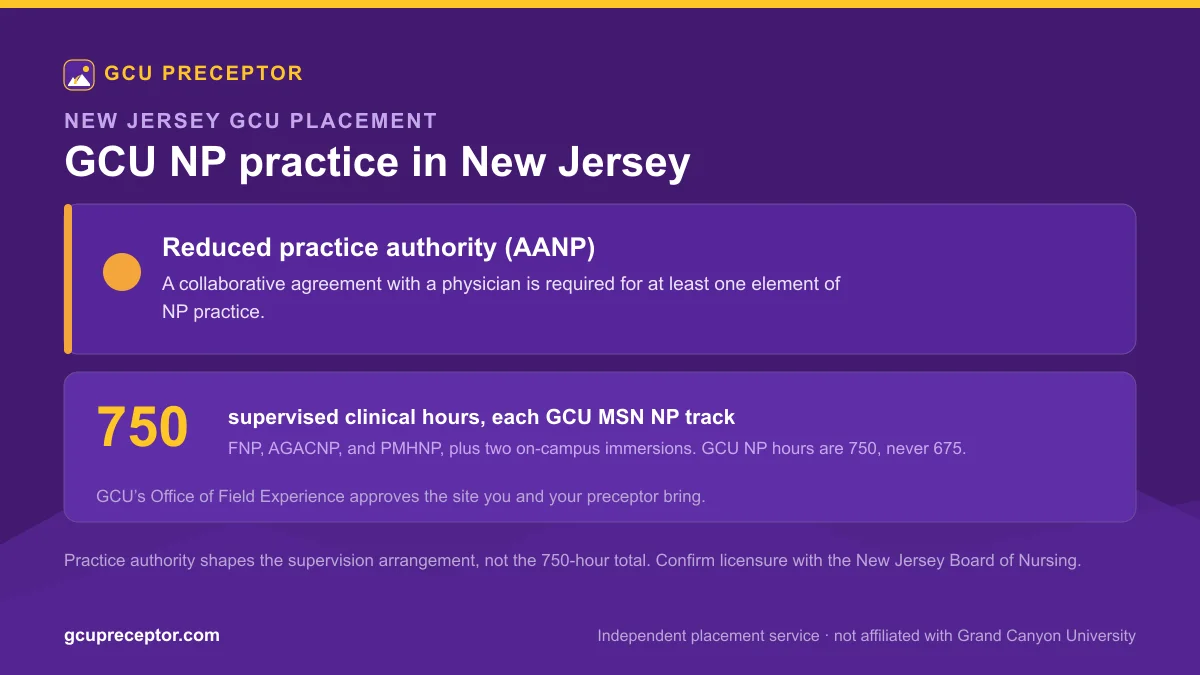
New Jersey remains reduced practice under the AANP category
The American Association of Nurse Practitioners lists New Jersey as a reduced practice state. Historically, the state's advanced practice nurses needed a joint protocol with a New Jersey physician before prescribing medication or devices. New Jersey changed part of that structure in 2026, so older summaries that describe one rule for every APN are no longer enough.
According to the New Jersey Board of Nursing's alert, a law effective April 2, 2026 allows certain experienced APNs in specified population focuses to order and prescribe without a joint protocol when they satisfy the law's independent practice requirements. APNs who do not qualify remain subject to the applicable collaborative framework. Because eligibility is clinician specific, a student should not label every New Jersey NP independent or assume every NP needs the same agreement.
The day-to-day clinical lesson is straightforward: use the clinician's current status and practice arrangement, not an outdated blog post. Independent eligibility affects how the APN is authorized to practice, but it does not decide whether the clinician may supervise a particular GCU rotation. National certification, patient population, specialty, setting, and OFE approval still control the placement fit.
The New Jersey Board of Nursing is the current source
New Jersey uses the title advanced practice nurse, or APN, for nurse practitioners and certain other advanced nursing roles. The Board of Nursing certifies APNs, regulates nursing practice, publishes applications and rules, and provides license status resources. Its APN materials address education, national examination, RN licensure, prescribing, and state certification.
Check the proposed preceptor's active RN license and APN certification through the state system. Then ask the clinician or practice to clarify whether current prescribing authority rests on independent practice eligibility or a joint protocol. Students do not need to interpret the legal documents themselves, but knowing which structure applies prevents an inaccurate site description in eDocs. For questions about the new law or the clinician's authority, rely on the Board's current alerts and instructions.
A license check is only the first filter. Confirm what the clinician actually does, which ages and conditions the practice sees, and whether the site permits students to take part in relevant care. OFE, not the New Jersey Board, determines whether that practical experience meets GCU's course requirements.
A dense state still requires a wide search
Newark, Jersey City, Paterson, and the communities facing New York City contain many health systems, clinics, and behavioral health programs. They also draw placement requests from nursing schools across the region. Expanding through Bergen, Essex, Hudson, Passaic, Union, and Middlesex counties can produce more options than searching by one city name, but commute time and bridge or tunnel traffic should be considered before accepting a schedule.
Central New Jersey offers practices around New Brunswick, Edison, Woodbridge, Princeton, and Trenton. Farther south, Camden, Cherry Hill, Vineland, and Atlantic City anchor different clinical networks, while shore communities have seasonal patient patterns that may affect a rotation. The state is geographically compact, yet a site that looks close on a map can be impractical at peak travel times. Confirm shift hours and travel before the nomination reaches OFE.
GCU requires the student to source a preceptor. The Office of Field Experience helps manage and approve the field experience, but it does not perform the search. When a clinician agrees, the student nominates the preceptor and site through the Field Experience Site Information Form in the eDocs app. OFE reviews that submission under the course and GCU's preceptor requirements. Our independent service can run the outreach, while the student still follows eDocs and OFE remains responsible for approval.
Keep the 750 hours tied to the right population
GCU's MSN FNP, AGACNP, and PMHNP tracks each require 750 supervised clinical hours. Those totals must be built through experiences appropriate to the track and course. A family practice office may be well suited to FNP primary care but not to adult acute care. A psychiatric practice may fit PMHNP work but cannot substitute for a different population focus simply because an APN leads the site.
The MSN NP tracks also require two on-campus immersions in Phoenix. For a New Jersey student, those trips need advance planning for flights, local arrangements, and time away from a clinical site. The immersion requirement is why the tracks are not 100% online, even though coursework and approved placements can be completed while the student lives in New Jersey.
Students log approved clinical time in the Lopes Activity Tracker, or LAT, and preceptors approve the entries in ThunderTime. Agree on a review rhythm before the term gets busy. Students in other pathways should use their own requirements: the FNP post-master's certificate includes 750 hours, DNP students record per-course hours connected to the Direct Practice Improvement project and IRB, and NRS-465 requires 40 practicum hours for RN-to-BSN students.
Ask before relying on telehealth
Telehealth appears in many New Jersey primary care, specialty, and behavioral health practices. State authority to provide a virtual visit and GCU permission to count that encounter are separate questions. Confirm with the program and OFE whether the specific course allows virtual participation and how supervision must occur. Keep an in-person plan for outcomes that depend on physical examination, direct procedures, or an acute care environment.
If repeated outreach has not produced a suitable New Jersey option, request a free placement review. We will assess your specialty, course dates, location, travel limits, and schedule, then source a match for OFE consideration. We work independently of GCU, do not guarantee placement or GCU approval, and collect payment only when a placement is secured.
Frequently asked questions
Is New Jersey full practice after the 2026 APN law?
AANP currently categorizes New Jersey as reduced practice. The 2026 law creates independent prescribing eligibility for certain experienced APNs in specified population focuses, but it does not place every APN under one independent model. Check current Board guidance and the individual clinician's status.
Must my New Jersey preceptor have a joint protocol?
It depends on the clinician's eligibility under the current 2026 law. Certain qualifying APNs may order and prescribe without a joint protocol, while other APNs remain under applicable collaboration requirements. The New Jersey Board of Nursing is the proper source for a specific clinician's situation.
How does a New Jersey site reach GCU for approval?
The student enters the preceptor and site through the Field Experience Site Information Form in the eDocs app. GCU's Office of Field Experience reviews the nomination. Students should not start counting hours until the university has completed the required approval.
Can I use one New Jersey site for several NP courses?
Possibly, if the preceptors, patient populations, services, and dates fit each course and OFE approves each required experience. Do not assume that a site approved once automatically satisfies later rotations with different specialty or population requirements.
Get your GCU clinicals handled.
Tell us your track and term. We’ll map your clinical requirement and start the search, in person or virtual. No payment until you’re matched.