Clinical Placement in New Hampshire for GCU Nurse Practitioner Students
New Hampshire is a full practice authority state, which makes it one of the friendlier corners of New England for a GCU nurse practitioner student to complete clinical hours. Here is how practice law, the Board of Nursing, and preceptor sourcing fit together for students from Manchester to the North Country.
Get matched, free
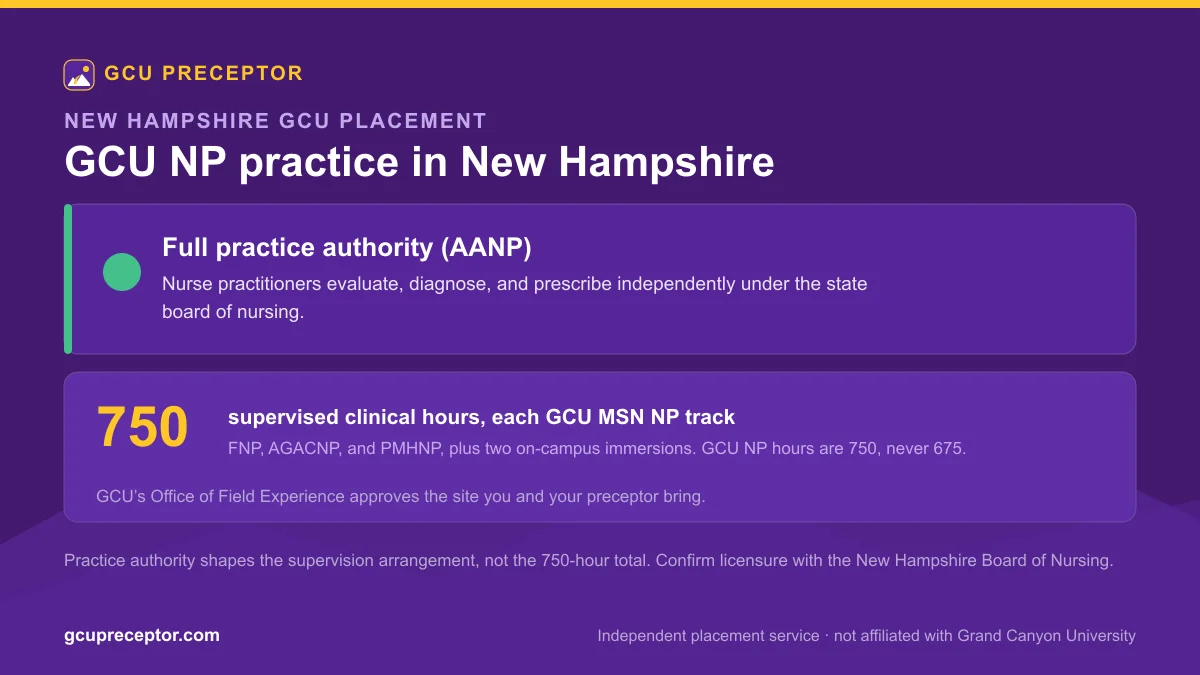
New Hampshire is a full practice state, and it shows in daily work
The American Association of Nurse Practitioners lists New Hampshire as a full practice state. Licensed NPs here evaluate patients, diagnose, order and interpret tests, and start and manage treatment, including prescribing, under the sole authority of the state licensing board. There is no collaborative agreement to sign and no supervising physician to name on paperwork.
For a GCU student, that climate matters more than it first appears. Nurse practitioners in New Hampshire can own clinics, carry independent panels, and make the final call on patient care, which means an experienced NP in Nashua or Concord can precept you on the strength of their own license. The oversight you receive during rotations is educational, from your preceptor and from GCU faculty, not a physician sign-off required by state law. That independence tends to widen the pool of willing preceptors compared with restricted states.
Who regulates nursing here: the Board of Nursing within OPLC
The New Hampshire Board of Nursing operates inside the state's Office of Professional Licensure and Certification (OPLC), based in Concord. The board licenses RNs and APRNs, defines scope of practice under the state's Nurse Practice Act, and handles discipline and license verification. APRN applicants hold national certification in their population focus and apply through OPLC's online portal.
Before you nominate a preceptor, spend five minutes on verification. Look up the license through OPLC's public lookup, confirm it is active and unencumbered, and note the exact name on the license so your paperwork matches. GCU's Office of Field Experience verifies credentials when you submit the Field Experience Site Information Form in eDocs, and clean paperwork on the first pass is the easiest way to protect your start date.
Quick verification checklist
- Active New Hampshire APRN or physician license, confirmed through the OPLC lookup
- National certification matching your track, for example FNP for FNP students
- A practice site with the visit volume your clinical course requires
- Willingness to approve hours in ThunderTime as you log them in the Lopes Activity Tracker
Where placements actually happen across the Granite State
Most of New Hampshire's population sits in the southern tier, so Manchester, Nashua, Derry, and Salem carry the densest concentration of family practices, urgent cares, and behavioral health clinics. Concord adds the capital's health infrastructure, and the Seacoast towns of Portsmouth, Dover, and Exeter support busy primary care and specialty groups. West and north, the Upper Valley around Lebanon and Hanover anchors academic-flavored medicine, while the Lakes Region, the Monadnock region around Keene, and North Country towns like Littleton and Berlin lean on community hospitals, rural health clinics, and community health centers.
That geography shapes strategy by specialty. FNP students usually match into family medicine, internal medicine, pediatrics, and women's health settings anywhere in the state. PMHNP students find strong options in community mental health centers and psychiatric practices, including telepsychiatry. AGACNP students generally need hospital settings, which concentrates searches in Manchester, Lebanon, Concord, and the Seacoast.
Here is the GCU reality: the university does not place you. You source your own preceptor, then the Office of Field Experience reviews and approves the site and preceptor you bring, nominated through the Field Experience Site Information Form in the eDocs app. Once approved, you log hours in the Lopes Activity Tracker and your preceptor signs off in ThunderTime. Our service takes over the sourcing step: we identify and contact qualified New Hampshire preceptors, confirm willingness and credentials, and hand you a match ready for OFE paperwork. You are matched first and pay only when a placement is secured. See how it works.
Meeting 750 hours from New Hampshire
Each of GCU's three MSN nurse practitioner tracks requires 750 supervised clinical hours with specialty-matched preceptors, spread across your clinical courses. Plan those hours against New Hampshire winters and commute times honestly; a preceptor 90 minutes away in good weather is farther than that in January. Splitting hours across two or three approved sites is common and can keep weekly logistics workable.
Remember the on-campus component. Every MSN NP student attends two immersion sessions in Phoenix, so the program is not 100% online, and Granite State students should budget for that travel early. Post-master's students have a parallel path, including a 750 hour FNP certificate, through the post-master's certificate options. DNP students complete the Direct Practice Improvement project with hours attached to each course rather than one published total, and RN-to-BSN students complete a 40 hour practicum through NRS-465. The full picture is on our clinical hours page.
Telehealth hours in a rural state
Telehealth is a practical fixture in northern and western New Hampshire, and some preceptors offer virtual visit experience, especially in psychiatric and primary care. Whether virtual hours count toward a given course is a program-level decision that varies by specialty and course objectives. Confirm with your GCU program and OFE before you count on any virtual arrangement, and treat telehealth as a supplement to an in-person site rather than a replacement.
If your search stalls, hand it off
Cold-calling clinics between shifts is where most placement timelines slip. If your messages have gone unanswered for a few weeks, request a free placement review and we will map realistic New Hampshire options for your track and timeline. We assist with sourcing and coordination; we never guarantee placement or GCU approval, and OFE always makes the final call on any site. Fees are simple and due only once your placement is secured; details are on the cost page.
Frequently asked questions
Does New Hampshire's full practice authority change GCU's preceptor requirements?
No. State law defines what your preceptor may do in practice, while GCU defines who may precept you. You still need a specialty-matched, appropriately licensed preceptor approved by the Office of Field Experience. Full practice authority simply means independent NPs, including practice owners, can serve without any physician arrangement. See preceptor requirements.
How do I verify a New Hampshire preceptor's license?
Use the public license lookup run by the Office of Professional Licensure and Certification, which houses the New Hampshire Board of Nursing. Confirm the license is active, note the exact legal name, and check certification in the right population focus before you file the eDocs site form.
Can I complete rotations in Massachusetts or Maine instead?
Sometimes. GCU students near the border do place across state lines, but every site is approved individually by OFE, and each state has its own practice rules and expectations for preceptors. Tell us where you can realistically commute and we will search on both sides of the line.
Do New Hampshire students still travel to Phoenix?
Yes. All three MSN NP tracks include two on-campus immersions in Phoenix in addition to the 750 clinical hours you complete in your own community.
How early should I start looking for a preceptor in New Hampshire?
Begin four to six months before your first clinical course. Southern New Hampshire has more sites but also more students competing from many programs; the North Country has fewer sites but often warmer responses. Starting early leaves room for OFE review and any paperwork fixes, and a free placement review is a fast first step.
Get your GCU clinicals handled.
Tell us your track and term. We’ll map your clinical requirement and start the search, in person or virtual. No payment until you’re matched.