Finding a Montana Preceptor as a GCU Nursing Student
Montana is a full practice authority state, and that shapes almost everything about NP training here, from who can precept you to what your career looks like after graduation. This page walks Grand Canyon University students across Montana through the licensure landscape, the Board of Nursing, and the practical work of lining up preceptors for your clinical hours.
Get matched, free
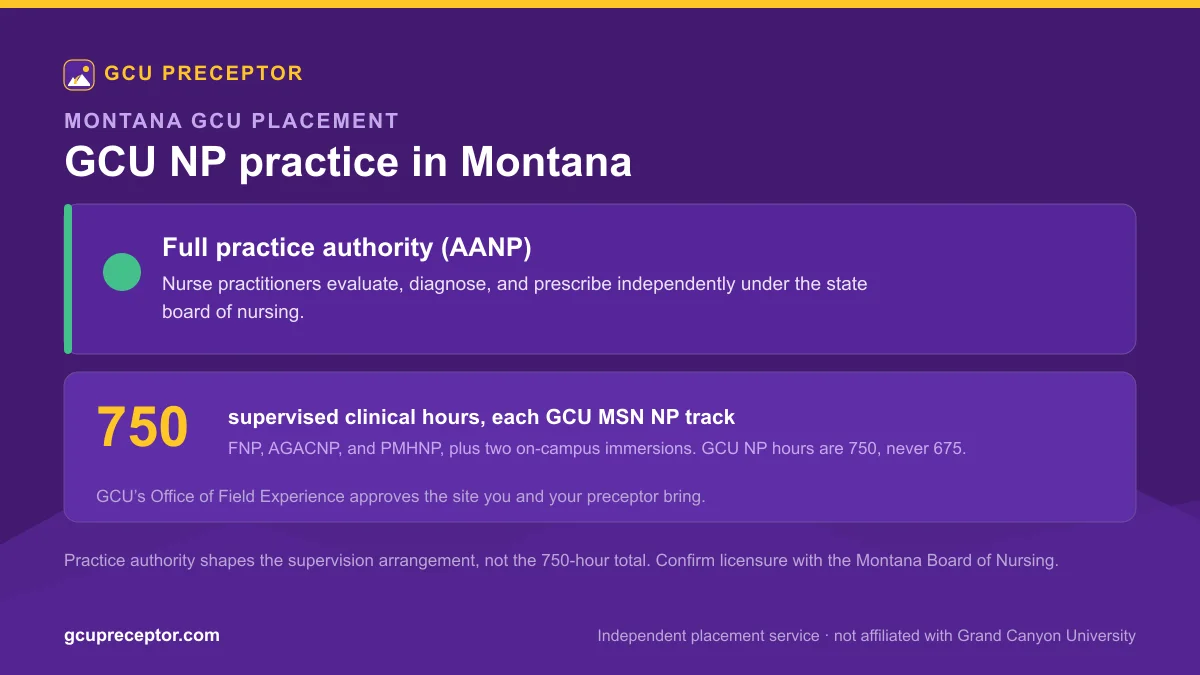
Montana NPs practice with full authority
The American Association of Nurse Practitioners classifies Montana as a full practice state. A licensed nurse practitioner in Montana can evaluate patients, diagnose, order and interpret diagnostic tests, and initiate and manage treatment, including prescribing, under the exclusive licensure authority of the Montana Board of Nursing. There is no required collaborative or supervisory agreement with a physician built into the license.
Day to day, that means a Montana NP can carry a patient panel in Billings, staff a rural clinic on the Hi-Line, or open an independent practice in the Flathead Valley without a physician co-signing charts. For a GCU student, it also means the NPs you approach about precepting tend to have wide scope and genuine decision-making authority, which makes for strong precepted learning.
One important distinction: full practice authority belongs to licensed NPs, not students. During your practicum you work under the supervision of your approved preceptor at a site the Office of Field Experience has signed off on, whatever the state allows licensed clinicians to do on their own.
What the Montana Board of Nursing handles
The Montana Board of Nursing sits within the state Department of Labor and Industry in Helena. It licenses RNs and APRNs, writes and enforces practice rules under the Montana Nurse Practice Act and its administrative rules, investigates complaints, and runs license verification. APRN applicants need an active RN license, graduate-level APRN education, and current national certification in their role and population focus, with applications handled through the state's online licensing portal and renewal on a two-year cycle.
The board's site is also a working tool during your preceptor search. Before you nominate anyone, look up the license of the NP or physician you hope to work with and confirm it is active and unencumbered. It is a two minute check that can save you weeks, because a preceptor whose license does not verify cleanly will not clear GCU review either.
The preceptor search in a frontier state
GCU does not place students. You source your own preceptor, and OFE approves the site and preceptor you bring forward. That gap between finding and approving is what this service exists to fill, and in Montana the finding part has a particular character: the state is enormous, and the provider pool is concentrated in a handful of population centers, chiefly Billings, Missoula, Great Falls, Bozeman, Helena, Butte, and Kalispell.
If you live in one of those cities, you have real options, but you are also competing with students from other nursing programs asking the same clinicians. If you live in a smaller community, somewhere like Havre, Lewistown, Glendive, or Miles City, the nearest specialty-matched preceptor may be an hour or more away, and your clinical schedule starts to revolve around drive time. Neither situation is a dead end. Both reward starting early and casting a wider net than feels comfortable.
A few patterns hold up well for Montana students searching on their own:
What tends to work in Montana
- Start with clinicians who already know you, including providers at your own workplace, before cold-contacting strangers.
- Ask community health centers and critical access hospitals; smaller organizations can be more open to students than large systems, though their onboarding may move slowly.
- Be flexible about geography. A willing, well-matched preceptor two towns over usually beats months of waiting for one in your zip code.
- Verify licenses and talk through GCU's preceptor requirements before you get attached to a candidate.
From handshake to approved hours: the GCU pipeline
Once a Montana clinician says yes, the GCU process takes over. You nominate the site and preceptor through the Field Experience Site Information Form in the eDocs app, and the Office of Field Experience reviews and approves the placement. From there, you log every clinical hour in the Lopes Activity Tracker, and your preceptor confirms those hours in ThunderTime. Keeping LAT current from day one matters, because unapproved or sloppily logged hours are a common source of end-of-course pain.
GCU's three MSN nurse practitioner tracks, FNP, AGACNP, and PMHNP, each require 750 supervised clinical hours with specialty-matched preceptors, plus two on-campus immersions in Phoenix. Your precepted hours happen at your approved Montana sites; the immersions are the travel part, so budget for two trips to Arizona. Post-master's certificates, including the 750-hour FNP certificate, follow the same student-sourced placement model.
The pattern extends across GCU's other practice programs. DNP students complete the Direct Practice Improvement project with IRB involvement, accruing hours course by course rather than against one published total, and RN-to-BSN students complete the NRS-465 Applied EBP Project and Practicum with 40 hours. GCU's nursing programs hold CCNE accreditation and the university is accredited by the Higher Learning Commission, which is part of why boards and employers accept these hours in the first place.
Telehealth hours in a long-distance state
Montana medicine runs on distance, and telehealth is a normal part of practice here. That does not automatically make virtual hours count toward your practicum. Whether a telehealth arrangement is acceptable depends on your specific program and course requirements, not on state law, so confirm with your program and OFE before you build a plan around a virtual preceptor. In-person hours remain the default expectation, especially for hands-on assessment skills, and a hybrid arrangement is often the realistic middle ground for rural students.
Getting matched in Montana
We run preceptor sourcing for GCU students across Montana, from Billings and Bozeman to Missoula, Great Falls, and the Flathead. You tell us your track, your course window, and how far you can travel; we do the outreach, vet licensure and specialty fit against what GCU requires, and hand you a preceptor ready for your eDocs nomination. The terms are simple: we match first, and you pay only when your placement is secured. Details are on the cost page and how it works.
If your clinical course is on the horizon and the search has stalled, request a free placement review or use the form on this page. We will tell you honestly what your options look like from where you live.
Frequently asked questions
Is Montana a full practice authority state for nurse practitioners?
Yes. AANP lists Montana as a full practice state, meaning licensed NPs evaluate, diagnose, order and interpret tests, and manage treatment, including prescriptions, under the licensure authority of the Montana Board of Nursing, with no mandatory physician collaboration agreement. As a student, you still train under an approved preceptor at an OFE-approved site.
Can I complete all of my GCU clinical hours in Montana?
Your precepted clinical hours are completed at approved sites in Montana, wherever OFE signs off. The two on-campus immersions for the MSN NP tracks are held in Phoenix, so those are the portions that require travel out of state.
Who approves my Montana preceptor, you or GCU?
Always GCU. You nominate the site and preceptor through the Field Experience Site Information Form in the eDocs app, and the Office of Field Experience reviews the nomination against program requirements. We source and vet candidates so your nomination goes in strong, but approval authority rests entirely with GCU.
How early should a Montana student start the preceptor search?
Earlier than feels necessary. Rural sites can be slow to onboard students, credentialing and site paperwork take time, and specialty matches such as PMHNP are thin outside the larger cities. Starting a full semester before your clinical course is a sensible floor, and starting earlier costs you nothing.
Do you guarantee placement or GCU approval?
No, and you should be wary of anyone who does. We match you with a specialty-appropriate, license-verified preceptor before you pay anything, and payment is due only when your placement is secured. Final approval of any site or preceptor always belongs to GCU's Office of Field Experience.
Get your GCU clinicals handled.
Tell us your track and term. We’ll map your clinical requirement and start the search, in person or virtual. No payment until you’re matched.