Finding a Missouri Preceptor for GCU Clinical Hours
Missouri is a restricted practice state, and nurse practitioners commonly deliver care through a formal collaborative practice arrangement with a physician. A GCU placement can work well in that environment when the preceptor, patient population, and site are checked early and submitted to OFE on time.
Get matched, free
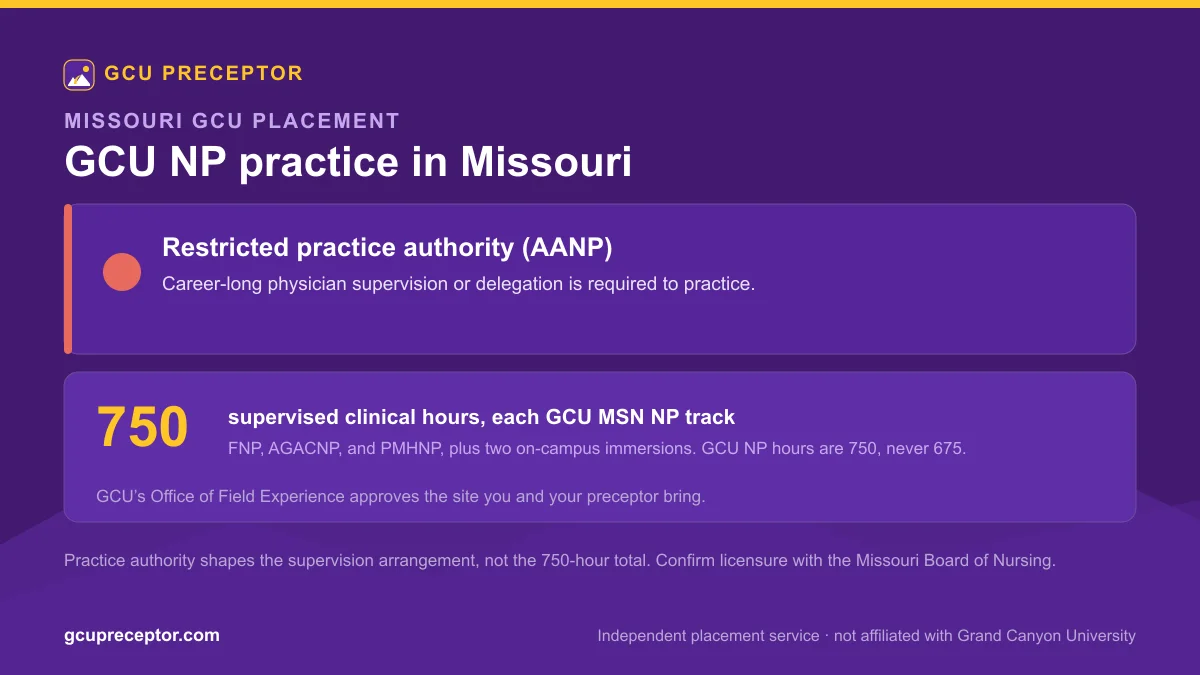
Missouri's restricted practice rules shape the site
The American Association of Nurse Practitioners categorizes Missouri as a restricted practice state. Under the AANP definition, state law restricts at least one element of NP practice and requires career-long supervision, delegation, or team management by another health provider. Missouri's Board of Nursing directs APRNs and employers to its collaborative practice materials for the state requirements.
In daily care, a collaborating physician does not necessarily stand in the room for each NP visit. The practice uses a documented relationship and agreed clinical structure, and the NP remains responsible for care delivered within nursing education, certification, and authorized scope. The precise arrangement depends on current state requirements and the practice. The Board's materials, rather than a clinic's informal description, should guide questions about legal compliance.
For a student, restricted practice does not prevent a strong learning experience. It means the proposed NP preceptor works inside a regulated practice structure that OFE may need to understand through the site documentation. It also makes early credential review useful. A willing NP with the wrong specialty or a site that cannot support the course is not a workable shortcut.
Use the Missouri State Board of Nursing as the reference point
The Missouri State Board of Nursing recognizes advanced practice registered nurses and publishes advanced practice information, applications and forms, recognized specialties, collaborative practice materials, controlled substance prescriptive authority guidance, and links for credential verification. These resources are housed within Missouri's Division of Professional Registration.
Start by checking the preceptor's current nursing license and APRN recognition. Then confirm national certification and compare the clinician's active patient population with the course. The Board record answers the state credential question; GCU answers the academic placement question. A hospital badge, website biography, or verbal assurance should not replace either review.
Practices may also set their own rules for students, documentation access, onboarding, and clinical activities. Those policies can be more limiting than the maximum work a licensed clinician may perform. Ask about them before building a term schedule, especially in hospital or health system placements with a separate education office.
Missouri searches work best as regional searches
St. Louis and Kansas City contain the broadest range of health systems, outpatient networks, psychiatric services, and specialty practices. They also receive requests from many local and distance nursing students. A metro search should include surrounding communities such as St. Charles, Florissant, Chesterfield, Independence, Lee's Summit, and Liberty when the commute is manageable. That wider circle can reach practices whose student calendars differ from the major systems.
Outside the two largest metros, Springfield is a major center for southwest Missouri, Columbia supports central Missouri, and Jefferson City adds public and private clinical networks. Joplin serves the southwest corner, while Cape Girardeau supports southeast Missouri and nearby rural communities. Smaller cities can offer continuity and a broad patient mix, but fewer clinicians may be available in a requested specialty. PMHNP and AGACNP students should search early because the qualifying settings are narrower than a general list of clinics suggests.
The student is responsible for sourcing a preceptor. The Office of Field Experience assists with the field-experience process and approves the site the student selects, but it does not locate a preceptor. The Field Experience Site Information Form in the eDocs app is used to nominate the site and clinician. OFE reviews the submission against the course and preceptor requirements. Our role is to carry out the sourcing and present a match; GCU remains the final approval authority.
Protect the 750-hour timeline across multiple terms
Each GCU MSN NP track requires 750 supervised clinical hours: FNP, AGACNP, and PMHNP. The number is consistent, but the patient populations and settings are track specific. An FNP student needs experiences across the lifespan in primary care. An AGACNP student needs acute and complex adult care. A PMHNP student needs psychiatric mental health practice. Plan each Missouri rotation as a piece of that specialty-specific sequence, not simply as hours on a calendar.
GCU also requires two on-campus immersions in Phoenix for each MSN NP track. Because of those campus visits, the programs are not 100% online. Missouri students should reserve the travel dates before finalizing clinical days, work shifts, or family responsibilities. An approved local site does not replace either immersion.
At the clinical site, students record time in the Lopes Activity Tracker, or LAT, and preceptors approve the records through ThunderTime. Discuss that responsibility with the preceptor at the start and enter hours consistently. For comparison, GCU's post-master's FNP certificate includes 750 hours; the DNP uses per-course practice hours connected with a Direct Practice Improvement project and IRB; and the RN-to-BSN NRS-465 practicum is 40 hours. Follow the requirements for your actual program rather than borrowing another student's schedule.
Confirm how virtual encounters fit
Missouri practices may use telehealth for psychiatric care, rural access, follow-up, and selected primary or specialty visits. Whether those encounters satisfy a GCU clinical requirement varies by program and course. Confirm the proposed format with the program and OFE, including how the preceptor will supervise the student. Do not assume that a state-permitted telehealth service will count academically, and retain enough in-person experience for course outcomes that require direct assessment.
If a restricted pool or approaching deadline has slowed your Missouri search, request a free placement review. We will look at your course, dates, region, and travel range before sourcing a match for OFE submission. We are independent from GCU and cannot guarantee placement or university approval. You pay only when a placement has been secured.
Frequently asked questions
Is Missouri a restricted practice state for NPs?
Yes. AANP lists Missouri as restricted practice. Missouri APRNs commonly practice through regulated collaborative arrangements, and the State Board of Nursing publishes the current advanced practice and collaborative practice materials. Check the Board rather than relying on a general national summary for operational details.
Can a Missouri physician precept a GCU NP student?
A physician may be eligible when the specialty, patient population, site, and course requirements align, but OFE decides whether the specific nomination qualifies. Review GCU's preceptor requirements and submit the clinician through the eDocs site process before beginning any hours.
Does GCU approve the Missouri site before I start?
Yes. The student submits the selected site and preceptor through the Field Experience Site Information Form in eDocs, and OFE reviews the nomination. Do not begin or count clinical time until GCU has provided the required approval.
Where can I verify a Missouri NP preceptor?
Use the Missouri State Board of Nursing resources within the Division of Professional Registration to verify nursing credentials and review advanced practice recognition. Also confirm national certification and current patient population, since a valid license alone does not prove course fit.
Get your GCU clinicals handled.
Tell us your track and term. We’ll map your clinical requirement and start the search, in person or virtual. No payment until you’re matched.