Preceptor and Clinical Placement Help for GCU Students in Mississippi
Grand Canyon University NP students in Mississippi complete the same 750 supervised clinical hours as their classmates everywhere else, but they do it inside one of the stricter practice environments in the country. Here is how reduced practice, the Mississippi Board of Nursing, and GCU's site-approval workflow fit together, and how we take the preceptor search off your plate.
Get matched, free
Mississippi is a reduced practice state
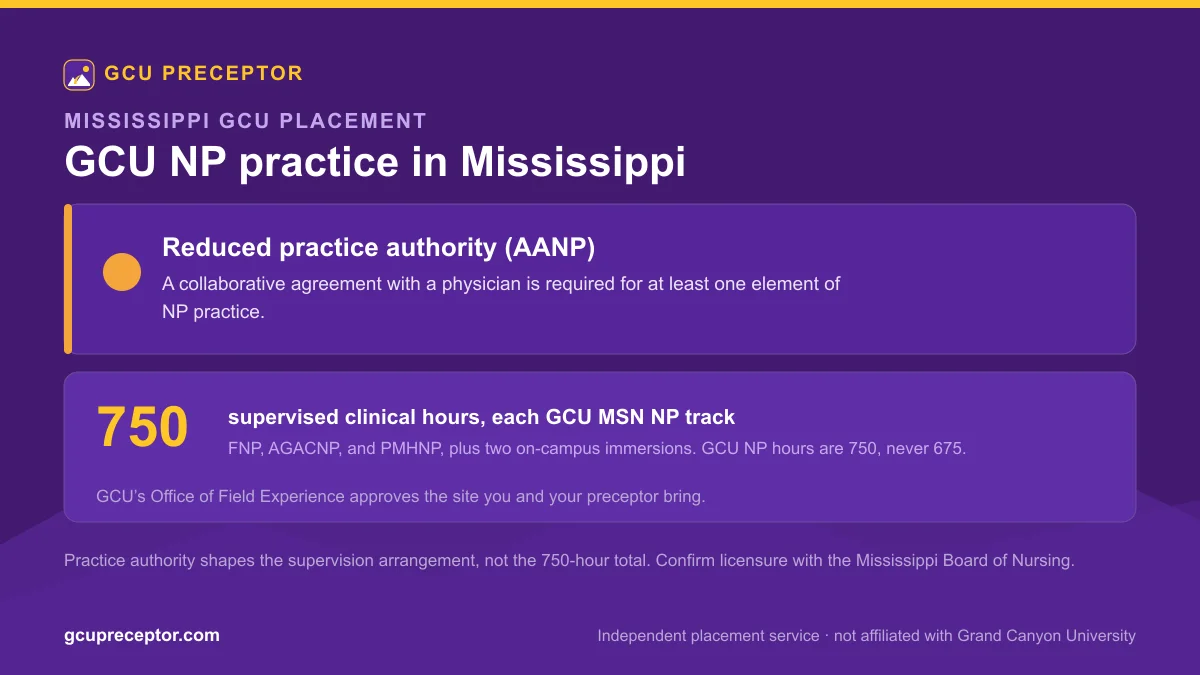
The short answer first: the American Association of Nurse Practitioners classifies Mississippi as a reduced practice state. Licensed nurse practitioners here must hold a collaborative agreement with a Mississippi-licensed physician for as long as they practice. There is no hour threshold after which the requirement falls away and no independent practice pathway under current state law.
Day to day, Mississippi NPs still assess patients, order and interpret tests, make diagnoses, and prescribe. The collaborative agreement sits behind that work: the physician's practice must be compatible with the NP's, the arrangement is documented before the NP begins seeing patients, and board rules call for ongoing quality review that includes a monthly look at a sample of the NP's charts. The exact mechanics live in the board's advanced practice rules, so read the current text rather than relying on summaries.
For a GCU student, this matters in a practical way. Because every practicing NP in Mississippi is tied to a collaborating physician, preceptor candidates tend to sit inside physician-anchored clinics, hospital systems, and group practices. That shapes who can say yes to a student, and it is one reason cold-emailing lone NPs in Mississippi returns fewer answers than students expect.
What the Mississippi Board of Nursing oversees
The Mississippi Board of Nursing licenses the state's RNs and APRNs, writes the administrative rules for advanced practice, and handles discipline. To practice as an NP in Mississippi you need RN licensure or multistate privilege, a graduate nursing education, national certification in your population focus, and APRN licensure from the board. You can hold the APRN license before you have a job, but you may not begin practice until your site, collaborating physician, and agreement are in place and approved.
Two student-relevant pointers. First, license verification: the board's site at msbn.ms.gov is the place to confirm that a prospective preceptor holds an active, unencumbered Mississippi license, and we run that check on every candidate we bring you. Second, if you plan to stay in Mississippi after graduation, the collaborative agreement requirement will apply to you, so a preceptorship inside a strong physician-connected practice doubles as a preview of your future working arrangement and a source of post-graduation contacts.
Finding a preceptor across Mississippi
GCU does not place you. You source your own preceptor, and the Office of Field Experience reviews and approves the site and preceptor you bring forward. The nomination happens through the Field Experience Site Information Form in the eDocs app; once approved, you log hours in the Lopes Activity Tracker and your preceptor signs off in ThunderTime. Our job is the hard middle step: we run the sourcing, you present the approved-ready preceptor to OFE.
Where the opportunities actually are: the Jackson metro carries the state's densest concentration of clinics and specialty practices, which helps PMHNP and acute care students in particular. The Gulf Coast corridor through Gulfport, Biloxi, and Ocean Springs supports steady family practice and behavioral health volume. Hattiesburg anchors the Pine Belt, Tupelo and Oxford serve the northeast, Meridian covers east central Mississippi, and Southaven sits in fast-growing DeSoto County just south of Memphis.
The Delta is the flip side. Communities like Greenville, Clarksdale, and Cleveland face well-documented clinician shortages, so preceptor supply is thin even though patient need is high. Students there often widen the search radius or mix nearby regions. If you are in a rural corner of the state, say so early; it changes the sourcing strategy, and it is exactly the situation where a dedicated placement search earns its keep.
The 750 hours, seen from Mississippi
Every GCU MSN nurse practitioner track requires 750 supervised clinical hours with specialty-matched preceptors: FNP hours across the lifespan in primary care settings, AGACNP hours with acutely ill adults and older adults, and PMHNP hours in psychiatric and behavioral health care. The post-master's certificates follow the same logic, including a 750-hour FNP certificate. DNP students accrue practicum hours course by course around the Direct Practice Improvement project, and RN-to-BSN students complete a 40-hour practicum in NRS-465.
Remember that GCU's NP programs are not 100% online: each MSN NP track includes two on-campus immersions in Phoenix. Mississippi students should budget travel for those early, then plan the clinical hours around local rotations. A workable pattern we see often: primary care hours near home in the Pine Belt or on the Coast, with a specialty rotation arranged in the Jackson metro where the site variety is greater.
Virtual visits and in-person hours
Telehealth is a real part of Mississippi practice, especially for behavioral health in rural counties, and some rotations include virtual visits alongside in-person care. Whether telehealth time counts toward your required hours varies by program and course, so confirm with your GCU program team and OFE before you count a single virtual encounter. Treat telehealth as a supplement to an approved in-person site, not a substitute for one.
Getting a Mississippi placement moving
If the search is stalling, here is our part in plain terms: tell us your track, your city, and your course timeline, and we go find the preceptor. You are matched first and pay only when a placement is secured; the fee structure is here. Start with a free placement review and we will tell you honestly how your region looks before you commit to anything. We are an independent service, separate from GCU, and final approval of any site always rests with OFE.
Frequently asked questions
Do GCU students need a collaborative agreement to complete clinical hours in Mississippi?
No. The collaborative agreement is a requirement for licensed APRNs in practice, not for students. During your practicum you work under an OFE-approved preceptor at an approved site, log hours in the Lopes Activity Tracker, and your preceptor verifies them in ThunderTime. The agreement becomes your concern after graduation, once you hold Mississippi APRN licensure and begin practice.
Who can precept a GCU NP student in Mississippi?
It depends on your track and course, and the preceptor requirements page walks through the criteria. Broadly, preceptors are experienced clinicians whose specialty matches your rotation, and the Office of Field Experience makes the final call on every nomination submitted through the eDocs site form. In Mississippi, both NPs practicing under collaborative agreements and physicians commonly precept students.
Can I split my hours between Mississippi and a neighboring state?
Sometimes, and it is common for students near Memphis or Mobile to look across the line. Each site is nominated and approved individually through eDocs, so raise cross-border plans with OFE before committing to a site. If you want us to source in two regions at once, say so in your placement review and we will run both searches.
How do I confirm a Mississippi preceptor's license is active?
Use the license verification tools on the Mississippi Board of Nursing site at msbn.ms.gov for APRNs and RNs; physician licenses are verified through the State Board of Medical Licensure. We complete these checks on every preceptor we present, before your paperwork ever goes to OFE.
Get your GCU clinicals handled.
Tell us your track and term. We’ll map your clinical requirement and start the search, in person or virtual. No payment until you’re matched.