Finding Your GCU Preceptor in Michigan
Michigan holds nurse practitioners to a restricted practice environment, which shapes everything from prescribing to the way your preceptor's clinic runs. This guide walks GCU nursing students through the Michigan rules, the Board of Nursing, and the practical work of securing a clinical site anywhere from Detroit to Marquette.
Get matched, free
Michigan practice authority in plain terms
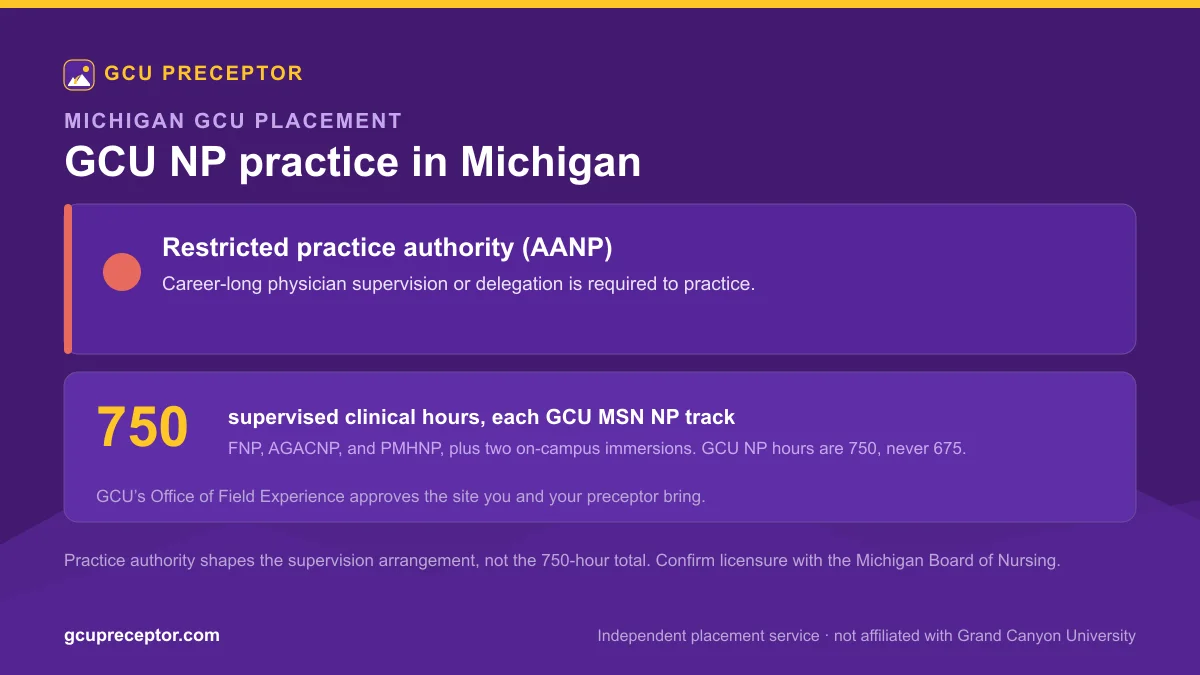
The American Association of Nurse Practitioners classifies Michigan as a restricted practice state, its most limited category. Michigan's Public Health Code never adopted a stand-alone scope of practice for nurse practitioners. Instead, an NP holds an RN license plus a specialty certification granted under MCL 333.17210, and key parts of advanced practice still run through physician involvement.
The practical dividing line is prescribing. A 2016 update to the Public Health Code allowed Michigan APRNs to prescribe nonscheduled drugs on their own authority, but prescribing controlled substances still requires delegation from a physician. Most NPs in the state therefore work inside written delegation or collaboration arrangements, with a physician somewhere in the chart flow.
For a student, this is useful context rather than an obstacle. Your rotations happen inside teams where delegation is routine, and watching how an experienced Michigan NP documents delegated prescribing is training you will actually use after graduation. Your supervised hours count the same as they would in a full practice state; see clinical hours for how GCU structures them.
What the Michigan Board of Nursing handles
The Michigan Board of Nursing sits inside the Department of Licensing and Regulatory Affairs (LARA), Bureau of Professional Licensing, in Lansing. It licenses RNs and grants the APRN specialty certifications Michigan recognizes: nurse practitioner, nurse midwife, and clinical nurse specialist.
Licensing runs through the MiPLUS online system, which doubles as the public lookup you can use to confirm that a prospective preceptor holds an active, unencumbered Michigan license before you nominate them. Verification of national certification must be sent to the Bureau directly by the certifying body, so build lead time into any post-graduation licensure plan.
Quick pointers
- Verify any Michigan preceptor's license through the MiPLUS lookup before submitting paperwork
- Board contacts and licensing guides live on the LARA nursing pages, not a separate board website
- National certification verifications go from the certifying body straight to the Bureau of Professional Licensing
Finding a preceptor in Michigan, the GCU way
GCU does not place you. You source your own preceptor, and the Office of Field Experience reviews and approves the site and preceptor you bring forward. The nomination itself moves through the Field Experience Site Information Form in the eDocs app, and no hours count until OFE signs off.
Michigan gives you real geographic range. Metro Detroit, spanning Wayne, Oakland, and Macomb counties, has the deepest bench of clinics and health systems. Grand Rapids anchors a strong West Michigan market, with Kalamazoo and Battle Creek nearby. Lansing, Ann Arbor, Flint, and Saginaw each carry active primary care and behavioral health networks, and Traverse City serves much of northern lower Michigan. In the Upper Peninsula, Marquette is the hub, though sites there are fewer and book early.
The catch is competition. Michigan universities graduate large NP cohorts every year, and clinics near the population centers field steady streams of placement requests. Preceptors who say yes tend to be won through persistent, personal outreach rather than mass emails, which is exactly the work our team takes off your plate. See how it works or start at find a preceptor.
The 750 hours, seen from Michigan
Every GCU MSN nurse practitioner track requires 750 supervised clinical hours: FNP, AGACNP, and PMHNP. Those hours must be completed with specialty-matched preceptors, so a PMHNP student needs psychiatric settings, not a family practice that occasionally treats depression.
Two pieces happen outside Michigan entirely: GCU's NP tracks include two required on-campus immersions in Phoenix, which is why the programs are not 100% online. Budget for that travel. Everything else happens at your approved Michigan site, logged by you in the Lopes Activity Tracker and approved by your preceptor in ThunderTime. Logging details live at Lopes Activity Tracker.
Post-master's students follow the same sourcing path, including the 750-hour FNP certificate; see post-master's certificates. DNP students build hours course by course around the Direct Practice Improvement project, covered at DNP practicum, and RN-to-BSN students complete a 40-hour practicum for NRS-465, covered at RN-to-BSN practicum.
Virtual visits and in-person hours
Telehealth is now ordinary in Michigan primary care and behavioral health, and some preceptors run hybrid schedules. Whether virtual visit hours count toward your practicum depends on your specific program and course, and OFE evaluates the site as a whole. Confirm telehealth acceptability with your program and OFE before committing to a virtual-heavy site, especially for courses built around hands-on assessment.
Where we fit
We are an independent placement service for GCU nursing students, independent of GCU, and OFE always has the final say on any site. Our team runs the outreach, screens each candidate against GCU's preceptor requirements, and hands you a match ready for the eDocs nomination. You are matched first and pay only when a placement is secured; pricing details are on the cost page. If your Michigan search has stalled, request a free placement review and we will map your options by specialty and region.
Frequently asked questions
Is Michigan really a restricted practice state for NPs?
Yes. AANP places Michigan in its restricted category because physician involvement is still required for core elements of NP practice, most visibly delegation for controlled substance prescribing. That status shapes how your preceptor's clinic operates, not whether your GCU hours count.
Can my Michigan preceptor be a physician instead of an NP?
Sometimes. Eligibility depends on your program's handbook and the specialty match for the course, and the Office of Field Experience approves every preceptor individually through the eDocs site form. Review preceptor requirements and confirm with OFE before investing in outreach.
Do I ever have to leave Michigan during a GCU NP program?
Yes, twice. Each MSN NP track includes two required on-campus immersions at GCU in Phoenix, so the programs are not fully online. All 750 supervised clinical hours, however, can be completed at approved sites in Michigan.
How early should I start looking for a Michigan preceptor?
Two terms ahead is a safe floor, and earlier for PMHNP rotations or anything in northern Michigan or the Upper Peninsula, where sites are scarce. OFE approval adds its own timeline after a preceptor agrees, so submit the eDocs form as soon as your match is confirmed.
Get your GCU clinicals handled.
Tell us your track and term. We’ll map your clinical requirement and start the search, in person or virtual. No payment until you’re matched.