Massachusetts Preceptor Matching for GCU Nursing Students
Massachusetts grants nurse practitioners full practice authority, and its healthcare market runs from Boston's academic medical centers to community clinics in the Berkshires. Here is how GCU students across the Commonwealth secure preceptors, clear OFE approval, and log their 750 hours.
Get matched, free
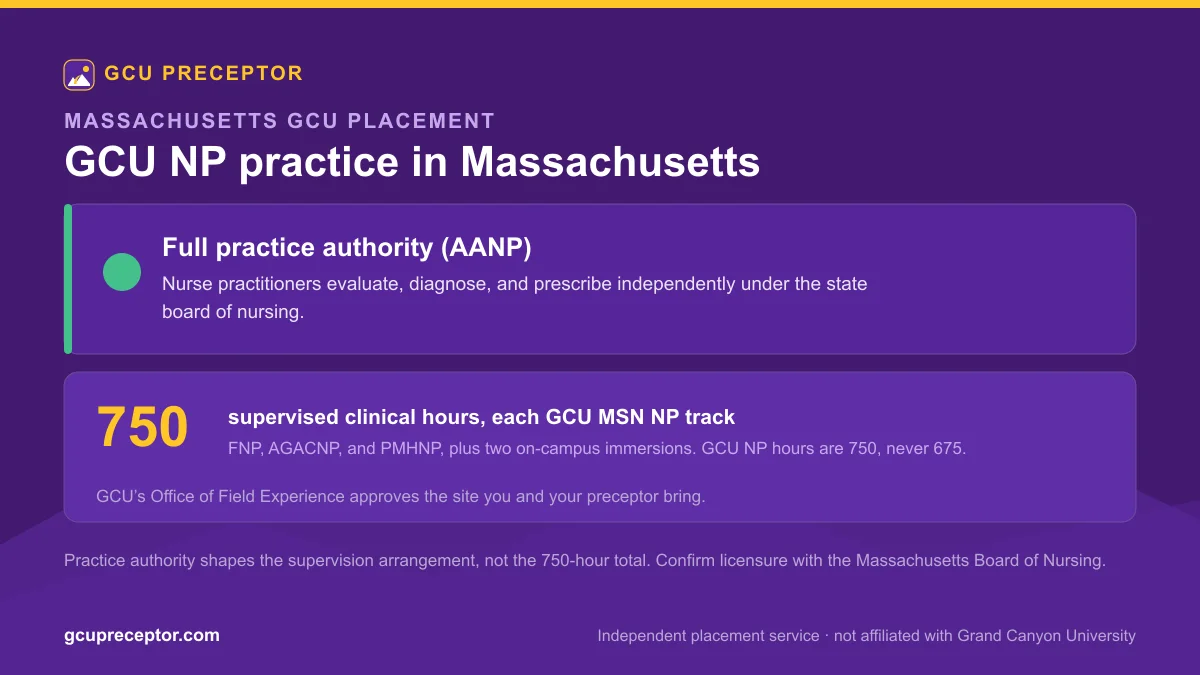
Massachusetts is a full practice state, with one catch for new grads
The American Association of Nurse Practitioners classifies Massachusetts as a full practice state. That status arrived on January 1, 2021, when An Act Promoting a Resilient Health Care System That Puts Patients First became law and made permanent what pandemic-era executive orders had started. Under it, certified nurse practitioners evaluate patients, diagnose, order and interpret tests, and manage treatment under the licensure authority of the state's nursing board rather than through mandated physician oversight.
There is one wrinkle worth knowing before you graduate. Massachusetts requires newly certified NPs to complete at least two years of supervised prescriptive practice with a qualifying physician or independent NP before prescribing on their own; after that, an attestation to the board removes the supervision requirement. So full practice authority is real, but it is earned over your first two years rather than handed over at licensure.
For a GCU student in clinicals, the practical upside is a deeper preceptor pool. Because experienced NPs here practice and prescribe independently, NP-owned primary care offices and behavioral health practices are common across the state, and those clinicians can serve as preceptors without a physician co-signing their day.
The Board of Registration in Nursing and your future license
Nursing in the Commonwealth is governed by the Massachusetts Board of Registration in Nursing, which sits within the Department of Public Health. The board licenses RNs and issues APRN authorization in five categories, including Certified Nurse Practitioner, and it recognizes graduate programs accredited by national bodies such as CCNE, which is the accreditor of GCU's nursing programs.
Two pointers matter during clinicals. First, you can confirm any prospective preceptor's Massachusetts license and authorization through the board's public license verification tool on Mass.gov, and we recommend doing that before a site is nominated. Second, when you finish your program you will apply to the same board for APRN authorization on top of an RN license, so keeping clean, verifiable hour logs in the Lopes Activity Tracker now saves headaches later.
Finding a preceptor across the Commonwealth
GCU does not place you at a clinical site. You source your own preceptor, and the Office of Field Experience reviews and approves the site and preceptor you bring forward through the Field Experience Site Information Form in the eDocs app. Once approved, your hours flow through the Lopes Activity Tracker and your preceptor signs off in ThunderTime. That sourcing step is exactly what we take off your plate.
Massachusetts rewards a wide search. Boston and Cambridge hold famous teaching hospitals, but they also hold a dense crowd of local nursing students competing for the same rotations, so answer rates there can be slow. We routinely have better luck in Worcester, Springfield, Lowell, Lawrence, Brockton, New Bedford, and Fall River, along with MetroWest suburbs, Cape Cod practices, and Pittsfield and the Berkshires in the west.
The settings that say yes most often in this state are the ones full practice authority helped create.
Where we look for Massachusetts matches
- Community health centers in the Gateway Cities, where precepting is part of the culture
- NP-owned primary care and psychiatric practices operating independently under full practice authority
- Urgent care and retail clinics along the I-90 and I-495 corridors
- Behavioral health groups and telepsychiatry practices for PMHNP students
- Hospitalist and specialty teams for AGACNP students in Worcester, Springfield, and Boston
Meeting GCU's 750 hours from Massachusetts
Each of GCU's three MSN nurse practitioner tracks, FNP, AGACNP, and PMHNP, requires 750 supervised clinical hours with specialty-matched preceptors. An FNP student needs primary care across the lifespan, which in Massachusetts often means a family practice or community health center panel; an AGACNP student needs acute and complex adult care of the kind concentrated in Worcester and Boston hospitals; a PMHNP student needs psychiatric settings, a genuine area of strength in this state. The full picture of how hours break down by course lives on our clinical hours page.
Remember that these programs are not 100% online: every MSN NP student attends two on-campus immersions in Phoenix. From Massachusetts that means planning two trips out of Logan or a regional airport, so build travel into your semester budget alongside your clinical schedule.
GCU's other practicum programs follow the same student-sourced model at different scales. Post-master's APRN certificates, including a 750-hour FNP certificate, run through the same OFE approval path; the DNP centers on the Direct Practice Improvement project with hours accrued per course; and RN-to-BSN students complete a 40-hour applied EBP practicum. Details sit on our post-master's certificate, DNP practicum, and RN-to-BSN practicum pages.
A note on telehealth hours
Massachusetts practices adopted telehealth widely, and some preceptors will offer virtual visit time, especially in psychiatry. Whether those hours count toward your requirement depends on your course and specialty, and acceptability varies, so confirm with your GCU program and the OFE before agreeing to a schedule built around virtual care. Our default is to secure in-person placements and treat telehealth as a supplement.
What working with us looks like
We are an independent placement service, separate from GCU, and we never promise that a site will be approved or that a placement is guaranteed. What we do is run the search: identify licensed, specialty-matched Massachusetts preceptors, make the calls, confirm willingness and availability, and hand you a candidate ready for the eDocs site form. You are matched first and pay only when a placement is secured; our cost page explains the structure and how it works walks through the timeline.
If your rotation start date is getting close, send us your track, your city, and your dates through a free placement review and we will tell you honestly what your options in Massachusetts look like. You can also browse our other state guides if you are willing to precept across the New Hampshire or Rhode Island line.
Frequently asked questions
Does GCU find my preceptor in Massachusetts?
No. GCU students source their own preceptors, and the Office of Field Experience approves the site and preceptor you nominate through the eDocs Field Experience Site Information Form. That search is the part we handle for you, anywhere in the Commonwealth.
Can an independent nurse practitioner precept me in Massachusetts?
Often, yes. Massachusetts is a full practice state, so experienced NPs run their own practices and can supervise students in their specialty. Your preceptor still has to meet GCU's criteria and pass OFE review, so check our preceptor requirements page before nominating anyone.
How many clinical hours does GCU require for NP students?
Each MSN NP track, whether FNP, AGACNP, or PMHNP, requires 750 supervised clinical hours with specialty-matched preceptors, logged in the Lopes Activity Tracker and approved by your preceptor in ThunderTime, plus two on-campus immersions in Phoenix.
Can I practice independently in Massachusetts right after graduation?
Not immediately. Massachusetts grants full practice authority, but newly certified NPs must first complete at least two years of supervised prescriptive practice before attesting to the Board of Registration in Nursing for independent prescribing. Check the board's site for current rules.
Get your GCU clinicals handled.
Tell us your track and term. We’ll map your clinical requirement and start the search, in person or virtual. No payment until you’re matched.