Maryland Preceptor Options for GCU Nursing Students
Maryland gives nurse practitioners full practice authority, so certified NPs practice without a career-long physician agreement. That supportive regulatory setting creates varied clinical options for GCU students, but the preceptor and site still must match the course and receive OFE approval.
Get matched, free
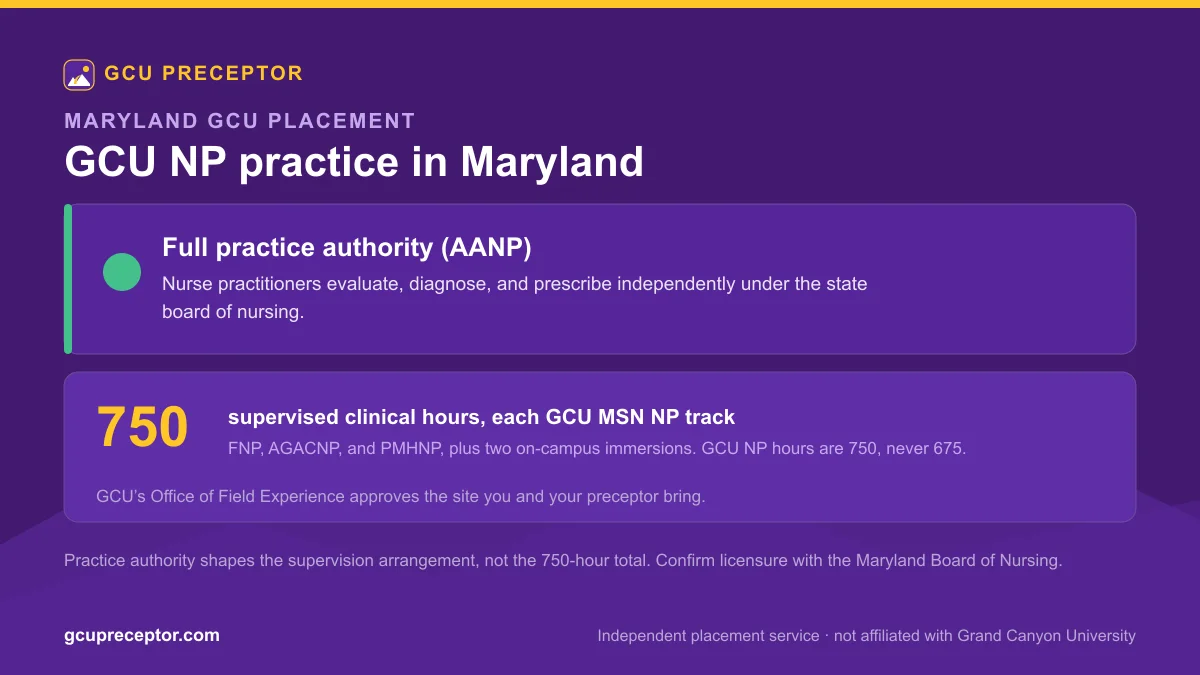
Maryland is a full practice authority state
The American Association of Nurse Practitioners classifies Maryland as a full practice state. Maryland law describes nurse practitioner practice as independent and includes assessment, diagnosis, ordering and interpreting laboratory tests, prescribing, treatment, consultation, referral, and emergency care within the NP's authorized scope. The Maryland Board of Nursing, rather than a physician contract, is the central licensing authority for nurse practitioners.
Full practice authority does not mean an NP works without professional consultation. Maryland's scope expressly includes consulting, collaborating with, or referring to an appropriate physician or other health care provider as patient needs require. The important distinction is that the state does not impose a career-long physician collaboration agreement as the condition for routine NP practice.
For a student, this can broaden the mix of potential teaching sites. An independently owned primary care practice, behavioral health office, community clinic, or health system group may all employ qualified NPs. It does not remove academic requirements. A preceptor's population focus, certification, actual patient panel, and capacity to supervise must align with the GCU course.
The Maryland Board of Nursing certifies the preceptor's role
Maryland uses the title certified registered nurse practitioner, or CRNP. The Maryland Board of Nursing states that CRNP applicants need a current Maryland RN license in good standing or an eligible multistate RN privilege, graduation from a Board-approved accredited graduate NP program, and current national certification in each specialty requested. Its advanced practice pages provide applications, eligibility information, regulations, and license verification resources.
Before a site nomination, confirm that the proposed preceptor holds an active credential in the specialty represented to you. Maryland's full practice status is not a substitute for verification. Also ask what the clinician does each week. A broad certification title does not establish that a current role provides enough pediatric, adult acute care, or psychiatric encounters for a particular rotation. GCU's OFE evaluates the proposed match under university criteria, while the Board remains the source for state licensure and scope questions.
Questions that reveal real rotation fit
- Is the Maryland RN privilege and CRNP certification current?
- Does national certification match the population focus required by the course?
- Will the student see the needed patient ages, conditions, and care setting during the term?
- Can the site provide consistent supervision and complete GCU's field-experience process?
Use Maryland's compact geography to expand the search
Baltimore offers large health systems, ambulatory networks, community health centers, psychiatric services, and specialty practices. The surrounding corridor through Towson, Columbia, Ellicott City, Glen Burnie, and Annapolis can keep a search within a realistic commute while adding independent offices and suburban clinics. Near Washington, Bethesda, Silver Spring, Rockville, and the rest of Montgomery and Prince George's counties create another dense clinical market, with competition from several local nursing programs.
Western and Eastern Maryland should not be treated as afterthoughts. Frederick and Hagerstown serve growing regional populations, Cumberland supports western communities, and Salisbury is a clinical center for the Eastern Shore. Smaller practices in surrounding counties may offer close continuity with patients, though they can have limited room for students. Starting ahead of the term gives a clinic time to consider schedules and complete institutional steps.
The GCU workflow is the same throughout Maryland: students source their own preceptors. The Office of Field Experience supports and reviews the field experience but does not place the student. After a clinician agrees, the student uses the Field Experience Site Information Form in the eDocs app to nominate the preceptor and site. OFE compares that submission with the course and GCU's preceptor requirements. We can take on the sourcing work, but the university alone decides whether a match is approved.
Map the 750 clinical hours across specialties and terms
GCU requires 750 supervised clinical hours in each of its three MSN NP tracks: FNP, AGACNP, and PMHNP. The shared total does not make the rotations interchangeable. FNP placements need primary care across the lifespan, AGACNP placements focus on acute and complex adult care, and PMHNP placements require psychiatric mental health experience. One Maryland site may support more than one course, but only when its clinicians, patients, and services fit the relevant outcomes.
Students sometimes plan around the clinical total and overlook the campus component. GCU's MSN NP tracks also have two on-campus immersions in Phoenix, adding required in-person travel to every track. Maryland students should account for flights, local transportation, and time away from work when they build the same calendar that contains clinical shifts.
Once the Maryland rotation has been approved and begins, the student logs clinical time in the Lopes Activity Tracker, known as LAT. The preceptor approves the entries in ThunderTime. Current logs reduce end-of-term confusion and give the preceptor a manageable review routine. Different GCU programs use different hour structures: the post-master's FNP certificate includes 750 hours, the DNP uses per-course hours for the Direct Practice Improvement project with IRB, and the RN-to-BSN NRS-465 practicum requires 40 hours.
Balance in-person learning with Maryland telehealth
Maryland clinicians use telehealth in behavioral health, primary care follow-up, specialty consultation, and other services. Virtual care can widen exposure, but whether a remote encounter counts is a GCU program and course decision, followed by OFE review of the site and supervision plan. Confirm the answer before creating a schedule that depends on virtual hours. Courses built around physical assessment or direct acute care may require substantial in-person participation.
When the Maryland search is taking more time than the coursework, submit a free placement review. We will assess your specialty, dates, location, and travel range, then source a match for OFE consideration. We are independent of GCU, do not guarantee placement or approval, and charge only when a placement has been secured.
Frequently asked questions
Do Maryland nurse practitioners need physician supervision?
Maryland is a full practice authority state, and CRNP practice is not conditioned on a career-long physician supervision agreement. NPs still consult and refer when patient needs call for another professional's expertise, and every clinician remains responsible for practicing within certification and scope.
Does full practice authority make OFE approval automatic?
No. State authority describes how a licensed CRNP may practice. GCU separately decides whether that clinician and site satisfy the course and field-experience requirements. Students must submit the eDocs site form and receive OFE approval before beginning hours.
Can a Maryland PMHNP preceptor support my FNP rotation?
Not merely because both are nurse practitioners. The preceptor's certification, patient population, practice setting, and available experiences must match the course. Review GCU's requirements and let OFE make the final determination on the nomination.
Are the two Phoenix immersions included in the 750 clinical hours?
Treat them as separate required parts of the MSN NP program. Each track requires 750 supervised clinical hours and also includes two on-campus immersions in Phoenix. Plan Maryland placement shifts and Arizona travel together so dates do not conflict.
Get your GCU clinicals handled.
Tell us your track and term. We’ll map your clinical requirement and start the search, in person or virtual. No payment until you’re matched.