Preceptor Placement in Louisiana for GCU Nursing Students
Louisiana sits in the AANP's reduced practice column, which shapes who can precept you and how clinics say yes. Here is how GCU students across the state line up preceptors, get their sites approved, and log every one of their 750 hours.
Get matched, free
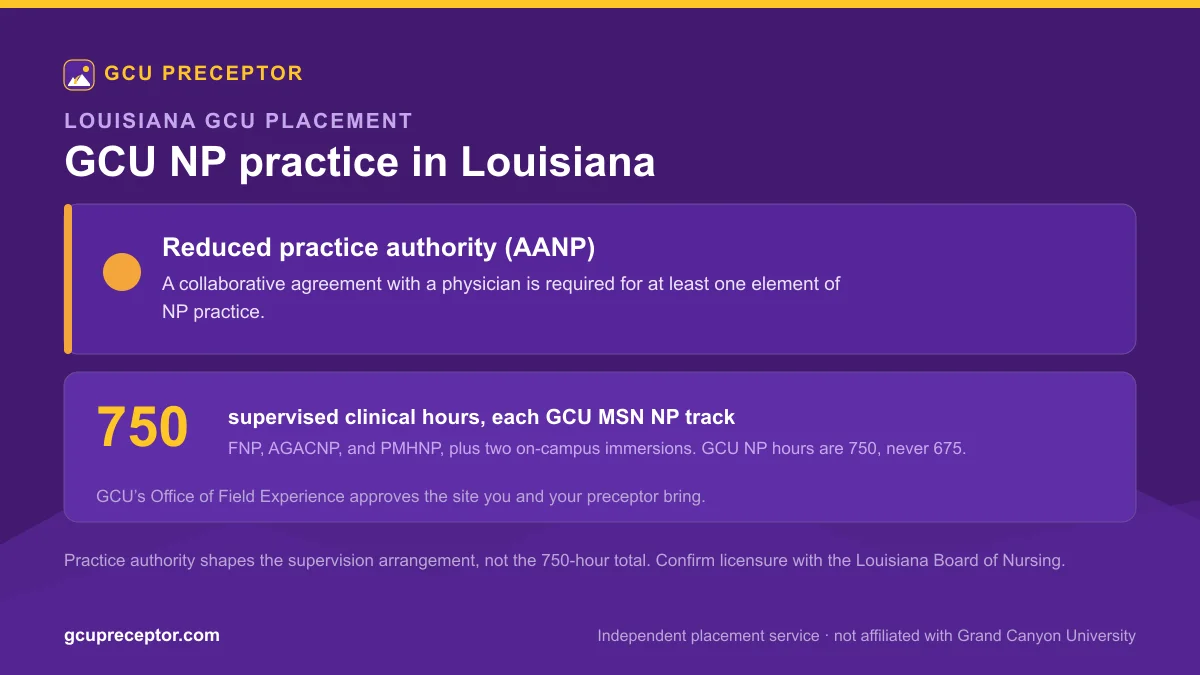
Reduced practice in Louisiana, explained in plain terms
The AANP lists Louisiana as a reduced practice state. Licensed nurse practitioners there can assess patients, diagnose, order studies, and prescribe, but only within a collaborative practice agreement, a written document signed with one or more Louisiana physicians and submitted to the state board for approval. The board approves no more than two collaborating physicians per practice site, and the agreement must follow the board's own template.
For a GCU student, the label matters less than the culture it creates. Louisiana clinics are used to paperwork that spells out who oversees what, so a well-prepared preceptor request, with your program details and hour requirements already laid out, gets a warmer reception than a cold ask. It also means many of the NPs you might train under carry their own collaboration obligations, which can shape how much precepting time they are able to offer.
What the Louisiana State Board of Nursing handles
The Louisiana State Board of Nursing (LSBN), based in Baton Rouge, licenses the state's RNs and advanced practice registered nurses. It processes APRN licensure and prescriptive authority applications, reviews the collaborative practice agreements described above, and publishes the required forms and templates on its .gov site.
Two practical uses for students. First, confirm that any prospective preceptor holds a current, unencumbered Louisiana license before you bring the site to GCU; LSBN's online verification makes that quick. Second, if you plan to practice in Louisiana after graduation, bookmark the APRN licensure page now, because the certification and collaboration paperwork will run through this same board.
Finding a preceptor across Louisiana's parishes
GCU does not place students. You source your own preceptor, then the Office of Field Experience reviews and approves the site you bring, starting with the Field Experience Site Information Form in the eDocs app. Once approved, you log hours in the Lopes Activity Tracker and your preceptor signs off in ThunderTime. The finding part, the hardest part, is the piece we take off your plate.
Where you look matters in Louisiana. New Orleans and its metro hold the deepest bench of clinics and specialty practices, and Baton Rouge adds a second urban market with heavy primary care demand. Shreveport and Bossier City anchor the northwest, Lafayette and Lake Charles cover Acadiana and the southwest, and Monroe and Alexandria serve the central and northeastern parishes. Rural and bayou communities from Houma down through the river parishes often welcome students precisely because providers are scarce, though travel time becomes part of the plan.
Competition is real: several Louisiana nursing programs send students into the same clinics each term, so start conversations at least a semester ahead. Or hand us the search: read how it works and see find a preceptor for what we need from you before we start calling.
Your 750 hours, from the bayou to Phoenix
Every GCU MSN nurse practitioner track, FNP, AGACNP, and PMHNP, requires 750 supervised clinical hours with specialty-matched preceptors. A family practice course needs a family-focused site, acute care hours need hospital or ICU exposure, and psychiatric hours need a psychiatric prescriber, so a Louisiana search usually means lining up two or three distinct sites over the course of the program. Our clinical hours page breaks the totals down by course.
Two on-campus immersions in Phoenix are also built into the NP tracks, so the programs are not 100% online; budget for that travel alongside your Louisiana rotations. In other programs the numbers change: the post-master's certificate FNP option also carries 750 hours, the DNP practicum accrues hours course by course while you complete the Direct Practice Improvement project, and RN-to-BSN students complete a 40 hour applied evidence-based practice project through NRS-465.
Virtual rotations and telehealth in Louisiana
Telehealth precepting exists in Louisiana, and some sites blend in-person days with virtual visits. Whether a given rotation can count virtual hours depends on your course, your specialty, and OFE's review of the site, so confirm with your program team and the Office of Field Experience before you commit to anything remote.
How we help, and what it costs
Here is our part, stated plainly: we find Louisiana preceptors for GCU students, you are matched first, and you pay only when a placement is secured. We run the outreach, screen candidates against GCU's preceptor requirements, and hand you a provider ready for the eDocs nomination. We never guarantee placement or GCU approval, no honest service can, but we do the calling, vetting, and follow-up that would otherwise eat your study time. Pricing is on the cost page, and you can start with a free placement review: tell us your track, your target start date, and your parish.
Frequently asked questions
Can GCU nursing students complete clinical hours in Louisiana?
Yes. GCU students routinely train at Louisiana sites. You find the preceptor, the Office of Field Experience approves the site through the eDocs Field Experience Site Information Form, and your hours are logged in the Lopes Activity Tracker with preceptor approval in ThunderTime. We help with the finding step in any parish.
Does Louisiana's collaborative practice rule affect student rotations?
Not directly. The collaborative practice agreement governs how licensed NPs practice, not how students train. It does mean an NP preceptor operates under a physician collaboration filed with the LSBN, which can shape their schedule and how much supervision time they can commit, so ask about it early.
Who can serve as my preceptor in Louisiana?
It depends on your course. NP rotations need specialty-matched providers, generally NPs or physicians whose practice fits your track, and every preceptor should hold an active Louisiana license you can verify through the state board. GCU's Office of Field Experience makes the final call on each site; review our preceptor requirements overview before you nominate.
Can I split my 750 hours across more than one Louisiana site?
Usually, yes. Most students rotate through two or three sites so each specialty course gets a matched preceptor. Each site is nominated separately through eDocs and approved by OFE, and your Lopes Activity Tracker entries keep the totals straight across sites.
Get your GCU clinicals handled.
Tell us your track and term. We’ll map your clinical requirement and start the search, in person or virtual. No payment until you’re matched.