Finding a Kentucky Preceptor as a GCU Nurse Practitioner Student
Kentucky sits in the AANP's reduced practice column, and that shapes everything from who can precept you to how your preceptor prescribes. Here is how GCU nurse practitioner students across the Commonwealth line up clinical sites, and how we can take the search off your plate.
Get matched, free
Reduced practice in Kentucky, in plain terms
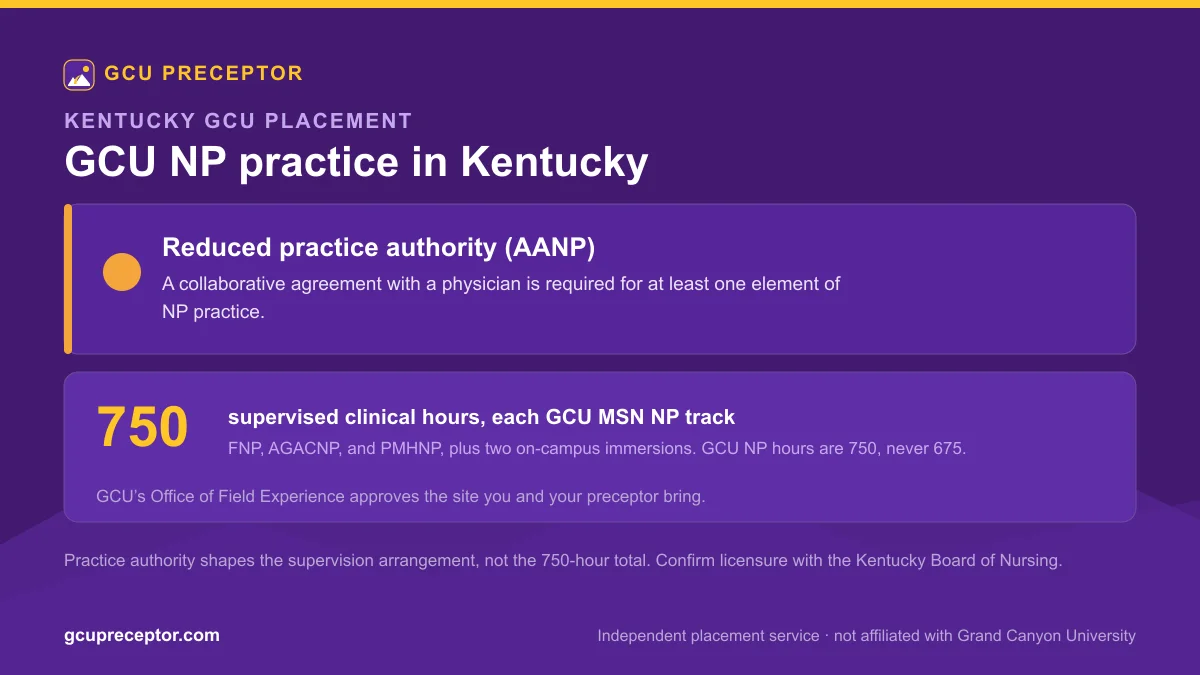
The American Association of Nurse Practitioners classifies Kentucky as a reduced practice state. Kentucky APRNs hold their own license to evaluate patients, reach diagnoses, and manage treatment, but prescriptive authority runs through written agreements with a physician. The state splits those into two documents: one covering nonscheduled legend drugs, commonly called the CAPA-NS, and a separate agreement for controlled substances, the CAPA-CS.
The trend line favors NPs. Kentucky has been loosening the framework rather than tightening it, and experienced prescribers who meet the board's criteria can request release from an agreement requirement after four years of prescribing, so many veteran Kentucky NPs carry far fewer strings than a new graduate does. For you as a student, the day-to-day meaning is simpler: the NPs who might precept you in Kentucky are accustomed to structured oversight and careful documentation, which tends to make them exacting, thorough teachers. The board publishes the current rules, so treat KBN as the source of truth rather than a forum thread.
Working with the Kentucky Board of Nursing
The Kentucky Board of Nursing, headquartered in Louisville, licenses the state's RNs, LPNs, and APRNs. Advanced practice licensure follows the APRN model with population foci, so GCU's FNP, AGACNP, and PMHNP tracks each map onto a recognized Kentucky APRN role. Licensure applications, renewals, and public license verification all run through the board's online portal at kbn.ky.gov.
Why this matters before your first clinical day: when you nominate a Kentucky site and preceptor through GCU's Field Experience Site Information Form in the eDocs app, you want that preceptor's license to be active and unencumbered. The board's free lookup makes that a five-minute check, and it also shows whether an NP preceptor holds prescriptive authority, useful context when you are choosing between two willing providers.
Sourcing a preceptor across the Commonwealth
GCU does not place you. The Office of Field Experience reviews and approves the site and preceptor you bring forward, but the finding is on the student. That model works fine when you happen to know a provider; it gets stressful fast when you are cold-emailing clinics between shifts. Closing that gap is exactly what we do: outreach, vetting, and paperwork preparation so your nomination reaches OFE ready to approve. See how it works or start with find a preceptor.
Geography matters in Kentucky. Louisville and Lexington concentrate the large health systems, specialty practices, and psychiatric clinics, which suits AGACNP and PMHNP students but also draws competition from local nursing programs. Northern Kentucky, including Covington, Newport, and Florence, plugs into the Cincinnati metro's clinical market. Bowling Green, Owensboro, and Paducah anchor the west, while Ashland, Pikeville, and the Appalachian east run heavily on NP-led primary care. Rural counties often welcome FNP students warmly, but there are fewer providers to ask, so the calendar is your biggest risk there.
The 750 hours, seen from Kentucky
Each of GCU's three MSN NP tracks requires 750 supervised clinical hours with specialty-matched preceptors, and every one of those hours can be completed at approved sites near your Kentucky home. The two on-campus immersions in Phoenix are the exception; they are required, so the program is not 100% online. You log hours in the Lopes Activity Tracker, and your preceptor approves them in ThunderTime, which keeps your clinical hours record clean for graduation and certification.
Specialty matching is where Kentucky students most often stumble. A PMHNP student needs psychiatric rotations, not a family practice that occasionally manages anxiety, and an AGACNP student needs acute and complex care, which usually means Louisville, Lexington, or a regional hospital rather than a storefront clinic.
Beyond the MSN tracks
- Post-master's certificates, including the 750-hour FNP certificate, follow the same source-your-own-preceptor model.
- DNP students complete the Direct Practice Improvement project with IRB review; practicum hours accrue per course rather than as one published total.
- RN-to-BSN students complete the 40-hour NRS-465 Applied EBP Project and Practicum, a far lighter lift that still needs an approved setting.
Virtual visits versus in-person hours
Telehealth is a real part of Kentucky care delivery, especially across the eastern counties where a psychiatric NP may cover several small towns by video. Whether precepted virtual encounters count toward a specific GCU course is a program-level decision that can differ by track and by course, so confirm with your program team and OFE before you build a rotation around it. Most Kentucky students end up blending: in-person primary care or acute hours plus some telehealth exposure where the course allows.
What working with us looks like
We are an independent placement service, not part of Grand Canyon University, and we never guarantee placement or OFE approval of any site. What we do is straightforward: you tell us your track, your Kentucky location, and your course dates; we run targeted outreach to specialty-matched providers in your area, vet the willing ones against GCU's preceptor requirements, and prepare the details your eDocs nomination needs. You are matched first and pay only when a placement is secured; fees are laid out plainly on our cost page. If a semester deadline is bearing down on you, request a free placement review and we will tell you honestly what is findable in your part of the state.
Frequently asked questions
Do I need my own collaborative agreement to complete clinical hours in Kentucky?
No. CAPA-NS and CAPA-CS agreements apply to licensed APRNs who prescribe. As a GCU student you train under your preceptor's supervision and your existing RN license, with hours documented in LAT and approved in ThunderTime. Your preceptor's own agreement status is their responsibility, not yours.
Can a nurse practitioner precept me in Kentucky, or does it have to be a physician?
Kentucky NPs, physicians, and other specialty-matched providers can generally serve, subject to GCU's criteria for the specific course. OFE has the final say through its eDocs review, so check the preceptor requirements before you ask a provider to commit.
How early should I start looking for a Kentucky preceptor?
Four to six months before the course starts is a sane floor. Louisville and Lexington sites field requests from several local programs, and rural sites are often willing but slow to complete credentialing paperwork. If you engage us, outreach starts immediately rather than after your first dozen unanswered emails.
Will I ever have to leave Kentucky during the program?
Twice, for the two required on-campus immersions in Phoenix. All 750 clinical hours for the MSN NP tracks can be completed at OFE-approved sites in Kentucky, so day-to-day clinical training stays close to home.
Get your GCU clinicals handled.
Tell us your track and term. We’ll map your clinical requirement and start the search, in person or virtual. No payment until you’re matched.