Find Your GCU Preceptor in Kansas
Kansas moved to full practice authority in 2022, and that changes the preceptor picture for GCU students across the state. Here is how practice authority, the Kansas State Board of Nursing, and GCU's 750-hour clinical requirement fit together, and how we help you secure a site.
Get matched, free
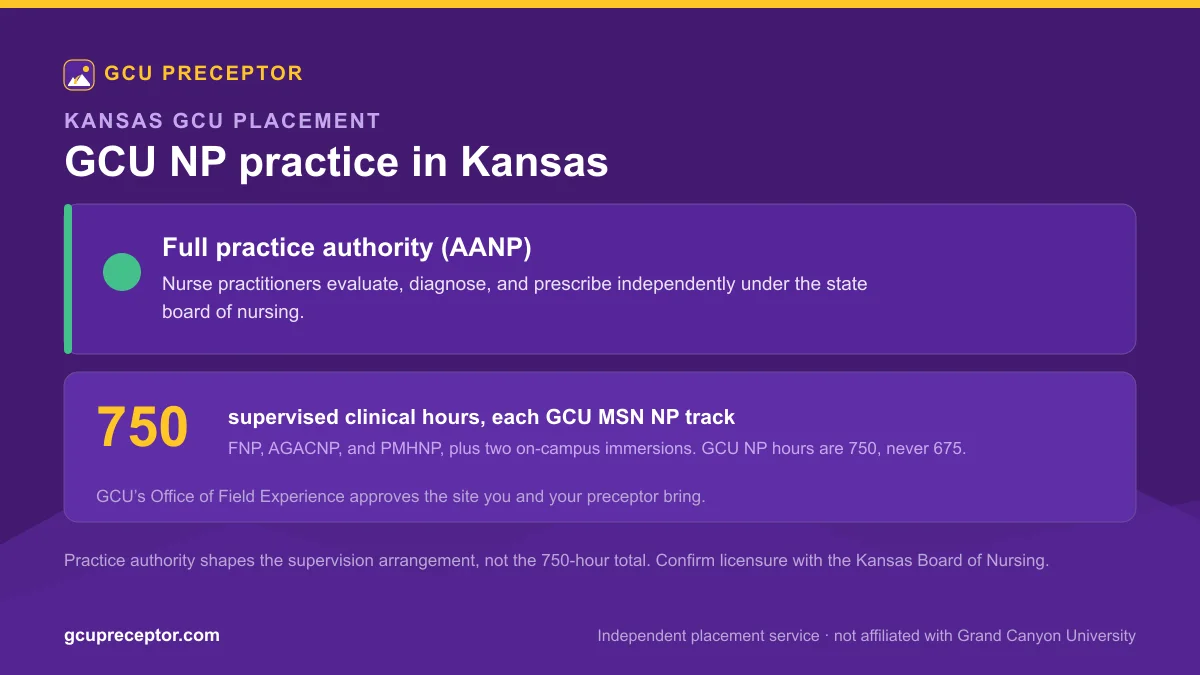
Kansas gives nurse practitioners full practice authority
Kansas is listed as a full practice state on the AANP State Practice Environment map. When House Bill 2279 became law in 2022, Kansas became the 26th state to let advanced practice registered nurses evaluate patients, order and interpret diagnostic tests, and initiate and manage treatments, including prescriptions, under the licensure authority of the Kansas State Board of Nursing alone. No collaborative practice agreement with a physician is required.
Day to day, that shows up everywhere GCU students train. Nurse practitioners in Kansas own clinics in Wichita and Salina, run primary care in frontier counties out west, and anchor behavioral health practices that would otherwise go unstaffed. For you as a student, full practice authority widens the preceptor pool: independent NP-owned practices are legitimate clinical sites alongside physician groups and hospital systems, so there are more doors to knock on.
The 2022 law did pair independence with accountability. APRNs seeking Kansas licensure now need national certification in their role and population focus and must carry professional liability coverage. Keep that in mind if you plan to practice in Kansas after graduation.
What the Kansas State Board of Nursing governs
The Kansas State Board of Nursing (KSBN), headquartered in Topeka, licenses RNs, LPNs, and APRNs, approves nursing education programs, and handles complaints and discipline. It recognizes four APRN roles: nurse practitioner, clinical nurse specialist, certified nurse-midwife, and certified registered nurse anesthetist.
If Kansas is where you plan to practice, the path runs through a Kansas RN license first, then APRN licensure built on graduate coursework in advanced pharmacology, advanced pathophysiology, and advanced health assessment. Applications, education requirements, and the license verification lookup all live on the board's site at ksbn.kansas.gov, which is also where we confirm every prospective preceptor's license status during vetting.
One detail worth knowing: for students who begin an advanced practice program on or after March 1, 2025, KSBN's education rules call for at least 750 practice hours in the clinical track. GCU's MSN NP tracks already require exactly 750 supervised clinical hours, so the program's structure matches the Kansas licensure floor rather than falling short of it.
How GCU students actually land Kansas preceptors
GCU does not place you. You source your own preceptor, and the Office of Field Experience reviews and approves the site and preceptor you bring forward. The nomination happens through the Field Experience Site Information Form in the eDocs app, your hours are logged in the Lopes Activity Tracker, and your preceptor signs off in ThunderTime. Read more about how OFE approval and the Lopes Activity Tracker fit into your timeline.
Where do Kansas students look? The Johnson County corridor, Overland Park, Olathe, Shawnee, and Kansas City on the Kansas side, holds the densest concentration of clinics, but it is also where every regional NP program competes for the same preceptors. Wichita, Topeka, Lawrence, and Manhattan offer strong mid-sized markets. West of Salina, in towns like Hays, Garden City, Dodge City, and Liberal, willing preceptors exist and often welcome students warmly, but expect long drives and small practices that can only take one student at a time.
That search, the cold outreach, the vetting against GCU's preceptor requirements, the paperwork chase, is the part we take off your plate. We run the sourcing; OFE still makes the approval call.
Meeting the 750-hour requirement from Kansas
Every GCU MSN NP track requires 750 supervised clinical hours with specialty-matched preceptors. FNP students need family practice settings that span the lifespan, AGACNP students need acute and complex care, which in Kansas usually means hospital settings in Wichita, Kansas City, or Topeka, and PMHNP students need psychiatric providers, a specialty where Kansas practices increasingly blend office and telehealth care.
The programs are not 100% online. Plan on two on-campus immersions at GCU's Phoenix campus, with flights from Wichita and Kansas City making the trips manageable, while the rest of your clinical work happens in your own Kansas community. Post-master's students follow the same sourcing path, including the 750-hour FNP certificate. DNP practicum hours accrue per course around the DPI project, and RN-to-BSN students complete the 40-hour NRS-465 practicum. See how clinical hours break down by program.
Virtual rotations in a telehealth-friendly state
Telehealth is well established in Kansas, especially in psychiatric care reaching rural counties, so some preceptors will offer virtual or hybrid rotation hours. Whether those hours count toward your requirement varies by course and specialty. Confirm with your GCU program and OFE before you commit to a virtual arrangement; assessment-heavy rotations still generally expect in-person time.
Get a Kansas placement review
We are an independent placement service, separate from GCU, and we never guarantee placement or OFE approval. What we do promise: we match you with a vetted Kansas preceptor first, and you pay only when your placement is secured. See how it works and what it costs, or start with a free placement review and tell us your specialty, your city, and your target rotation dates.
Frequently asked questions
Does full practice authority change who can precept me in Kansas?
It widens the pool of practicing NPs, including independent NP-owned clinics, but GCU's rules decide who qualifies. Your preceptor must meet GCU's preceptor requirements for your specialty, and the Office of Field Experience must approve the site you nominate through the eDocs site form.
Can I complete all my clinical hours in Kansas?
Yes. All 750 supervised clinical hours for the MSN NP tracks can be completed at approved sites in Kansas. The two required immersions take place on campus in Phoenix, so budget for two trips during the program.
How do I verify a Kansas preceptor's license?
Use the license verification tool on the Kansas State Board of Nursing site, ksbn.kansas.gov. We check license status, discipline history, and specialty fit for every preceptor we present.
Do Kansas rotations require a collaborating physician?
Not because of state law. Since 2022, Kansas APRNs practice without a collaborative practice agreement. As a student, you always work under your approved preceptor's supervision, and that preceptor must match your track under GCU policy.
Get your GCU clinicals handled.
Tell us your track and term. We’ll map your clinical requirement and start the search, in person or virtual. No payment until you’re matched.