Preceptor help in Iowa for GCU nurse practitioner students
Iowa grants nurse practitioners full practice authority, which makes it one of the friendlier states for a GCU student searching for clinical placement. Here is how ARNP licensure, preceptor sourcing, and GCU's 750-hour requirement actually fit together from Des Moines to the smallest county seat.
Get matched, free
What full practice authority means in Iowa
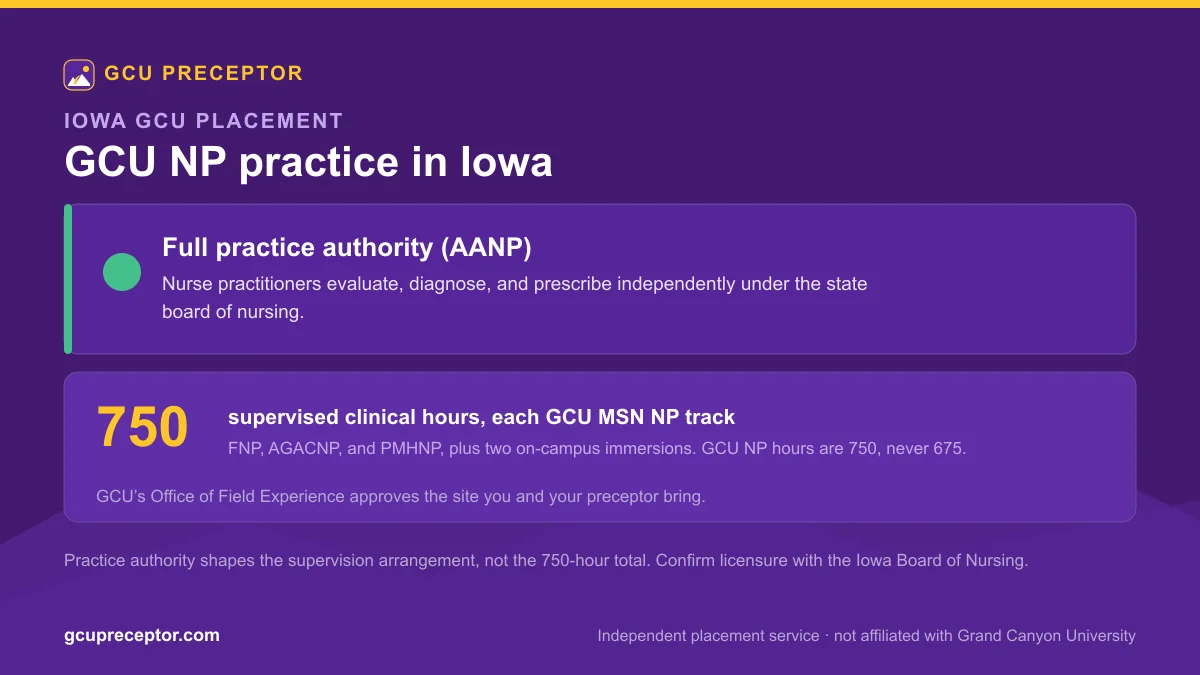
The AANP classifies Iowa as a full practice state. Licensed nurse practitioners in Iowa evaluate patients, diagnose, order and interpret tests, and prescribe medications, including controlled substances, under the sole authority of the state's nursing board. No collaborative agreement or physician oversight contract is required for an NP to practice.
For a GCU student, that environment matters in two practical ways. First, the preceptor pool is wider: experienced NPs who own or run their own clinics can precept you without a supervising physician signing off on the arrangement. Second, you get to train inside the model you will likely practice in. In many of Iowa's rural counties the NP is the primary care presence in town, so students see the full scope of independent practice, not a narrowed version of it.
The Iowa Board of Nursing and the ARNP license
Iowa licenses nurse practitioners as Advanced Registered Nurse Practitioners, or ARNPs. The Iowa Board of Nursing, which now operates within the state's Department of Inspections, Appeals, and Licensing, governs RN and ARNP licensure, approves nursing education programs, and handles discipline. Its official site is nursing.iowa.gov, and licensure applications run through the state's online portal.
An Iowa ARNP needs an active RN license, graduate education in the NP role, and current national certification from a recognized certifying body. Why does this matter to you as a student? Because your preceptor's license is part of your site approval. Before you nominate anyone, run their name through the board's online verification tool to confirm the license is active and unencumbered. GCU's Office of Field Experience checks credentials during approval, and a preceptor who fails verification late in the process can cost you a semester. Our preceptor requirements page covers what GCU looks for beyond the license itself.
Finding a preceptor across Iowa's cities and counties
GCU does not place you. You source your own preceptor, the Office of Field Experience approves the site you bring, and the nomination happens through the Field Experience Site Information Form in the eDocs app. Once approved, you log hours in the Lopes Activity Tracker and your preceptor confirms them in ThunderTime. The sourcing step is the hard part, and it is the part we run for you.
Where do Iowa placements actually happen? The Des Moines metro holds the state's largest concentration of clinics and health systems, followed by Cedar Rapids, Davenport and the Quad Cities, Sioux City, Waterloo, Dubuque, and Council Bluffs on the Nebraska border. Iowa City is a strong clinical hub but also the most competitive market in the state, since local nursing programs fill many of its slots first. The counterweight is rural Iowa: across the state's 99 counties, family practice clinics, community health centers, and critical access hospitals are often glad to host a student, and a drive of thirty or forty minutes can turn a dead-end search into a signed preceptor.
Where each GCU track tends to land in Iowa
- FNP students: family medicine and internal medicine clinics, community health centers, and rural health clinics in county seats across the state.
- PMHNP students: behavioral health clinics and integrated primary care in Des Moines, Cedar Rapids, and Waterloo, plus telepsychiatry practices serving rural counties.
- AGACNP students: hospital medicine, ICU, and specialty inpatient services, concentrated in Des Moines, Iowa City, Davenport, and Sioux City.
Putting 750 hours together from Iowa
Each of GCU's three MSN NP tracks, FNP, AGACNP, and PMHNP, requires 750 supervised clinical hours with specialty-matched preceptors, and the post-master's FNP certificate carries the same 750-hour requirement. Those hours break across multiple courses, so most students work with more than one preceptor over the program. Lining up the next site before the current rotation ends is the single best habit an Iowa student can build, and it is exactly the pipeline work we handle. See clinical hours for how the totals divide by course.
Remember that the program is not 100% online: every MSN NP student attends two on-campus immersions in Phoenix. From Iowa that usually means flying out of Des Moines, Cedar Rapids, or Omaha's Eppley Airfield if you live in the western half of the state. Budget the travel early so it never collides with a clinical rotation.
DNP students work differently: the Direct Practice Improvement project runs through IRB review and practicum hours are set per course rather than as one published total. RN-to-BSN students complete a 40-hour applied EBP practicum in NRS-465. Both can be completed at Iowa sites, and our DNP practicum and RN-to-BSN practicum pages walk through the details.
Virtual visits and in-person hours in Iowa
Telehealth is entrenched in Iowa, especially in psychiatric care for rural counties, and some preceptors now split their week between in-person and virtual visits. Whether telehealth time counts toward your clinical hours depends on your course and specialty, and the answer changes as programs update policy. Confirm with your program and the Office of Field Experience before you count on virtual hours, and treat telehealth as a supplement to a strong in-person site rather than a substitute for one.
Skip the cold-call season
Most Iowa students who come to us have already sent dozens of unanswered emails to clinics. We work the sourcing instead: our team contacts Iowa providers who fit your specialty and schedule, vets them against GCU's requirements, and hands you a confirmed preceptor ready for your eDocs nomination. You are matched first and pay only when a placement is secured. We never guarantee placement or GCU's approval of any site, but approval is the OFE's decision on a nomination we have already built to pass. Start with a free placement review and tell us your track, your city, and your rotation start date.
Frequently asked questions
Can a nurse practitioner precept me in Iowa, or do I need a physician?
Iowa's full practice environment means many ARNPs run their own practices and can precept without any physician involvement. GCU accepts appropriately licensed providers matched to your specialty, which can include NPs, physicians, and in some cases other qualified clinicians. Check the preceptor requirements for your specific course before nominating anyone.
How do I verify an Iowa preceptor's license before nominating them?
Use the license verification tool on the Iowa Board of Nursing site at nursing.iowa.gov to confirm the ARNP or other license is active and in good standing. Do this before you submit the Field Experience Site Information Form in eDocs, since the Office of Field Experience will review the same credentials during approval.
Can I complete all 750 clinical hours without leaving Iowa?
Yes. All 750 supervised hours for the FNP, AGACNP, or PMHNP track can be completed at approved Iowa sites, logged in the Lopes Activity Tracker and confirmed by your preceptor in ThunderTime. The only required travel outside Iowa is the two on-campus immersions in Phoenix.
Are rural Iowa sites worth considering, or should I hold out for Des Moines?
Rural sites are often the faster and richer option. Iowa's smaller communities carry provider shortages, so clinics there tend to welcome students, and full practice authority means you may train under an NP managing a panel independently. If you live in a metro, widening your search radius by thirty miles frequently shortens the wait for a placement.
Get your GCU clinicals handled.
Tell us your track and term. We’ll map your clinical requirement and start the search, in person or virtual. No payment until you’re matched.