GCU Clinical Preceptors and Placement Planning in Indiana
Indiana is a reduced practice state for nurse practitioners, with a written collaborative practice agreement tied to APRN prescriptive authority. For GCU students, understanding that framework makes it easier to vet a potential preceptor and present a complete clinical site for review.
Get matched, free
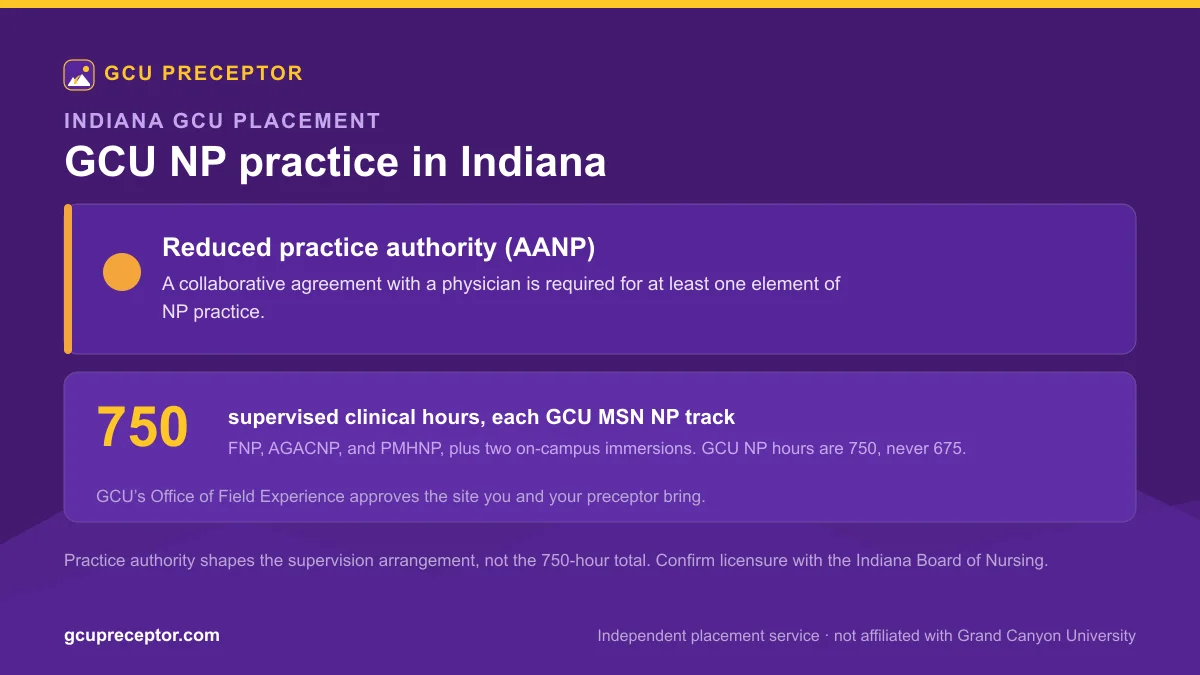
Indiana is reduced practice, with collaboration focused on prescribing
The American Association of Nurse Practitioners lists Indiana as a reduced practice state. The Indiana State Board of Nursing explains that APRNs seeking prescriptive authority must maintain a written collaborative practice agreement with a licensed practitioner. The agreement describes how the clinicians cooperate, coordinate, and consult in patient care and provides for reasonable and timely review of the APRN's prescribing practices.
Indiana's licensing language can surprise students. The Board notes that the APRN license concerns authority to prescribe; a certified nurse practitioner who does not need prescriptive authority practices under an Indiana RN license or an eligible multistate RN privilege. In an ordinary clinic, however, many NPs prescribe as part of their role, so the collaborative agreement is a familiar part of operations.
Collaboration does not turn every patient visit into a jointly conducted appointment. An NP can manage the encounter within the clinician's authorized scope and practice setting while consulting according to the written agreement and professional needs. For a clinical rotation, the useful questions are whether the preceptor's credentials are current, whether the preceptor treats the population required by the course, and whether the site can provide appropriate supervision.
What the Indiana State Board of Nursing record tells you
The Indiana State Board of Nursing operates through the Professional Licensing Agency. Its nursing pages cover RN and compact privileges, APRN prescriptive authority, application requirements, collaborative agreements, renewals, and license verification. The Board also audits selected APRNs with prescriptive authority for compliance with continuing education and collaborative agreement requirements.
A license lookup should be part of initial screening, not an afterthought after a clinician has agreed. Verify the RN basis for practice and the relevant prescriptive authority record, then confirm national certification and specialty directly with the clinician. A valid Indiana credential establishes legal standing, but it does not by itself establish that an FNP, AGACNP, or PMHNP preceptor fits a particular GCU course. OFE makes that academic and field-experience determination.
A sensible credential review
- Use Indiana's official licensing system to verify current status.
- Confirm the preceptor's certification and regular patient population.
- Ask the practice about student access, supervision, and term availability.
- Submit the complete site information to OFE and wait for approval before counting hours.
Search beyond one Indianapolis hospital system
Indianapolis has the largest concentration of clinics, hospitals, behavioral health programs, and specialty groups in the state. It also receives substantial student demand. Students can widen a central Indiana search through Carmel, Fishers, Noblesville, Greenwood, Avon, and Plainfield without abandoning a practical commute. Independent primary care and outpatient psychiatric practices may have different teaching calendars than major systems, so both deserve attention.
Other regional centers can be just as useful. Fort Wayne supports northeast Indiana, South Bend and Mishawaka serve the northern tier, Lafayette and West Lafayette draw patients from surrounding counties, and Evansville anchors the southwest. Bloomington, Terre Haute, Columbus, Muncie, and Richmond each offer local networks with a different mix of primary, acute, and behavioral care. A placement must fit the course, but a broader radius often creates more possibilities than repeating calls to the same large facilities.
At GCU, the student is expected to source the preceptor. The Office of Field Experience supports the process and approves the student-selected site, but it does not find the site. The student nominates the clinician and practice with the Field Experience Site Information Form in the eDocs app. OFE then assesses the information under GCU's preceptor requirements. We can conduct the Indiana outreach and identify a match for submission, while GCU retains final authority over approval.
Connect each Indiana rotation to the full 750-hour plan
GCU's FNP, AGACNP, and PMHNP MSN tracks each require 750 supervised clinical hours. The total is the same across the three tracks, but the experiences are not interchangeable. FNP work centers on primary care across the lifespan, AGACNP work requires adult and older adult acute or complex care, and PMHNP work requires psychiatric mental health practice. Course instructions and OFE review determine whether a specific Indiana setting fits.
The clinical hours can take place at approved Indiana sites, yet each MSN NP track also includes two on-campus immersions in Phoenix. Those campus visits are why the programs are not 100% online. Reserve travel time separately from clinical shifts and verify that a proposed preceptor's availability does not conflict with an immersion or other required course activity.
After an approved rotation begins, students enter their hours in the Lopes Activity Tracker, or LAT. Preceptors review and approve those records through ThunderTime. Regular entries help both parties catch a wrong date, category, or total promptly. Other GCU programs follow different structures: the post-master's FNP certificate includes 750 hours, DNP students complete per-course hours connected to a Direct Practice Improvement project and IRB, and RN-to-BSN students complete 40 practicum hours in NRS-465.
Decide on virtual participation before the first shift
Telehealth is part of care delivery in Indiana, particularly for behavioral health, follow-up visits, and patients far from a specialty office. Its presence at a clinic does not make virtual participation automatically acceptable for a GCU rotation. Ask the program and OFE whether the course permits it, how supervision must occur, and which encounters may count. In-person experience is still important when course outcomes require physical assessment or direct clinical work.
If your calls are not reaching available Indiana preceptors, a free placement review can clarify the next move. Share your track, course, city, travel radius, and term dates, and we will source an appropriate match for you to present to OFE. We are an independent service, separate from GCU; we cannot promise a placement or university approval, and payment is due only after a placement is secured.
Frequently asked questions
Is Indiana a full practice state for nurse practitioners?
No. AANP categorizes Indiana as reduced practice. The Board requires an APRN with prescriptive authority to have a written collaborative practice agreement with a licensed practitioner. Review current Board guidance for the preceptor's exact credential and prescribing situation.
Who approves my Indiana clinical site for GCU?
GCU's Office of Field Experience makes the approval decision. You source a willing preceptor and nominate the site through the eDocs Field Experience Site Information Form. A match from our service still goes through the same OFE review and is not guaranteed approval.
Where should I search outside Indianapolis?
Consider Fort Wayne, South Bend and Mishawaka, Lafayette, Evansville, Bloomington, Terre Haute, Muncie, Columbus, and nearby communities when travel is workable. The best city is the one that offers a properly credentialed, specialty-matched preceptor and a setting OFE approves for the course.
Can telehealth encounters count toward my Indiana clinical hours?
Possibly, but acceptance varies by program, course, and site. Confirm the planned virtual format with your GCU program and OFE before depending on those hours. Do not assume that a clinic's use of telehealth makes every remote encounter eligible.
Get your GCU clinicals handled.
Tell us your track and term. We’ll map your clinical requirement and start the search, in person or virtual. No payment until you’re matched.