How GCU Nursing Students Find Preceptors in Illinois
Illinois is a reduced practice state, even though qualified APRNs can earn a separate full practice authority license. For a GCU student, that distinction helps explain how a prospective preceptor practices and what credentials should be checked before a site goes to university review.
Get matched, free
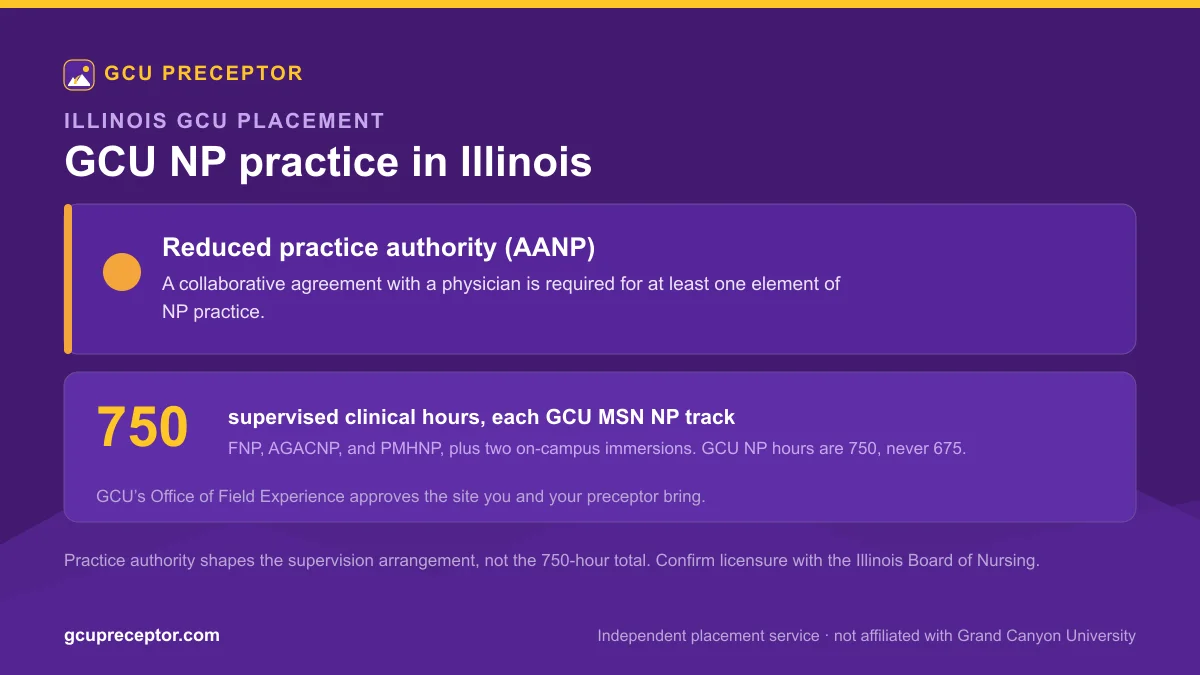
Illinois uses a reduced practice model with an FPA pathway
The American Association of Nurse Practitioners classifies Illinois as a reduced practice state. Illinois permits an advanced practice registered nurse who satisfies the state's experience and education requirements to apply for full practice authority, but the state does not give that status automatically to every newly licensed APRN. An APRN without the full practice authority credential practices under the applicable written collaborative or delegated prescriptive structure.
Day to day, the distinction is visible in a clinic's credentialing file more than in the exam room. Both an APRN with full practice authority and an APRN working through collaboration can assess patients and deliver care within the clinician's education and national certification. The difference concerns the legal authority behind that practice, especially prescribing. A student should not assume that years in practice equal an FPA license. The actual Illinois license record is the reliable answer.
This does not decide whether an NP can precept you. It is one part of the credential picture that GCU's Office of Field Experience reviews. Specialty alignment, current licensure, site fit, and the duties available during the rotation remain central. A family NP working in primary care may suit an FNP course, while adult acute care and psychiatric courses need clinicians and settings that match those populations.
Check Illinois credentials at the state source
Nursing licenses are administered through the Illinois Department of Financial and Professional Regulation, with the Illinois Board of Nursing serving within that regulatory system. IDFPR lists registered professional nurse, APRN, APRN full practice authority, and related controlled substance credentials among the nursing professions it regulates. Its online license lookup is the practical place to confirm a proposed preceptor's current status.
Use the Board and IDFPR materials for current questions about initial licensure, renewal, delegated prescriptive authority, and full practice authority applications. Regulations can change, and a clinic's internal privileging can be narrower than the maximum scope permitted by the state. For placement planning, verify the clinician and then look at what the site will actually allow a student to observe and perform under supervision.
Useful checks before nomination
- Confirm the RN and APRN records are current through IDFPR license lookup.
- Match the preceptor's national certification and everyday patient population to the GCU course.
- Ask whether the clinic can support the assessments, encounters, and supervision expected for the rotation.
- Leave final site and preceptor approval to GCU's Office of Field Experience.
Build the search around Illinois regions and clinical fit
Chicago and its suburbs offer the state's widest range of health systems, independent practices, community clinics, psychiatric services, and specialty groups. They also attract students from many nursing programs. A search limited to downtown Chicago can stall because teaching capacity is already committed. Expanding into Evanston, Skokie, Oak Park, Naperville, Joliet, Elgin, and the wider collar counties can reveal practices that fit the same commute window.
Central and downstate Illinois require a different map. Rockford serves northern Illinois, Peoria and Bloomington Normal anchor central markets, Springfield combines public and private health care, and Champaign Urbana supports a broad regional patient base. Decatur, Quincy, Belleville, Carbondale, and communities near the Metro East can be valuable options when the course and travel radius permit. Rural sites may offer meaningful continuity with patients, but availability is often tied to a small number of clinicians, so early outreach matters.
GCU students are responsible for sourcing their own preceptor. The Office of Field Experience supports the field experience and approves the student-selected site; it does not perform the placement search. Once a clinician agrees, the student submits the Field Experience Site Information Form through the eDocs app. OFE evaluates the information against the course and preceptor requirements before hours may begin. Our independent service handles outreach and sourcing, but no outside service can guarantee GCU approval.
Plan all 750 hours, not only the next Illinois rotation
Each GCU MSN nurse practitioner track, FNP, AGACNP, and PMHNP, requires 750 supervised clinical hours. Those hours need specialty-matched experiences, so accepting an available clinician who does not serve the required population can create a problem later. A rotation plan should account for course sequence, term dates, patient mix, and any limits the site places on student participation.
Illinois students complete approved clinical experiences in their state, but the NP programs still include two on-campus immersions in Phoenix. That required travel means the tracks are not 100% online. Put immersion dates beside Illinois rotation dates when arranging work leave and transportation so neither part of the program competes with the other.
During the field experience, the student records hours in the Lopes Activity Tracker, commonly called LAT, and the preceptor reviews and approves them in ThunderTime. Keeping entries accurate and timely makes discrepancies easier to resolve while the encounter is still fresh. Students in other GCU pathways should follow their own program rules: the FNP post-master's certificate includes 750 hours, DNP practice work supports a Direct Practice Improvement project with IRB and per-course hours, and NRS-465 in the RN-to-BSN pathway includes a 40-hour practicum.
Treat virtual care as a course question
Illinois practices use telehealth in primary care, behavioral health, follow-up care, and some specialty services. That does not mean every virtual encounter counts toward every GCU clinical course. The acceptable format depends on the program, the course outcomes, the supervision available, and OFE's review of the site. Confirm expectations before relying on remote encounters, and expect in-person care to remain important for hands-on assessment and specialty experiences.
If your Illinois search is producing silence or your deadline is getting close, request a free placement review. We will review the specialty, region, schedule, and term dates, then source a suitable option for you to submit to OFE. We are independent from GCU, placement and university approval are never guaranteed, and you pay only when a placement is secured.
Frequently asked questions
Is Illinois a full practice authority state for nurse practitioners?
AANP classifies Illinois as reduced practice. The state offers a full practice authority license to APRNs who complete the applicable experience and education pathway, but not every Illinois APRN holds that credential. Check the clinician's current IDFPR record instead of inferring status from a job title.
Does GCU find an Illinois preceptor for NP students?
No. The student sources the preceptor, then submits the chosen site and clinician through the eDocs Field Experience Site Information Form. OFE supports the process and makes the approval decision. Our service can perform the sourcing independently, but we cannot guarantee OFE approval.
Can I complete all GCU NP requirements while living in Illinois?
You can complete the supervised clinical hours at approved Illinois sites, but the MSN NP tracks also require two on-campus immersions in Phoenix. The 750 clinical hours and the immersion travel are separate parts of the program, so include both in your calendar.
How early should I begin an Illinois preceptor search?
Begin well before the term, especially for PMHNP or AGACNP rotations and for searches limited to Chicago. A willing clinician is only the first step. The site information still needs to be submitted in eDocs and approved by OFE before clinical hours begin.
Get your GCU clinicals handled.
Tell us your track and term. We’ll map your clinical requirement and start the search, in person or virtual. No payment until you’re matched.