Idaho Preceptor Matching for GCU Nursing Students
Idaho is one of the friendlier states in the country for nurse practitioner practice, and that carries real advantages for Grand Canyon University students planning clinical rotations here. This page covers Idaho's full practice environment, the state board, and how to secure a preceptor anywhere from Boise to Coeur d'Alene.
Get matched, free
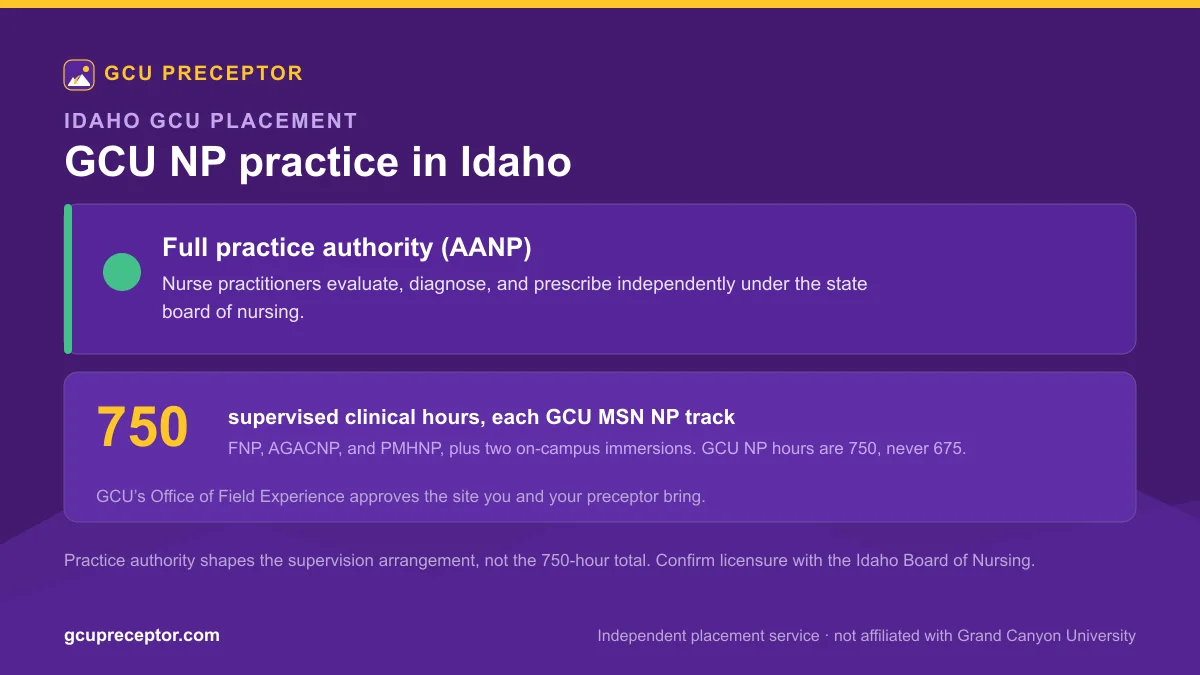
What full practice authority in Idaho means for you
The American Association of Nurse Practitioners classifies Idaho as a full practice state. Licensed NPs here evaluate patients, diagnose, order and interpret diagnostic tests, and initiate and manage treatments, including prescribing medications and controlled substances, under the licensure authority of the state nursing board alone. No collaborative agreement with a physician is required.
For a GCU student, that matters in two practical ways. First, the preceptor pool is wider: experienced Idaho NPs run their own clinics and can precept without a supervising physician signing off on their practice. Second, the care you observe is a clean picture of the role you are training for, because your preceptor makes independent decisions all day. Students in restricted states rarely get that view.
Idaho's Board of Nursing and licensure basics
Nursing in Idaho is regulated by the Idaho Board of Nursing, which operates within the state's Division of Occupational and Professional Licenses (DOPL). The board licenses RNs and APRNs, sets education and practice rules, and handles discipline. Its website is the authoritative place to confirm current APRN requirements, and the DOPL license search lets you verify any Idaho nurse or physician license in seconds, which is worth doing before you nominate a preceptor.
Idaho licenses NPs as APRNs on the basis of graduate education and national certification, and the state participates in the Nurse Licensure Compact for RN licensure. Rules do get updated, so treat the board's site as the source of truth and confirm anything that affects your rotation dates.
How the GCU placement process works from Idaho
GCU does not place students with preceptors. You source your own preceptor and clinical site, and the university's Office of Field Experience (OFE) reviews and approves what you bring. The nomination happens through the Field Experience Site Information Form in the eDocs app; once approved, you log hours in the Lopes Activity Tracker (LAT) and your preceptor verifies them in ThunderTime. Read more about the workflow on our Office of Field Experience and Lopes Activity Tracker pages.
The sourcing step is where Idaho students lose the most time. Cold calls to clinics in Meridian or Idaho Falls go unanswered, practice managers say yes and then go quiet, and semester start dates do not wait. That is the specific gap we fill: we run the outreach, confirm the clinician meets GCU's preceptor requirements, and hand you a match that is ready for the eDocs form.
Where Idaho placements actually happen
Idaho's population, and therefore most of its clinical capacity, sits in a handful of corridors. Where you live shapes the search:
Regions we search
- Treasure Valley: Boise, Meridian, Nampa, and Caldwell hold the state's densest mix of primary care, psychiatric, and acute care settings, which helps FNP, PMHNP, and AGACNP students alike.
- Eastern Idaho: Idaho Falls, Pocatello, and Rexburg support steady family practice and behavioral health placements.
- Magic Valley: Twin Falls anchors clinics that serve a large rural and agricultural region.
- North Idaho: Coeur d'Alene, Post Falls, Sandpoint, Lewiston, and Moscow sit far from Boise, and students here sometimes look across the Washington border, which adds an out-of-state approval wrinkle to plan for.
The 750 hours, the Phoenix immersions, and telehealth
Each of GCU's three MSN nurse practitioner tracks, FNP, AGACNP, and PMHNP, requires 750 supervised clinical hours with specialty-matched preceptors, plus two on-campus immersions in Phoenix, so the programs are not 100% online. Idaho students usually split the hours across two or three preceptors as courses progress; our clinical hours page breaks down the pacing.
The post-master's certificates follow the same model, including a 750-hour FNP certificate. DNP students complete practicum hours course by course while carrying the Direct Practice Improvement project through IRB review, and RN-to-BSN students complete a 40-hour practicum in NRS-465.
One note on telehealth: some Idaho preceptors, especially in psychiatry, see most patients virtually. Whether those hours count depends on your course and specialty, so confirm with your program and the OFE before committing to a mostly virtual site.
If you would rather spend your energy on coursework than on cold outreach, we can carry the search for you. You are matched first and pay only when a placement is secured; see how it works, review our cost page, or request a free placement review and tell us your specialty and timeline.
Frequently asked questions
Can an Idaho nurse practitioner precept me without a physician involved?
In most cases, yes. Idaho grants NPs full practice authority, so an experienced NP can own the care your rotation is built around. Your preceptor still has to meet GCU's specialty and credential rules and be approved by the OFE through the eDocs site form, so review preceptor requirements before nominating anyone.
I live in a small Idaho town. Can I still complete my rotations locally?
Usually, with a longer runway. Rural Idaho clinics do take students, but a single family practice may already be committed to another learner, so start a semester early and cast a wide net across nearby towns. We regularly place students outside the Treasure Valley; a free placement review will tell you what is realistic near you.
Do the Phoenix immersions replace any of my Idaho clinical hours?
No. The two on-campus immersions are a separate program requirement. All 750 supervised hours for the FNP, AGACNP, and PMHNP tracks are completed at approved clinical sites, which for most readers of this page means sites in Idaho.
What does your service cost for an Idaho placement?
We match you first, and you pay only when a placement is secured. There is no charge to start a search or to talk through your timeline. Details are on our cost page.
Get your GCU clinicals handled.
Tell us your track and term. We’ll map your clinical requirement and start the search, in person or virtual. No payment until you’re matched.