Finding Your Hawaii Preceptor as a GCU Nurse Practitioner Student
Hawaii gives nurse practitioners full practice authority, but its island geography makes clinical placements some of the most competitive searches we run. This guide walks GCU students from Honolulu to Hilo through the practice climate, the Board of Nursing, and a realistic plan for all 750 hours.
Get matched, free
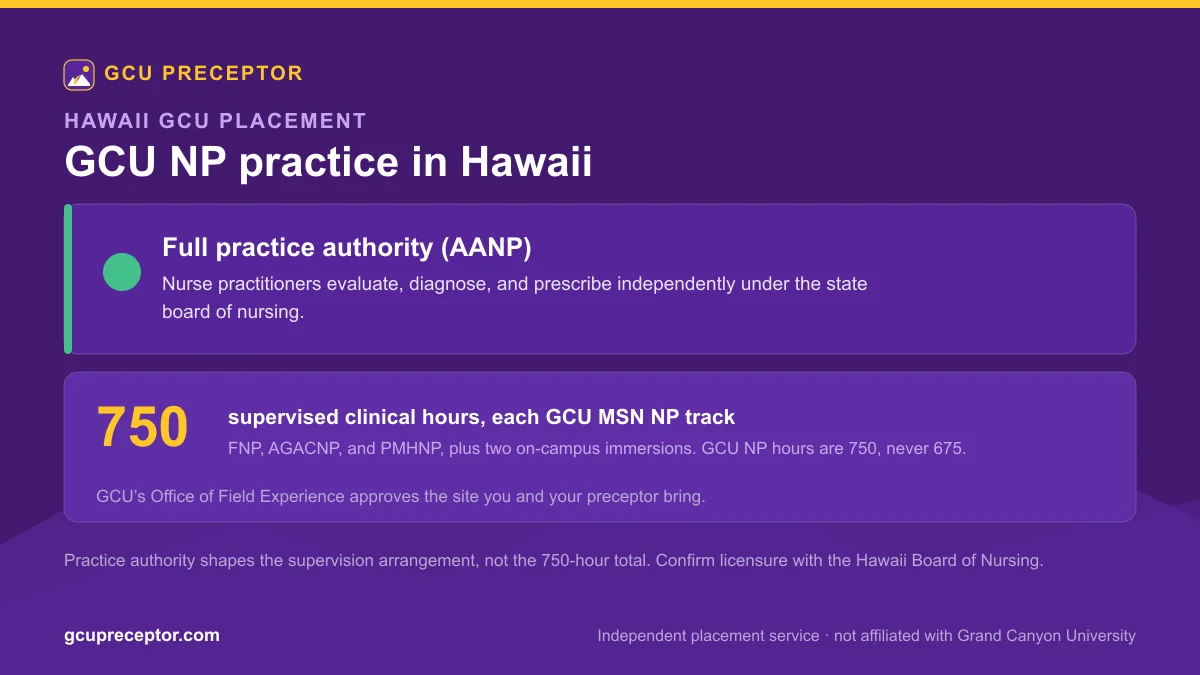
Hawaii is a full practice state, and that shapes your search
The American Association of Nurse Practitioners lists Hawaii as a full practice state. Licensed NPs in Hawaii evaluate patients, diagnose, order and interpret diagnostic tests, and initiate and manage treatments, including prescribing medications, under the licensure authority of the state board of nursing. There is no collaborating physician agreement to sign and no supervisory contract to renew.
For a GCU student, the day-to-day meaning is practical. Independent, NP-led practices are legal here, so the pool of potential preceptors includes experienced nurse practitioners running their own clinics, not just physician-owned groups. An NP with a small family practice in Kaneohe or a psychiatric practice in Honolulu can precept you, provided they meet GCU's preceptor requirements and pass review by the university.
One nuance worth knowing early: prescriptive authority in Hawaii is a separate recognition, called APRN-Rx, granted by the board on top of the APRN license and tied to advanced pharmacology coursework. It will matter to you at graduation, and it explains why some Hawaii NPs you meet describe their license and their prescriptive authority as two distinct credentials.
The Hawaii Board of Nursing, briefly
Nursing in Hawaii is regulated by the Hawaii Board of Nursing, which operates inside the Department of Commerce and Consumer Affairs under its Professional and Vocational Licensing Division. The board licenses RNs and APRNs, grants APRN prescriptive authority, publishes application forms, and maintains the online license lookup.
Two habits will save you headaches. First, keep your own RN license current and unencumbered for the length of your program, since practicum courses depend on it. Second, run every prospective preceptor through the DCCA license search before any paperwork is filed. GCU verifies credentials during site approval, and a lapsed or encumbered license discovered late can cost you a term.
Preceptor hunting, island by island
Oahu holds most of the state's providers. Honolulu, Pearl City, Kapolei, and Kaneohe are where the majority of family practices, behavioral health clinics, and acute care settings sit, which makes Oahu the easiest island to place in, and also the busiest. Local nursing programs rotate students through the same clinics, and many sites cap how many learners they take per term.
The neighbor islands are a different search. Hilo and Kona on Hawaii Island, Kahului and Wailuku on Maui, and Lihue on Kauai have smaller provider pools, and many clinicians there work in community health centers serving shortage areas. Willing preceptors exist, and full practice authority means some of the best ones are NPs practicing on their own, but reaching them takes far more outreach per confirmed yes than a mainland search.
Some students split rotations, flying inter-island for a concentrated stretch with a preceptor on another island. It can work, but weigh flight costs and scheduling before you commit. Whatever your island, start earlier than your mainland classmates would, and read our guide to finding a preceptor before you send a single email.
What GCU expects once you have a name
GCU does not place students. You source your own preceptor, and the Office of Field Experience supports and approves the site you bring. The nomination happens through the Field Experience Site Information Form in the eDocs app, where you identify the site and preceptor so OFE can review credentials and fit for your course.
After approval, tracking is standardized: you log hours in the Lopes Activity Tracker, and your preceptor confirms them in ThunderTime. None of that starts until a qualified Hawaii clinician has said yes, which is the step most students underestimate, and the step we take off your plate. Our team runs the outreach, you are matched first, and you pay only when a placement is secured.
750 hours, planned from the middle of the Pacific
GCU's three MSN nurse practitioner tracks each require 750 supervised clinical hours with specialty-matched preceptors: primary care across the lifespan for the FNP, adult and hospital-based settings for the AGACNP, and psychiatric care for the PMHNP. Every one of those hours can be earned at approved sites in Hawaii.
The programs are not 100% online, though. Each track includes two on-campus immersions at the Phoenix campus. From Honolulu that means a long overwater flight and a three hour time difference that holds year-round, since neither Hawaii nor Arizona observes daylight saving. Book flights early, plan the days off, and treat the immersions as fixed dates on your calendar.
Hawaii students in other programs follow the same site-approval path: the post-master's certificates including the 750 hour FNP certificate, the DNP practicum built around the Direct Practice Improvement project, and the RN-to-BSN practicum with its 40 hour applied project. Our clinical hours guide breaks down what counts where.
Telehealth, timing, and your next step
Telehealth is woven into Hawaii care delivery for obvious geographic reasons, and some rotations may include virtual visits. Whether those hours count toward your requirement depends on your course and specialty, so confirm with your program and OFE before you build a schedule around them.
If your search has stalled, or you would rather not spend evenings cold-calling clinics in Lihue, request a free placement review. We will tell you plainly what the pool looks like on your island and how long comparable matches have taken. We never guarantee placement or GCU approval of a site, and you owe nothing until a placement is secured. Splitting time between Hawaii and the mainland? Browse our other state guides.
Frequently asked questions
Can I finish all 750 clinical hours without leaving Hawaii?
Yes. Clinical hours are completed at OFE-approved sites, and Hawaii sites qualify like any mainland site once approved through the eDocs site form. The two on-campus immersions are the exception; those take place in Phoenix and require travel, but they are campus components, not preceptored clinical hours.
Can a nurse practitioner be my preceptor in Hawaii?
Often, yes. Hawaii's full practice environment means many experienced NPs practice independently, and NPs who meet GCU's specialty and licensure criteria are commonly approved. The final call always belongs to the Office of Field Experience, so review the preceptor requirements before proposing anyone.
How early should I start looking if I live on a neighbor island?
Earlier than almost anyone. Provider pools on Maui, Kauai, and Hawaii Island are small, and a single retirement or clinic closure can remove an option overnight. We recommend starting the search at least a term or two before your first practicum course, and sooner for psychiatric rotations.
Will GCU or the Board of Nursing find a preceptor for me?
No. The Board of Nursing licenses clinicians and does not arrange education placements, and GCU's OFE approves the preceptor you bring rather than assigning one. Sourcing is the student's job, which is exactly the gap our service covers; see how it works and what it costs.
Get your GCU clinicals handled.
Tell us your track and term. We’ll map your clinical requirement and start the search, in person or virtual. No payment until you’re matched.