Finding a GCU Preceptor in Georgia, a Restricted Practice State
Georgia is a restricted practice state for nurse practitioners, and Grand Canyon University expects you to bring your own preceptor before clinicals begin. Here is how NP practice actually works in Georgia, where the Board of Nursing fits in, and how we take the preceptor search off your plate.
Get matched, free
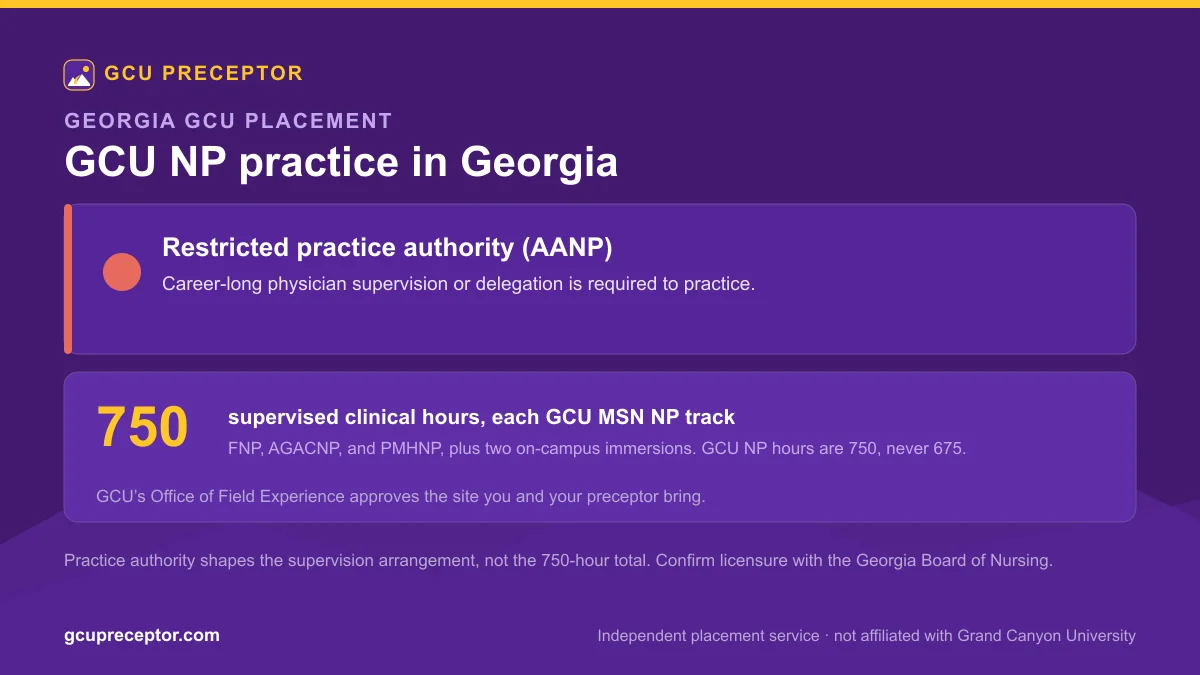
What restricted practice means in Georgia
The American Association of Nurse Practitioners lists Georgia as a restricted practice state, the most regulated of AANP's three categories. To practice and prescribe, a Georgia NP works under a nurse protocol agreement with a delegating physician for the entire span of their career. That agreement spells out which medical acts the physician delegates, including prescriptive authority, and it must be on file with state regulators before the NP can exercise those functions.
Day to day, this looks less dramatic than it sounds. Georgia NPs run primary care panels, staff urgent care and behavioral health clinics, and round in hospitals from metro Atlanta to Albany, and the delegating physician does not have to be in the building. What the category really signals is structure: every practicing NP is formally tied to a physician, and opening an independent NP-owned practice is far harder here than in full practice states. For a GCU student, there is a quiet upside. Georgia's model keeps NPs and physicians working side by side, so clinical sites are already built around supervision and tend to understand what hosting a learner involves.
How the Georgia Board of Nursing fits in
The Georgia Board of Nursing operates within the Georgia Secretary of State's office and governs RN licensure plus APRN authorization. Georgia does not issue a separate NP license; the board grants APRN authorization on top of an active Georgia RN license once your national certification is verified. Applications run through the board's online GOALS portal, and the board offers a free public license lookup that anyone can use without creating an account.
One quirk worth knowing: nurse protocol agreements are registered with the Georgia Composite Medical Board rather than the nursing board, because the authority flows from physician delegation. You will not touch that process as a student, but it is useful context when you talk with prospective preceptors. Do use the nursing board's verification tool to confirm that any preceptor you are considering holds a current, unencumbered Georgia license before you nominate them.
Securing a clinical site in Georgia the GCU way
GCU's model is student-sourced. The Office of Field Experience supports and approves the site you bring; it does not find one for you. You, or we on your behalf, identify a willing preceptor, then nominate the site and preceptor through the Field Experience Site Information Form in the eDocs app. Once OFE signs off, you log every clinical hour in the Lopes Activity Tracker and your preceptor approves those hours in ThunderTime.
Where do Georgia placements actually come from? Metro Atlanta is the densest market, with practices across Marietta, Decatur, Lawrenceville, and the city itself, but competition from local nursing programs there is real. We also match students with preceptors in Augusta, Columbus, Savannah, Macon, Athens, Valdosta, and Albany, and in the smaller towns of middle and south Georgia where a family practice or a behavioral health clinic may never have been asked to precept before. Those under-asked practices are often the fastest yes.
What we handle for you
- Sourcing and vetting Georgia preceptors matched to your track and course
- Confirming licensure and site details so your eDocs submission starts clean
- Coordinating with you through OFE review, following our process
- Matched first: you pay only when a placement is secured (details on our cost page)
The 750 hours, viewed from Georgia
Each of GCU's three MSN nurse practitioner tracks, FNP, AGACNP, and PMHNP, requires 750 supervised clinical hours with specialty-matched preceptors. An FNP student needs family practice style settings across the lifespan, an AGACNP student needs acute and complex adult care, and a PMHNP student needs psychiatric settings. Georgia can supply all three, though acute care rotations cluster around the larger hospital systems in Atlanta, Augusta, Savannah, and Macon.
Remember that these programs are not 100% online: every MSN NP student also travels to two on-campus immersions in Phoenix. Post-master's students face a similar picture, including a 750-hour FNP option among GCU's post-master's certificates. DNP students complete practicum hours course by course while advancing a Direct Practice Improvement project with IRB oversight, and RN-to-BSN students need a 40-hour practicum for NRS-465. Our clinical hours guide breaks all of this down.
Virtual visits versus in-person hours
Telehealth is well established in Georgia, especially in psychiatric care and in the rural counties south of the fall line. Whether telehealth encounters can count toward your clinical hours depends on your course, your specialty, and current program policy, so confirm with your GCU program team and OFE before you build a rotation around it. In-person hours remain the default and the safest plan.
Start with a free Georgia placement review
If a clinical start date is approaching and you still have no confirmed preceptor, do not spend another month cold-calling clinics that never answer. Tell us your track, your course sequence, and your corner of Georgia, and we will run the search while you keep studying. You are matched first and pay only when your placement is secured. Request a free placement review and we will come back with a concrete plan.
Frequently asked questions
Does GCU place students with preceptors in Georgia?
No. GCU's Office of Field Experience approves the preceptor and site you bring; it does not place students. That gap is exactly what our service fills: we source the Georgia preceptor, you nominate the site through the eDocs form, and OFE makes the final approval decision. No one can guarantee OFE approval, and we never claim to.
Can my Georgia preceptor be a nurse practitioner, or must it be a physician?
Preceptor credentials must match your course and specialty area, and both experienced NPs and physicians precept GCU students in Georgia. Review our preceptor requirements overview, then confirm the specific criteria for your course with OFE before nominating anyone.
Do Georgia's restricted practice rules limit what I can do as a student?
Restricted practice governs licensed NPs, not students in supervised rotations. Your scope during clinicals is set by GCU's course objectives and your preceptor's oversight, and you complete the same 750 hours as students in full practice states. The rules matter most after graduation, when practicing in Georgia will require a nurse protocol agreement with a delegating physician.
How do I verify a potential preceptor's Georgia license?
Use the Georgia Board of Nursing's free public lookup on the Secretary of State website. Search by name or license number to confirm the license is active and unencumbered. We run this check on every preceptor we propose before you ever see the match.
Are GCU's on-campus immersions held in Georgia?
No. The two required on-campus immersion experiences for MSN NP students take place at GCU's Phoenix campus, so plan for two trips to Arizona alongside your Georgia-based clinical hours.
Get your GCU clinicals handled.
Tell us your track and term. We’ll map your clinical requirement and start the search, in person or virtual. No payment until you’re matched.