Finding a Preceptor in Florida as a GCU Nurse Practitioner Student
Florida licenses one of the largest APRN workforces in the country, yet it remains one of the tougher states for nurse practitioners to practice independently. Here is what that means for GCU students lining up clinical hours in Florida, and how to secure the right preceptor before the semester clock starts.
Get matched, free
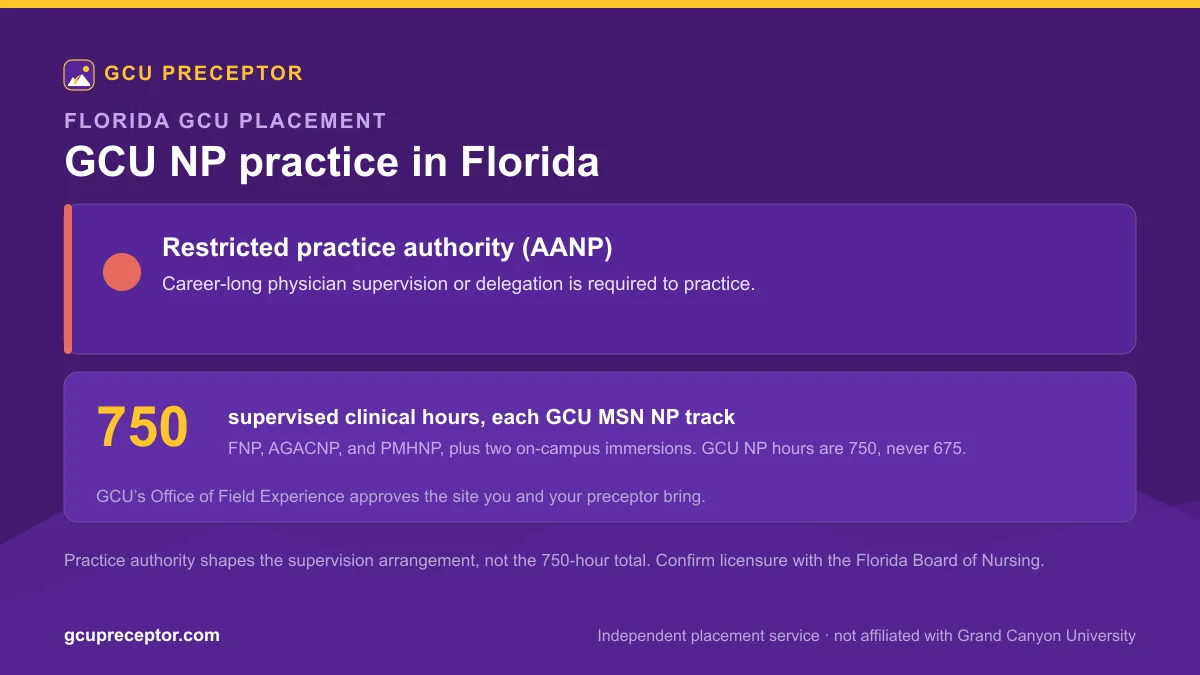
Florida keeps NP practice restricted, and that shapes your search
The American Association of Nurse Practitioners classifies Florida as a restricted practice state. In plain terms, most Florida nurse practitioners work under a written protocol with a supervising physician for as long as they practice. That protocol spells out what the NP may diagnose, treat, and prescribe, and it sits behind almost every clinic you might approach about precepting.
There is one carve-out worth knowing. Since 2020, Florida law (section 464.0123, Florida Statutes) has allowed APRNs to register for autonomous practice, but only in primary care, and only after documenting 3,000 clinical hours under physician supervision within the previous five years plus graduate coursework in differential diagnosis and pharmacology. Autonomous APRNs in family medicine, general pediatrics, and general internal medicine can practice without a supervising physician. Everyone else, including most acute care and many psychiatric NPs, still practices under protocol.
For a student, the day-to-day effect is simple: many Florida preceptor conversations involve more than one decision-maker. The NP may be willing, but the collaborating physician and the practice manager often have to sign off too. Placements here reward early outreach and persistence.
What the Florida Board of Nursing actually governs
The Florida Board of Nursing, operating under the Florida Department of Health, licenses RNs and APRNs, processes autonomous practice registrations, sets continuing education requirements, and handles discipline. Florida APRN licensure requires an active Florida RN license (Florida is a Nurse Licensure Compact state for RNs, but APRN licensure is state-specific), a qualifying graduate degree, and national board certification in the role and population focus.
Before you nominate any Florida preceptor to GCU, spend two minutes on the Department of Health's free license lookup to confirm the license is clear and active, and note whether the APRN holds autonomous registration. It is an easy screen that saves weeks if something is off, and it mirrors the checks GCU runs on its side.
How a Florida placement actually comes together at GCU
GCU does not assign preceptors. You source your own site and preceptor, and the Office of Field Experience reviews and approves what you bring. The nomination happens through the Field Experience Site Information Form in the eDocs app, which captures the site, the preceptor's credentials, and the planned experience. Nothing counts until that approval is in place, so file it well before your course starts.
Once you are cleared and rotating, you log hours in the Lopes Activity Tracker and your preceptor verifies them in ThunderTime. Florida sites are generally comfortable with this once it is explained: no software installs, just periodic approvals.
The sourcing itself is the hard part, and it is what we do. We run targeted outreach across Miami, Fort Lauderdale, and West Palm Beach, the Tampa Bay and Sarasota corridor, Orlando and the I-4 belt, Jacksonville, Tallahassee, Gainesville, Pensacola, and the Fort Myers and Naples market, then hand you vetted, willing preceptors who fit your track. You are matched first and pay only when a placement is secured; details are on how it works and cost.
Meeting the 750-hour requirement from Florida
Each of GCU's three MSN nurse practitioner tracks requires 750 supervised clinical hours with specialty-matched preceptors, plus two on-campus immersions in Phoenix. The immersions are the only travel built into the program; the clinical hours themselves can be completed near home in Florida.
Florida's patient mix is an asset if your rotations are matched well. The state's large retiree population creates deep adult and geriatric caseloads, while fast-growing family communities around Orlando, Tampa, and Jacksonville keep pediatric and family practice panels full.
Where each GCU track tends to land in Florida
- FNP students rotate through family medicine, internal medicine, pediatrics, and women's health, often in the primary care networks around Orlando, Tampa, and South Florida.
- AGACNP students need acute and complex care, typically hospitalist, ICU, or specialty inpatient services in the large systems of Miami, Tampa, Jacksonville, and Gainesville.
- PMHNP students precept in outpatient psychiatry, community mental health, and telepsychiatry practices, a sector Florida has expanded rapidly.
- Post-master's certificate, DNP practicum, and RN-to-BSN practicum students follow the same source-then-approve path with their own hour structures.
Virtual visits versus in-person hours
Telehealth is well established in Florida, and some practices will offer you virtual patient encounters. Treat them carefully: whether telehealth hours count varies by course and specialty, and a rotation built on them can unravel late. Confirm with your GCU program team and OFE before you rely on any virtual arrangement, and treat in-person precepting as the default.
Start before the semester clock does
In a restricted practice state, preceptor searches take longer because more people have to say yes. If cold-calling Florida clinics is not how you want to spend your term, tell us your track, city, and clinical start date through a free placement review and we will start the outreach while you focus on coursework. Review our preceptor requirements first so every candidate we surface is one OFE can approve.
Frequently asked questions
Is it harder to find a preceptor in Florida than in full practice states?
Often, yes. Because most Florida NPs practice under a physician protocol, a willing preceptor may still need sign-off from a collaborating physician and the practice's leadership. That adds time, not impossibility. Starting a semester ahead, or handing the outreach to a placement team, is the reliable fix.
Can an autonomous APRN in Florida serve as my GCU preceptor?
Potentially. Autonomous registration under Florida law is limited to primary care, so it most often fits FNP rotations. The preceptor still has to match your course's specialty and population focus and pass OFE review through the eDocs site form. See our preceptor requirements overview before nominating anyone.
Do I complete everything in Florida, or is travel required?
Your 750 supervised clinical hours can be completed at approved sites in Florida, near where you live. The two on-campus immersions in Phoenix are the only built-in travel for GCU's MSN NP tracks, so plan flights around those dates and keep the rest local.
Does GCU have to approve my Florida site before I start hours?
Yes. You nominate the site and preceptor through the Field Experience Site Information Form in eDocs, and the Office of Field Experience must approve it before any hours count. After approval, you log hours in the Lopes Activity Tracker and your preceptor verifies them in ThunderTime.
Get your GCU clinicals handled.
Tell us your track and term. We’ll map your clinical requirement and start the search, in person or virtual. No payment until you’re matched.