GCU Clinical Placements in Delaware, County by County
Delaware is a full practice authority state, so nurse practitioners there evaluate, diagnose, and prescribe under the Board of Nursing alone. That is good news for GCU students, and this page walks through what it means for your preceptor search from Wilmington down to the beach towns.
Get matched, free
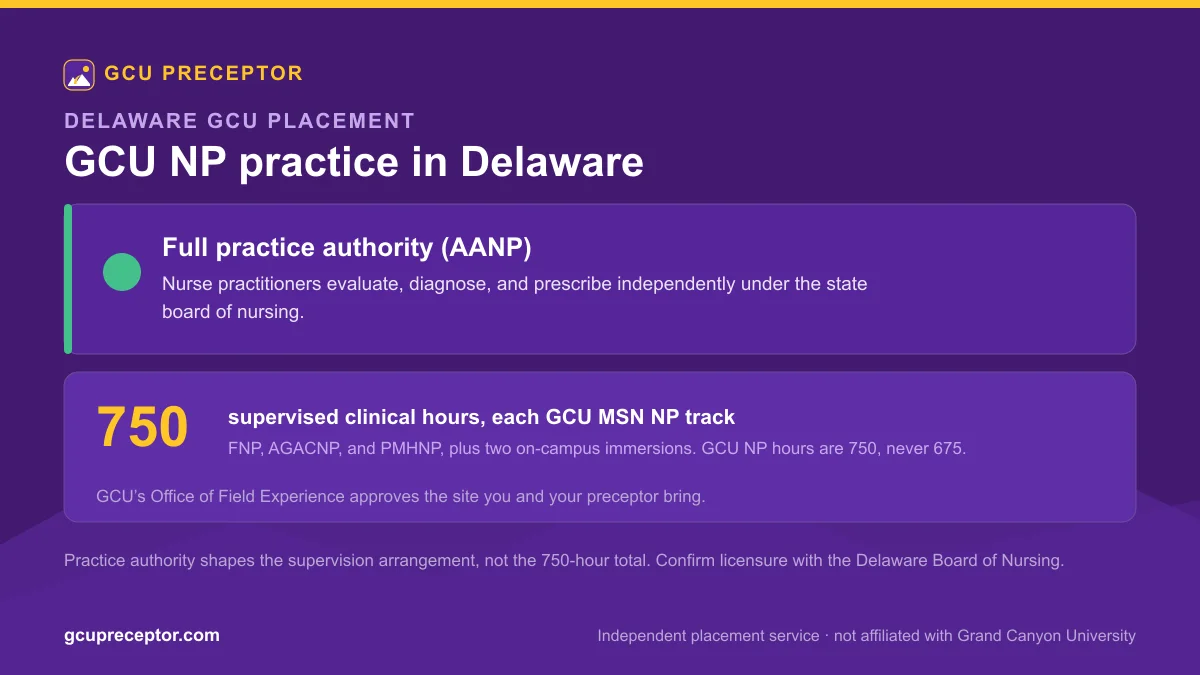
Full practice authority is the Delaware baseline
The American Association of Nurse Practitioners lists Delaware as a full practice state. Since House Bill 141 was signed in 2021, APRN licensure comes with full practice authority attached: nurse practitioners evaluate patients, order and interpret diagnostic tests, and initiate and manage treatments, including prescriptions and controlled substances, under the exclusive licensure authority of the state board of nursing. No mandatory collaborative agreement stands between a licensed Delaware NP and independent work, though individual employers may still require one internally.
Day to day, that shows up everywhere you might train. NP-led primary care practices operate in all three counties, health systems credential NPs to manage their own patient panels, and behavioral health clinics staff PMHNPs who handle medication management independently. For a clinical student, a mature full practice environment usually means a deeper pool of experienced NPs who own their schedules and can actually say yes to precepting, which matters more in a small state than almost anywhere else.
The Delaware Board of Nursing, in practice
APRN licensure runs through the Delaware Board of Nursing, which sits inside the state's Division of Professional Regulation. The board licenses RNs, LPNs, and APRNs, and it handles applications, renewals, and discipline through DELPROS, Delaware's online licensing portal. The APRN credential follows the familiar pattern: an active RN license, a graduate degree in your role, and national certification in your role and at least one population focus.
Two habits will serve you well during placement season. First, verify any prospective preceptor's license through the DELPROS lookup before you invest weeks in the relationship. Second, when a question comes up about scope or what a specific practice setting allows, go to the board's published rules in Title 24 of the Delaware Code rather than word of mouth; the answer you can cite is the one your preceptor's compliance office will accept.
Where GCU students actually find preceptors in Delaware
Here is the GCU reality: the university does not place you. You source your own preceptor, and GCU's Office of Field Experience approves the site and preceptor you bring forward. The site is nominated through the Field Experience Site Information Form in the eDocs app, your hours are logged in the Lopes Activity Tracker, and your preceptor signs off in ThunderTime. Our service exists for the first step, the sourcing, which is the part students in a three-county state feel most acutely. Read how the OFE approval flow works and what GCU expects of a preceptor before you start outreach.
New Castle County has the density: the ChristianaCare footprint around Wilmington and Newark, plus a thick band of private practices through Middletown. It also has the competition, because students from Philadelphia-area programs cross into the same offices. Kent County, anchored by Dover, Smyrna, and Milford, has fewer academic affiliations and often friendlier answers. Sussex County, from Seaford and Georgetown out to Lewes, Millsboro, and the coast, carries real primary care shortages and a large retiree population, which makes it fertile ground for family practice hours if you are willing to drive.
A Delaware outreach list that works
- Independent NP practices in Middletown, Smyrna, and Milford, where full practice authority means the decision maker is the NP
- Federally qualified health centers and rural clinics in Kent and Sussex counties, which live the access gaps NPs fill
- Behavioral health groups around Wilmington, Dover, and Georgetown for PMHNP hours
- Hospitalist and specialty groups along the I-95 and Route 1 corridors for AGACNP rotations
Mapping 750 hours onto the First State
Each of GCU's three MSN nurse practitioner tracks, FNP, AGACNP, and PMHNP, requires 750 supervised clinical hours with preceptors matched to your specialty and population focus. Family hours want lifespan primary care, acute care hours want hospital and specialty settings, and psych hours want settings where mental health is the work of the day. Delaware can supply all three, but rarely from a single site, so most students assemble two or three placements across a county or two. The clinical hours guide breaks down how the total splits across courses.
Remember the program is not 100% online: every track includes two on-campus immersions in Phoenix. From northern Delaware, Philadelphia International is the practical airport; from Sussex County, many students find BWI just as easy. Post-master's students follow the same sourcing path, including the 750-hour post-master's FNP certificate. DNP students accrue practicum hours per course while completing the Direct Practice Improvement project with IRB review, and RN-to-BSN students need the 40-hour NRS-465 practicum, which Delaware students often complete in community or public health settings.
Telehealth, timing, and getting help
Delaware practices adopted telehealth broadly, and some preceptors will offer virtual visit blocks. Whether those hours count toward your total varies by course and specialty, so confirm with your GCU program and OFE before you build a schedule around them, and treat in-person hours as your foundation.
One honest recommendation: start 90 days or more before your course opens, because OFE approval has its own timeline after you find the match. If you would rather not spend those weeks cold-calling practices, that is the work we do all day. Tell us your track, your ZIP code, and your window, and we run the statewide search: you are matched first and pay only when a placement is secured. Start with a free placement review, or see how it works end to end.
Frequently asked questions
Is Delaware a full practice authority state for nurse practitioners?
Yes. AANP classifies Delaware as a full practice state. Since House Bill 141 in 2021, APRN licensure carries full practice authority, so NPs evaluate, diagnose, and prescribe under the Board of Nursing without a mandatory collaborative agreement.
Does GCU find my preceptor in Delaware?
No. GCU students source their own preceptors. The Office of Field Experience then reviews and approves the site you nominate through the eDocs site form, your hours go into the Lopes Activity Tracker, and your preceptor approves them in ThunderTime. Our service handles the sourcing so you arrive at OFE with a ready match.
Can a Delaware nurse practitioner serve as my preceptor?
Often, yes. Preceptors are matched to your track's specialty and population focus, and Delaware's full practice environment gives it a strong bench of experienced NPs. Check the preceptor requirements for your course and confirm the specific match with OFE.
I live in Sussex County. Is placement realistic without leaving the state?
Usually. Seaford, Georgetown, Milford, and the Lewes corridor have active primary care and behavioral health practices, and shortage areas often welcome students. Acute care rotations may pull you north toward Dover or Wilmington, so budget drive time for AGACNP hours.
Do telehealth hours count toward my 750?
Sometimes, within limits that vary by course and specialty. Confirm with your GCU program and OFE before counting virtual visits toward your total, and keep in-person hours as the core of your plan.
Get your GCU clinicals handled.
Tell us your track and term. We’ll map your clinical requirement and start the search, in person or virtual. No payment until you’re matched.