Finding a Clinical Preceptor in Connecticut as a GCU Student
Connecticut is a full practice authority state, and it packs an unusually dense healthcare market into a small footprint. Here is what that means for GCU nurse practitioner students hunting for preceptors from Stamford to the Quiet Corner, and how to get the search off your plate.
Get matched, free
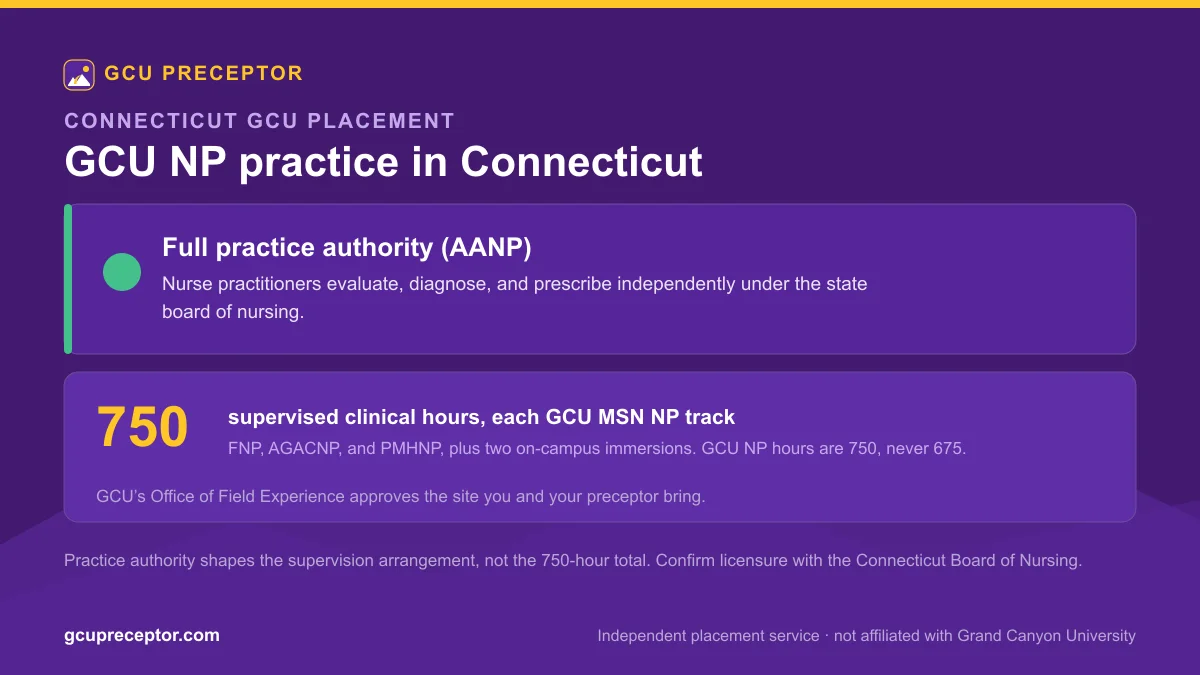
Full practice authority in Connecticut, with a waiting period
The American Association of Nurse Practitioners classifies Connecticut as a full practice state. Legislation passed in 2014 lets APRNs evaluate patients, diagnose, order and interpret tests, and manage treatment, including prescribing, under the licensure authority of the state board rather than under mandatory physician oversight.
There is one wrinkle worth knowing. Connecticut requires a transition period first: a newly licensed APRN must practice in collaboration with a physician for at least three years and 2,000 hours before practicing independently. After that milestone, collaboration becomes a choice, not a requirement.
For a GCU student this is mostly good news. Connecticut has a deep bench of experienced, independently practicing NPs across primary care, acute care, and psychiatry, plus plenty of physicians who are used to working alongside APRNs. Both groups make strong preceptor candidates. Your own supervision as a student never changes with state politics: you always practice under an approved preceptor at an approved site.
Who regulates nursing in Connecticut
Nursing in Connecticut is overseen by the Connecticut Board of Examiners for Nursing, which operates within the Department of Public Health. DPH issues RN and APRN licenses, while the board handles practice standards and discipline.
APRN licensure in Connecticut requires a Connecticut RN license, a graduate degree in the certified specialty, national certification from an approved body, and 30 hours of pharmacology coursework. You can confirm any potential preceptor's license status and history through the state's eLicense lookup before you nominate them, which is a smart step before paperwork starts.
Quick pointers
- Verify a Connecticut NP, PA, or physician license online before submitting a site nomination.
- Ask a prospective NP preceptor how long they have been licensed; seasoned APRNs past the collaboration window are common across the state.
- Connecticut APRNs renew with 50 contact hours of continuing education every two years, so most maintain active specialty involvement.
Where GCU students actually find preceptors in Connecticut
Connecticut's clinical geography splits into a few distinct markets. Hartford and its ring of suburbs anchor one, with large health systems, specialty groups, and community practices concentrated from New Britain up through the Farmington Valley. New Haven anchors another, dense with academic medicine, federally qualified health centers, and behavioral health programs. Fairfield County, from Bridgeport through Norwalk, Stamford, and Danbury, runs on a busy mix of private practices and urgent care. Waterbury, Middletown, Norwich, New London, the shoreline towns, the Litchfield Hills, and the rural northeast corner round out the map.
The catch: several in-state NP programs compete for these same sites, and popular primary care and psychiatric practices field steady streams of student requests. Cold calls go unanswered, office managers gatekeep, and the semester clock keeps moving. Students in smaller markets like Torrington or Willimantic often face the opposite problem, fewer sites overall, and may need to widen the radius toward Hartford or New Haven.
This is exactly the gap we work. We run targeted outreach to specialty-matched Connecticut preceptors on your behalf, confirm willingness and availability, and hand you a candidate ready for GCU's review. You are matched first and pay only when a placement is secured. Start with a free placement review or read how it works.
How GCU approval works from Connecticut
GCU does not place students. Its Office of Field Experience supports and approves the site you bring, so the sourcing burden sits with you. Once you have a willing Connecticut preceptor, you nominate the site and preceptor through the Field Experience Site Information Form in the eDocs app, and OFE reviews the match against preceptor requirements.
After approval, your documentation runs on GCU's tools: you log clinical hours in the Lopes Activity Tracker, and your preceptor approves them in ThunderTime. Build lead time into your plan. Site agreements and preceptor review take weeks, not days, so the best Connecticut students start sourcing a full term ahead. Our find a preceptor service plugs into this exact workflow: we deliver the preceptor, you keep the GCU process.
Meeting 750 hours from a Connecticut zip code
Each of GCU's three MSN nurse practitioner tracks requires 750 supervised clinical hours with specialty-matched preceptors. FNP students typically rotate through family practice, internal medicine, pediatrics, and women's health, all plentiful across Hartford and New Haven counties. AGACNP students need acute and complex care exposure, which concentrates in the larger hospitals of Hartford, New Haven, and Bridgeport. PMHNP students draw on Connecticut's substantial behavioral health network, from outpatient psychiatry groups to community mental health centers.
The MSN tracks are not fully online: every NP student attends two on-campus immersions in Phoenix, so budget two trips west, roughly a flight from Bradley International or the New York area airports. Post-master's students follow a similar clinical pattern, including a 750-hour FNP certificate option, detailed on our post-master's certificate page. DNP students complete practicum hours per course while building the Direct Practice Improvement project through IRB review, and RN-to-BSN students complete a 40-hour practicum in NRS-465. A fuller breakdown lives on our clinical hours page.
On virtual rotations: some Connecticut practices offer telehealth-heavy schedules, and acceptability varies by program, course, and competency. Before counting on a virtual or hybrid arrangement, confirm it with your program and OFE in writing.
Frequently asked questions
Is Connecticut a full practice authority state for nurse practitioners?
Yes. AANP classifies Connecticut as full practice. APRNs first complete a transition period of three years and 2,000 hours in collaboration with a physician, then may practice independently. As a student, none of this changes your status: you always train under an approved preceptor.
Can an APRN who is still in the collaboration period precept me?
A preceptor's independent practice status and their eligibility to precept are separate questions. GCU evaluates each nominated preceptor against its own criteria through the Office of Field Experience, so check the preceptor requirements and let OFE make the call on any specific candidate. Experienced, specialty-matched preceptors clear review most smoothly.
Do Connecticut students have to travel to Arizona?
Yes. GCU's MSN NP tracks include two required on-campus immersions in Phoenix, so the programs are not 100% online. Plan for two trips during the program; the rest of your clinical work happens at your approved Connecticut sites.
Can any of my clinical hours be completed through telehealth?
Sometimes, but do not assume. Telehealth acceptability depends on your program, the course objectives, and the competencies each rotation must cover. Get written confirmation from your program and OFE before you build a Connecticut placement around virtual visits.
What does preceptor placement help cost in Connecticut?
You are matched with a preceptor first and pay only when your placement is secured. Pricing details are on our cost page, and a free placement review is the fastest way to get a specific answer for your track and timeline.
Get your GCU clinicals handled.
Tell us your track and term. We’ll map your clinical requirement and start the search, in person or virtual. No payment until you’re matched.