Colorado Preceptor Matching for GCU Nurse Practitioner Students
Colorado gives nurse practitioners full practice authority, which widens your preceptor options considerably, yet GCU still expects you to bring your own approved preceptor. Here is how the state works, what the Office of Field Experience needs from you, and how we take the search off your plate.
Get matched, free
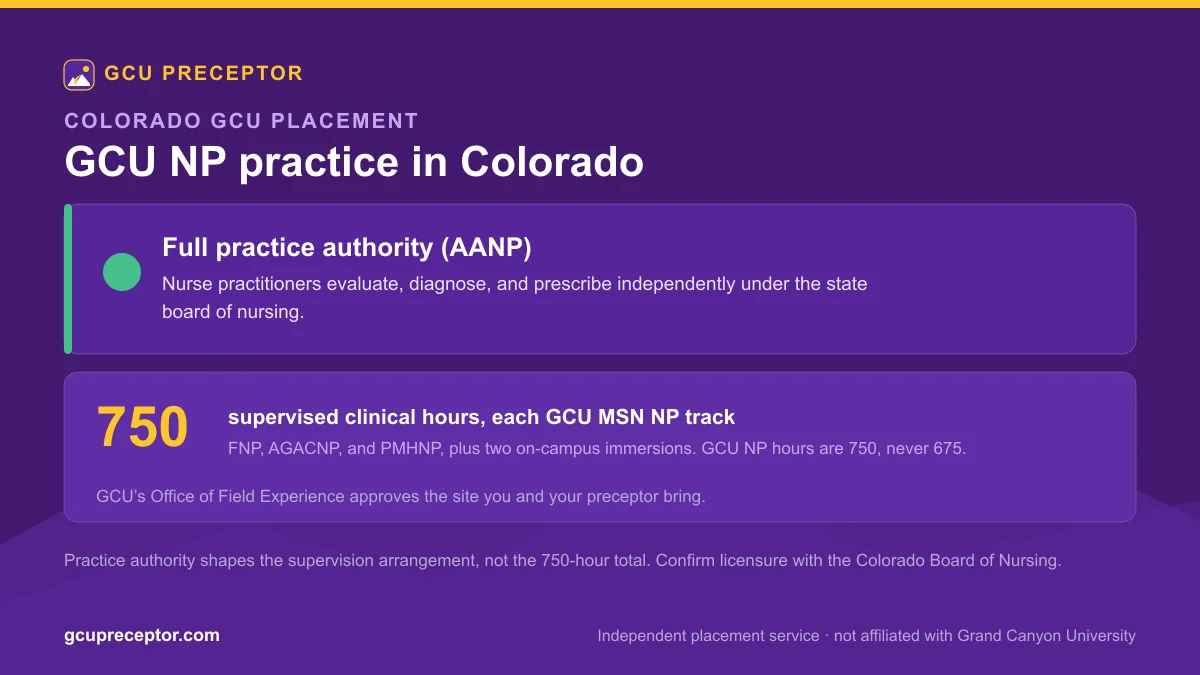
Full practice authority in Colorado, in plain terms
The AANP lists Colorado as a full practice state. Licensed NPs in Colorado evaluate patients, diagnose, order and interpret diagnostic tests, and initiate and manage treatments, including prescriptions, under the licensure authority of the Colorado State Board of Nursing alone. No physician collaboration or supervision agreement is required for an NP to run a practice.
For a GCU student hunting clinical hours, that is good news. Your potential preceptor pool includes independent NP-owned clinics, not just physician-led groups. A family NP running her own practice in Pueblo or a psychiatric NP seeing patients solo in Grand Junction can agree to precept you without asking anyone's permission first.
One wrinkle worth knowing: Colorado grants prescriptive authority in stages. A newly licensed APRN starts with provisional prescriptive authority and completes a structured prescribing mentorship before the board grants full authority. Most experienced preceptors hold full authority, but if you are considering an early-career NP, it is a detail worth checking on the board's site.
Who regulates NPs here: the Colorado State Board of Nursing
The Colorado State Board of Nursing sits inside the Division of Professions and Occupations at the Department of Regulatory Agencies, which everyone shortens to DORA. The board licenses RNs and advanced practice registered nurses, administers prescriptive authority, sets scope and delegation rules, and handles discipline.
Colorado licenses APRNs by role and population focus, built on an active RN license, graduate education, and national certification. You can verify any Colorado nurse's license, including a prospective preceptor's, through DORA's free online lookup, and we do exactly that for every candidate we bring you.
Colorado also participates in the Nurse Licensure Compact. If you hold a multistate RN license from another compact state, it generally covers clinical activity in Colorado, but confirm your situation with the board and with the Office of Field Experience before your rotation starts.
The preceptor search, from the Front Range to the Western Slope
GCU does not place you. You find a preceptor and a site, then the Office of Field Experience reviews what you bring, using the Field Experience Site Information Form in the eDocs app to nominate the site and preceptor. Once approved and rotating, you log hours in the Lopes Activity Tracker and your preceptor signs off in ThunderTime.
The search is the hard part, and Colorado has a particular shape to it. The Front Range corridor, Denver, Aurora, Colorado Springs, Fort Collins, Boulder, and Greeley, holds most of the state's clinics and most of its nursing students, so popular preceptors field a steady stream of requests from local programs. Meanwhile the Western Slope, the San Luis Valley, and the Eastern Plains have willing preceptors that Front Range students rarely think to ask, in towns like Montrose, Alamosa, and Sterling.
That is where our search earns its keep. We contact licensed, specialty-matched Colorado preceptors, screen them against GCU's preceptor requirements, and hand you a candidate ready for the eDocs nomination. Final approval always rests with the OFE. You are matched first and pay only when a placement is secured; see how it works and what it costs.
Fitting GCU's 750 hours into Colorado life
Each of GCU's three MSN NP tracks, FNP, AGACNP, and PMHNP, requires 750 supervised clinical hours with preceptors matched to your specialty and patient population. The post-master's certificates follow the same logic, including a 750-hour FNP certificate. DNP students complete practicum hours course by course around the Direct Practice Improvement project, covered in our DNP practicum guide, and RN-to-BSN students need 40 hours for the NRS-465 applied EBP practicum, covered in the RN-to-BSN guide.
Remember the NP programs are not 100% online: every MSN NP track includes two required on-campus immersions in Phoenix. From Colorado that is one of the easier trips in the country, a short nonstop flight from Denver, and the rest of your hours happen at approved sites back home.
Specialty shapes geography. AGACNP students need acute and hospital-based settings, which concentrates options in Denver metro and Colorado Springs systems. PMHNP students find demand nearly everywhere, since behavioral health shortages run deep in Colorado's mountain and rural counties. FNP students have the widest map of all, from family practices in Loveland to community clinics in Durango. Our clinical hours guide breaks down how the 750 hours distribute across courses.
Telehealth hours in a telehealth-friendly state
Colorado leans on telehealth heavily, especially for psychiatric care and for patients separated from the nearest clinic by a mountain pass. Some rotations may accommodate virtual visit hours, and PMHNP students ask about this most. Acceptability varies by course, specialty, and preceptor, so treat telehealth as a possibility to confirm with your program and the OFE, not a plan to build on. In-person remains the default expectation for most rotations.
If you would rather spend the next few months studying than cold-calling clinics, request a free placement review and tell us your track, your timeline, and where in Colorado you live. We will take the search from there.
Frequently asked questions
Is Colorado a full practice authority state for NPs?
Yes. The AANP classifies Colorado as full practice, meaning NPs evaluate patients, diagnose, order and interpret tests, and manage treatment, including prescribing, under the Colorado State Board of Nursing's licensure authority alone. New APRNs do move through a staged path to full prescriptive authority, so ask an early-career preceptor about their status.
Can an independent Colorado NP be my GCU preceptor?
Usually, yes. Because Colorado NPs practice without physician collaboration agreements, an experienced NP in your specialty can precept you on their own authority. They still must meet GCU's preceptor requirements and be approved by the Office of Field Experience through the eDocs site form before any hours count.
Do I need a Colorado RN license to complete clinicals in Colorado?
You need an RN license that is valid in Colorado. The state belongs to the Nurse Licensure Compact, so a multistate license from another compact state generally works, while a single-state license from elsewhere will not. Verify your status through DORA's license lookup and confirm requirements with the OFE.
How early should I start looking for a Colorado preceptor?
Start at least a full semester before your clinical course begins. OFE approval takes time on top of the search itself, and Front Range preceptors book up quickly. If you are already behind, a free placement review costs nothing and shows you what is realistic for your timeline.
Get your GCU clinicals handled.
Tell us your track and term. We’ll map your clinical requirement and start the search, in person or virtual. No payment until you’re matched.