Finding a GCU Preceptor in California
California is the largest nursing market in the country and one of the hardest places to line up an NP preceptor on your own. Here is how practice authority actually works in the state, what the Board of Registered Nursing oversees, and how GCU students get their clinical hours placed and approved.
Get matched, free
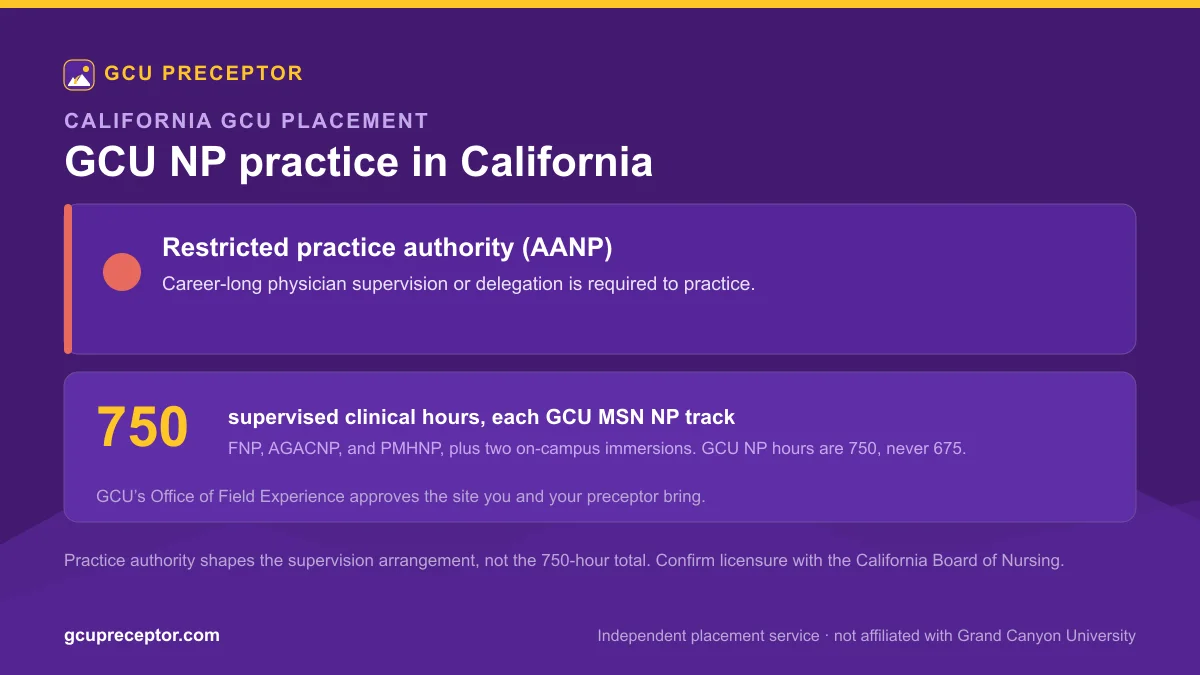
Where California stands on NP practice authority
The AANP classifies California as a restricted practice state. In plain terms, a standard California nurse practitioner does not practice on an independent license. Most NPs in the state work under standardized procedures, which are written policies developed and approved together with a physician and surgeon that spell out what the NP may do in that practice setting.
Assembly Bill 890, signed in 2020, opened two newer routes. A 103 NP has completed a transition to practice of three years or 4,600 hours in California and may work without standardized procedures, but only in a group setting that includes at least one physician. A 104 NP may practice independently within the population focus of their national certification, and because the law requires three years as a 103 NP first, the Board only began reaching that stage in 2026. The categories come from Business and Professions Code sections 2837.103 and 2837.104.
For a GCU student in clinicals, the day to day effect is simple: nearly every NP you might train under is embedded in a physician-connected practice structure. That shapes which sites say yes, how quickly agreements move, and why California placements reward early, organized outreach.
The California Board of Registered Nursing, in practical terms
NPs in California answer to the California Board of Registered Nursing (BRN), a board within the state Department of Consumer Affairs. The BRN licenses registered nurses, certifies nurse practitioners, issues the furnishing number an NP needs to furnish drugs and devices, and administers the newer 103 and 104 certifications created by AB 890.
Before you nominate a California site to GCU, it is worth five minutes to confirm your proposed preceptor's standing. You can verify any RN license or NP certification through the Department of Consumer Affairs license search linked from the BRN site, and the board's nurse practitioner practice pages explain furnishing and certification categories in detail.
What the BRN handles
- RN licensure and renewal across the state
- NP certification, plus 103 and 104 certification under AB 890
- Furnishing numbers for NPs who prescribe
- Public license verification through the DCA license search
Finding a preceptor when every program is competing for the same sites
California concentrates dozens of nursing programs into a handful of metros, so Los Angeles, Orange County, San Diego, and the Bay Area are some of the most saturated preceptor markets in the country. Students who only search close to a big-city home address often burn a full semester on unanswered emails. Odds improve fast in the Central Valley around Fresno, Bakersfield, and Modesto, in the Inland Empire around Riverside and San Bernardino, and in the Sacramento region and far northern counties, where clinics see fewer requests.
Here is the GCU reality: the university does not place you. You source your own preceptor, and GCU's Office of Field Experience reviews and approves the site you bring. The site and preceptor are nominated through the Field Experience Site Information Form in the eDocs app, your hours are logged in the Lopes Activity Tracker, and your preceptor signs off in ThunderTime. The sourcing gap in the middle is exactly what we fill.
We run the search for you: targeted outreach to California clinicians in your specialty, vetting against GCU's preceptor requirements, and steady follow-through until the paperwork is ready for OFE. You are matched first and pay only when a placement is secured. Our how it works page walks through each step, and pricing is explained here.
Your 750 hours, seen from California
Each of GCU's three MSN nurse practitioner tracks, FNP, AGACNP, and PMHNP, requires 750 supervised clinical hours with specialty-matched preceptors. A PMHNP student needs psychiatric-mental health settings, an AGACNP student needs acute and complex care with adult and older adult patients, and an FNP student needs primary care across the lifespan. In a state as large as California, matching the specialty is usually harder than finding a clinic, which is why we anchor the search to your track rather than to any willing site. The clinical hours page breaks the totals down by program.
The MSN tracks also include two required on-campus immersions in Phoenix, so the programs are not 100% online. From most of California that is a short flight or a day's drive, which makes GCU's structure less of a burden for West Coast students than for most of the country. Post-master's certificates, including a 750-hour FNP certificate, follow the same preceptor logic. DNP students complete practicum hours per course while building the Direct Practice Improvement project through IRB review, and RN-to-BSN students complete a 40-hour practicum in NRS-465.
Virtual hours, and a sensible next step
California clinics adopted telehealth early and many NP preceptors now split their week between video visits and exam rooms. Whether virtually precepted hours can count toward your course requirements varies by program and by course, so confirm with your GCU program team and OFE before you plan around telehealth. When it is approved, it can widen your search well beyond your zip code.
If you are staring down a deadline in a saturated California metro, you do not have to keep cold-calling alone. Tell us your track, your city, and your start date, and we will begin a targeted search, or request a free placement review and we will map your realistic options first. You can also compare notes with other states or browse the FAQ.
Frequently asked questions
Is California a full practice authority state for nurse practitioners?
No. The AANP lists California as a restricted practice state. Most NPs work under standardized procedures developed with a physician, though AB 890 created 103 NP and 104 NP certifications that reduce or remove that requirement for NPs who complete a multi-year transition to practice in California.
Who can serve as my GCU preceptor in California?
It depends on your program and course, and GCU's Office of Field Experience makes the final call on any site you nominate through the eDocs site form. Review the preceptor requirements for your track, and verify a proposed preceptor's California license through the BRN's license search before submitting paperwork.
Do California students still have to travel to Arizona?
For the MSN NP tracks, yes. GCU requires two on-campus immersions in Phoenix, while all 750 supervised clinical hours can be completed at approved sites near you in California. From most of the state, Phoenix is a short flight or a manageable drive.
Can any of my California clinical hours be completed through telehealth?
Sometimes. California preceptors use telehealth heavily, but whether virtual hours count toward a specific GCU course varies. Confirm with your program and OFE before relying on it, and treat approved telehealth as a supplement to in-person hours rather than a replacement.
How does your placement service work for California students?
You tell us your specialty track, preferred region, and timeline. We contact and vet California preceptors who fit GCU's requirements, you are matched first, and you pay only when a placement is secured. Then OFE approval, LAT logging, and ThunderTime sign-off proceed as usual. Start with a free placement review.
Get your GCU clinicals handled.
Tell us your track and term. We’ll map your clinical requirement and start the search, in person or virtual. No payment until you’re matched.