Arkansas Clinical Placements for GCU Nursing Students
Arkansas gives nurse practitioners a reduced practice environment, and GCU expects you to bring your own preceptor before the Office of Field Experience signs off. This page walks through both realities and shows how we find qualified Arkansas preceptors for GCU students.
Get matched, free
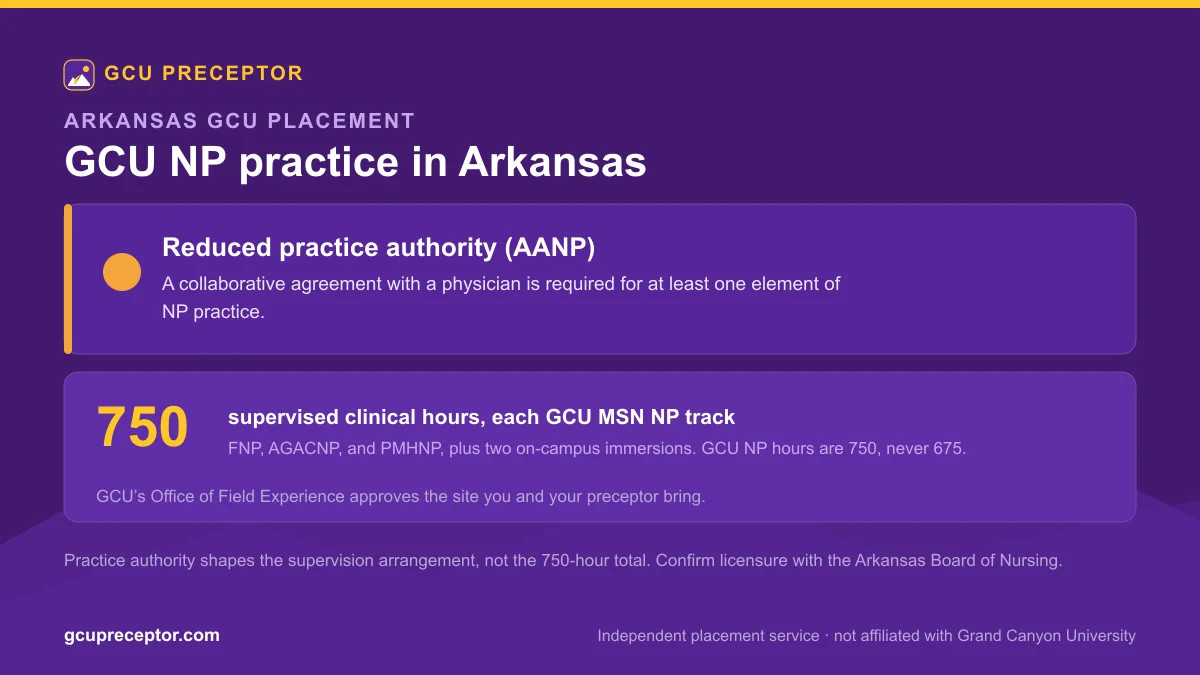
Arkansas is a reduced practice state, and it shapes your rotation
The American Association of Nurse Practitioners lists Arkansas as a reduced practice state. That label means state law reduces the ability of NPs to carry out at least one element of practice, and in Arkansas the sticking point is prescribing: an APRN who wants prescriptive authority must hold a collaborative practice agreement with a physician, and that agreement has to be on file with the state board before it can be used.
Day to day, Arkansas NPs still assess patients, order and interpret tests, make diagnoses, and manage treatment plans. The collaborative practice agreement sits in the background of all of it, spelling out how the physician stays available for consultation and referral, which protocols cover prescribing, and how quality assurance is maintained. Arkansas has also created a pathway for experienced NPs to apply for full independent practice after a period of collaborative work; the board publishes the current eligibility rules.
For a GCU student, none of this blocks an Arkansas placement. What it does mean is that your preceptor works inside a defined collaborative structure, and watching an NP manage that relationship, the consults, the chart reviews, the protocol updates, is genuinely useful preparation for practicing here after graduation.
The Arkansas State Board of Nursing: who governs your license
APRN practice in Arkansas is regulated by the Arkansas State Board of Nursing (ASBN), which operates under the Arkansas Department of Health. The board licenses RNs and APRNs, recognizes national certification for nurse practitioners, approves collaborative practice agreements, and grants prescriptive authority. Its rules and application materials live on the Arkansas Department of Health website, and most licensure business runs through the Arkansas Nurse Portal.
Two pointers worth bookmarking. First, license verification: before you nominate a preceptor, confirm their Arkansas license is active and unencumbered through the board's verification tools. Second, the collaborative practice agreement: an APRN preceptor with prescriptive authority should have a current agreement on record with the board, and asking about it early is a fair, professional question. We check both whenever we vet Arkansas preceptors for GCU students.
Finding a preceptor from Little Rock to the Ozarks
Here is the GCU reality: you source your own preceptor. The Office of Field Experience supports you and approves the site you bring, but it does not place students. You nominate your site and preceptor through the Field Experience Site Information Form in the eDocs app, OFE reviews and approves, then you log hours in the Lopes Activity Tracker while your preceptor verifies them in ThunderTime. The finding part, the hardest part, is yours. That is the gap we fill.
Arkansas placements cluster where the clinicians are. Central Arkansas, meaning Little Rock, North Little Rock, and Conway, has the deepest bench of family practice, acute care, and psychiatric sites. The northwest corridor of Fayetteville, Springdale, Rogers, and Bentonville is growing quickly and adding clinics with it. Fort Smith anchors the River Valley, Jonesboro serves the northeast, and Pine Bluff and the Delta communities need providers badly but have fewer of them. Rural placements can be deeply rewarding, though travel time is real.
Competition matters too. Arkansas has several in-state nursing programs sending their own students into the same clinics, so the strongest preceptors book up months ahead. Starting your search two terms before your practicum course is not overkill. Our find a preceptor service runs that outreach for you: we identify licensed, specialty-matched Arkansas preceptors, confirm willingness and availability, and hand you a candidate ready for the eDocs nomination.
750 hours, viewed from Arkansas
GCU's three MSN nurse practitioner tracks, FNP, AGACNP, and PMHNP, each require 750 supervised clinical hours with specialty-matched preceptors. An FNP student needs family practice exposure across the lifespan, an AGACNP student needs acute or hospital-based adult-gerontology settings, and a PMHNP student needs psychiatric care. All of those hours can be completed at approved Arkansas sites, but each track also includes two on-campus immersions in Phoenix, so the degree is not 100% online and the travel belongs in your plan.
Other GCU pathways carry their own field requirements. Post-master's certificates, including the 750-hour FNP certificate, follow the same preceptored model. DNP students complete the Direct Practice Improvement project with IRB review, with hours attached per course rather than one published total; see our DNP practicum page. RN-to-BSN students finish NRS-465, the Applied EBP Project and Practicum, at 40 hours; details on the RN-to-BSN practicum page. Our clinical hours guide breaks down how the totals accrue.
Telehealth hours: a short reality check
Telehealth is a large part of care delivery in rural Arkansas, and some rotations will include virtual visits. Whether telehealth time counts toward your preceptored hours varies by program and course, so confirm with your program and OFE before you build a schedule around it. In-person assessment remains the backbone of NP training, and OFE approval attaches to the specific site and preceptor you nominate.
If your Arkansas search is stalling, we can take it over. We match you with a vetted preceptor first, and you pay only when a placement is secured; see how it works or request a free placement review. We handle sourcing and paperwork, and while no one can guarantee OFE approval, we build every nomination around GCU's preceptor requirements so it arrives clean.
Frequently asked questions
Is Arkansas a full practice state for nurse practitioners?
No. AANP classifies Arkansas as a reduced practice state. APRNs who prescribe must maintain a collaborative practice agreement with a physician that is filed with and approved by the Arkansas State Board of Nursing. The board also offers a pathway for experienced NPs to apply for full independent practice; check its current rules for eligibility.
Does GCU place me with an Arkansas preceptor?
No. GCU students source their own preceptors. The Office of Field Experience approves the site and preceptor you nominate through the eDocs Field Experience Site Information Form and supports you along the way, but the searching is your responsibility. That search is exactly what our service handles for you.
Can I finish my GCU clinical hours without leaving Arkansas?
Your preceptored hours can be completed at approved sites in Arkansas, and placements exist across the state from Little Rock to Northwest Arkansas. Plan for the two on-campus immersions in Phoenix, though, which are required parts of the MSN NP tracks.
How do I confirm an Arkansas preceptor is licensed?
Use the Arkansas State Board of Nursing's license verification tools to confirm the license is active and in good standing before you submit the eDocs nomination. When we source a preceptor for you, licensure and specialty match are verified before you ever see the candidate.
Get your GCU clinicals handled.
Tell us your track and term. We’ll map your clinical requirement and start the search, in person or virtual. No payment until you’re matched.