Alaska Clinical Placements for GCU Nursing Students
Alaska gives nurse practitioners full practice authority, and the state needs every clinician it can train. Here is how GCU nursing students in Alaska line up preceptors, get their sites approved, and log their clinical hours close to home.
Get matched, free
What full practice authority means in Alaska
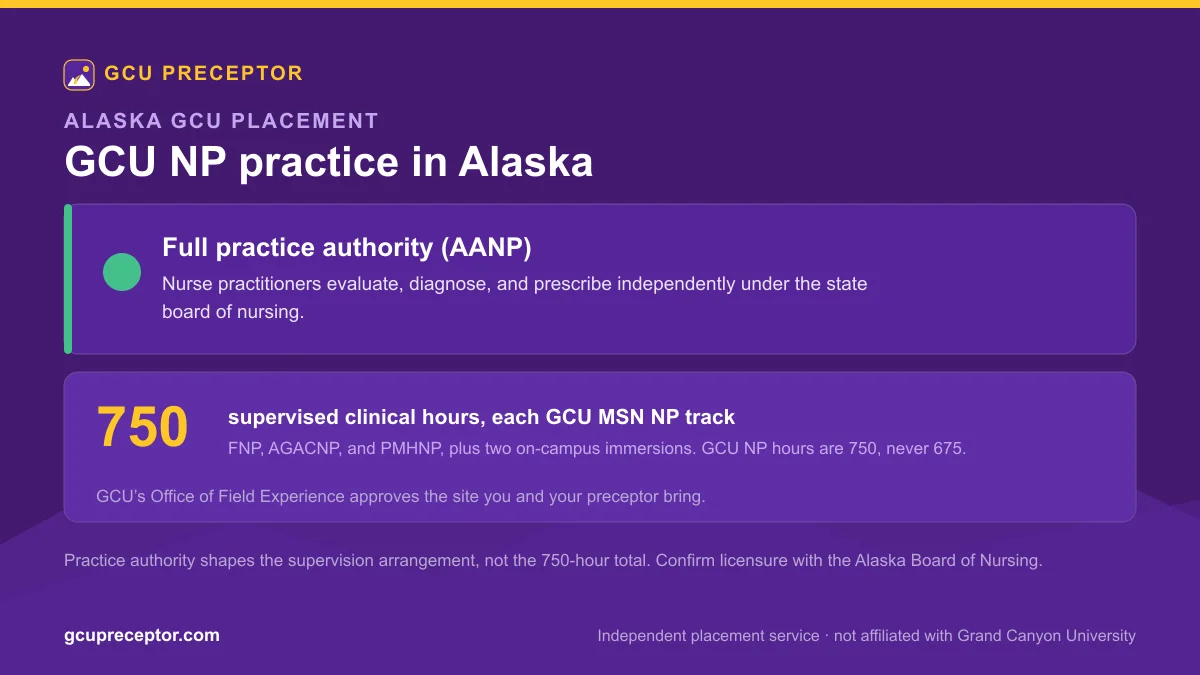
Alaska sits in the full practice category on the AANP State Practice Environment map. Licensed nurse practitioners in the state evaluate patients, diagnose, order and interpret diagnostic tests, and initiate and manage treatments, including prescribing medications and controlled substances, all under the licensure authority of the state board of nursing. There is no required collaborative agreement, no physician co-signature, and no supervision tether deciding where an NP can work.
Day to day, that looks like NPs owning their own patient panels, opening independent practices, and serving as the only advanced provider for an entire community. Alaska was one of the earliest states to take this path, and geography is a big reason why. Many Alaskan communities sit off the road system entirely, and NPs anchor primary care, behavioral health, and urgent care in places a physician may visit only a few times a year.
One clarification for students: full practice authority describes licensed NPs. While you are in a GCU program you still train under an approved preceptor at an approved site. The independence begins after graduation, national certification, and state licensure, in that order.
The Alaska Board of Nursing
Nursing in the state is governed by the Alaska Board of Nursing, which operates within the Division of Corporations, Business and Professional Licensing under the Department of Commerce, Community, and Economic Development. The board licenses RNs and LPNs and issues advanced practice registered nurse licensure for all four APRN roles, including nurse practitioners.
APRN applicants need an Alaska RN license, a nationally accredited graduate program, and current national certification in their role and population focus, and certification has to stay current for the license to stay valid. Applications and renewals run through the state's online licensing portal.
The board site matters to students for one more reason: verification. Before you nominate a preceptor, use the division's professional license search to confirm that the NP, physician, or PA you have in mind holds an active, unencumbered Alaska license. It takes five minutes and it saves weeks of rework if something is off.
Finding a preceptor across Alaska
GCU does not place students at clinical sites. You source your own preceptor, and the Office of Field Experience supports and approves the site you bring forward. The nomination itself happens through the Field Experience Site Information Form in the eDocs app, and OFE reviews the site and preceptor against program requirements before you can start hours.
Where do Alaskan students actually find those preceptors? Anchorage has the deepest bench by far: hospital-affiliated clinics, independent NP practices in Midtown and South Anchorage, and a wide range of behavioral health providers. The Mat-Su Valley around Wasilla and Palmer is growing quickly, and Fairbanks, Juneau, and the Kenai Peninsula communities of Soldotna, Kenai, and Homer each support a workable pool of family practice and psychiatric providers. Hub communities like Bethel, Nome, Kotzebue, Sitka, and Ketchikan have skilled clinicians too, though the provider pool is small and often tied to one organization.
Two practical notes. First, tribal health organizations and community health centers train many of Alaska's students, but larger systems often require their own affiliation agreements and credentialing steps, which add weeks to the timeline. Independent practices are frequently faster to confirm. Second, the small provider pool means the same preceptors get asked constantly. Start your search a full semester ahead, or let us run it for you through our placement service.
Meeting the 750 hours from the Last Frontier
Each of GCU's MSN nurse practitioner tracks, FNP, AGACNP, and PMHNP, requires 750 supervised clinical hours with specialty-matched preceptors. A PMHNP student needs psychiatric rotations, an AGACNP student needs acute and complex care, and an FNP student needs primary care across the lifespan, so the match matters as much as the license. You log every hour in the Lopes Activity Tracker, and your preceptor approves those hours in ThunderTime.
The programs also include two on-campus immersions in Phoenix, which is why no GCU NP track is 100% online. For Alaskan students that means real travel planning: flights from Anchorage or Fairbanks usually route through Seattle, so book early and build in a buffer day. Treat the immersion dates as fixed the moment you get them.
Alaska students in other GCU programs follow the same source-then-approve pattern with different hour structures: the post-master's certificates include a 750-hour FNP certificate, the DNP practicum builds hours course by course around the Direct Practice Improvement project and IRB process, and the RN-to-BSN practicum is a 40-hour applied EBP project in NRS-465. The full breakdown lives on our clinical hours page.
Telehealth and virtual rotations in Alaska
Telehealth is not a novelty in Alaska; it is how a large share of care actually reaches the bush. That makes virtual precepting an appealing idea, especially for students in smaller communities. Be careful here: whether telehealth hours count toward a given course varies by program and rotation, and hands-on assessment skills generally require in-person time. Confirm with your program and OFE before you build a plan around a virtual rotation, and treat telehealth as a supplement rather than the backbone of your 750 hours.
How placement works when we handle the sourcing
If you would rather spend your search time studying, this is the gap we fill. Tell us your track, your community, and your timeline, and we contact licensed Alaska providers who fit GCU's preceptor requirements, confirm their willingness and availability, and hand you a vetted match to submit through eDocs. You are matched first and pay only when a placement is secured; our cost page explains the model and how it works walks through each step. When you are ready, request a free placement review and we will map your options, whether you are in Anchorage or off the road system entirely. Placement approval always rests with GCU's OFE, and no service can guarantee it, so we build every match around their requirements from day one.
Frequently asked questions
Is Alaska really a full practice authority state for NPs?
Yes. AANP classifies Alaska as full practice, meaning licensed NPs evaluate, diagnose, order tests, and prescribe, including controlled substances, under the Alaska Board of Nursing without a physician agreement. As a student you still complete every clinical hour under an OFE-approved preceptor; the authority applies once you are licensed.
Can I complete all of my GCU clinical hours inside Alaska?
Usually, yes. Students routinely complete rotations in Anchorage, the Mat-Su Valley, Fairbanks, Juneau, the Kenai Peninsula, and hub communities, as long as OFE approves each site and preceptor through the eDocs site form. The two on-campus immersions in Phoenix are the exception; those require travel.
How do I verify an Alaska preceptor's license?
Use the professional license search on the Division of Corporations, Business and Professional Licensing site, which covers the Alaska Board of Nursing and the state's medical licensing. Confirm the license is active and unencumbered before submitting the Field Experience Site Information Form.
Does GCU find my preceptor for me?
No. GCU's Office of Field Experience supports and approves the preceptor and site you bring forward, but the sourcing is on you. That is exactly the work our service takes over: we find and vet a specialty-matched Alaska preceptor, and you submit the match for OFE approval.
Do rural or tribal health sites count for clinical hours?
They can, provided the preceptor matches your specialty and OFE approves the site. Plan extra lead time, because tribal health organizations and larger systems often require their own affiliation and credentialing steps before you can start.
Get your GCU clinicals handled.
Tell us your track and term. We’ll map your clinical requirement and start the search, in person or virtual. No payment until you’re matched.