Alabama Clinical Placements for GCU Nurse Practitioner Students
Alabama licenses nurse practitioners as CRNPs and requires every one of them to practice under a collaborative agreement with a physician, which shapes who can precept you and where. Here is what that means for GCU students completing clinical hours in Alabama, and how we take the preceptor search off your plate.
Get matched, free
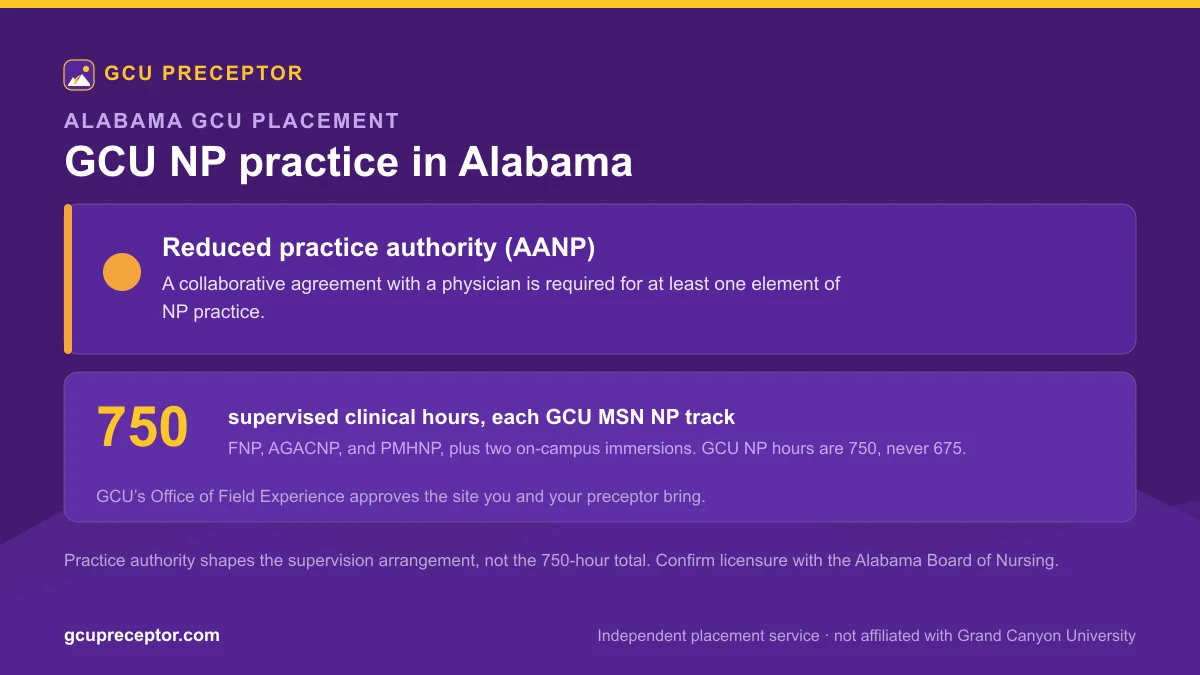
Alabama is a reduced practice state, and that matters for your rotation
The American Association of Nurse Practitioners classifies Alabama as a reduced practice state. In plain terms, state law limits at least one element of NP practice and requires a career-long regulated collaborative agreement with another health provider. In Alabama, that agreement is with a physician licensed in the state, and it stays in place for as long as the NP practices here.
Alabama NPs carry the title Certified Registered Nurse Practitioner, or CRNP. Collaboration does not mean a physician watches over the CRNP's shoulder all day. There is no requirement for direct, on-site supervision. What the rules do require is ongoing professional oversight and direction, documented time together, record review, and specialty-specific standard protocols that spell out what the CRNP may do, including prescribing.
For you as a student, the day-to-day effect is simple: nearly every NP who could precept you in Alabama works inside one of these collaborative arrangements. That is normal here, and it does not disqualify anyone. It just means credentials and practice details need to be confirmed early, before GCU reviews the site.
The Alabama Board of Nursing: who regulates what
The Alabama Board of Nursing, headquartered in Montgomery, licenses RNs and approves advanced practice. A CRNP approval sits on top of an active RN license and a national certification in the NP's specialty. Because collaborative practice involves physicians, the Board of Nursing shares oversight of those agreements with the Alabama Board of Medical Examiners, and the two boards jointly publish the standard protocols CRNPs practice under, including versions for family practice, psychiatric mental health, and adult acute care.
The board's website is the right first stop for anything license related. You can verify an Alabama nurse's license and CRNP approval there, read the advanced practice rules, and find the current protocol documents. If you are vetting a potential preceptor yourself, a quick verification through the board saves headaches later. When we source your preceptor, we run those checks before you ever see the match.
Finding a preceptor in Alabama as a GCU student
GCU expects you to bring your own preceptor. The Office of Field Experience supports and approves the site you present, but it does not find one for you. Once you have a willing preceptor, the site and preceptor are nominated through the Field Experience Site Information Form in the eDocs app, and OFE reviews everything against GCU's preceptor requirements before you can start hours.
Where you search matters in Alabama. Birmingham has the state's deepest bench of clinical sites and specialty practices, and Huntsville's rapid growth has pulled in new primary care and psychiatric providers. Montgomery, Mobile and the Gulf Coast, Tuscaloosa, Auburn and Opelika, Dothan and the Wiregrass, and the Shoals all support placements too. The hard part is the rural stretch, especially the Black Belt counties, where providers are scarce, panels are full, and a cold-call search can drag on for months.
That search is the part we take over. We reach out to vetted Alabama CRNPs, physicians, and clinics in your specialty, confirm their willingness and availability for your term dates, and hand you a match ready for the eDocs nomination. You are matched first and pay only when your placement is secured; our fee structure is on the cost page.
Meeting GCU's 750 hours from Alabama
Each of GCU's three MSN nurse practitioner tracks, FNP, AGACNP, and PMHNP, requires 750 supervised clinical hours with specialty-matched preceptors. An FNP student needs family practice settings across the lifespan, a PMHNP student needs psychiatric care, and an AGACNP student needs acute and complex care of adults. All of those hours can be completed at approved Alabama sites near you.
Two parts of the program do require travel: GCU's NP tracks include two on-campus immersions in Phoenix, which is why the programs are not 100% online. Everything else runs from Alabama. You log hours in the Lopes Activity Tracker, and your preceptor approves them in ThunderTime, so keeping your log current keeps your preceptor's part painless.
Beyond the MSN tracks, GCU offers post-master's APRN certificates, including a 750-hour FNP certificate, the DNP practicum built around the Direct Practice Improvement project with hours accruing per course, and the RN-to-BSN practicum, a 40-hour applied EBP experience in NRS-465. We place students from every one of these programs in Alabama.
Virtual or in-person hours in Alabama
Telehealth has real footing in Alabama, particularly for psychiatric care in rural counties, and some rotations can include telehealth encounters alongside in-person care. Whether virtual hours count toward your requirement depends on your program, your course, and OFE's review of the site, so confirm before you plan around them. In-person remains the default, especially for assessment-heavy rotations.
If you would rather spend your energy on patients than on cold calls, send us your program, specialty, and term dates for a free placement review. We will tell you honestly what your search looks like in your part of Alabama and get to work on a preceptor we can stand behind. We assist with sourcing; final approval of any site always rests with GCU.
Frequently asked questions
Does Alabama's collaborative practice requirement affect me as a student?
Not directly. The collaborative agreement governs your preceptor's practice, not your student status. What it means for you is that your CRNP preceptor practices under a standard protocol with a collaborating physician, so their scope is well defined. GCU's Office of Field Experience still reviews the preceptor and site against its own requirements before your hours begin.
Can a physician serve as my preceptor in Alabama?
Often, yes. Physicians in the right specialty are frequently a strong option, especially in rural Alabama where NPs are thin on the ground. The deciding factor is GCU's approval: the preceptor must match your track's specialty and meet the criteria on the preceptor requirements page, and OFE confirms fit through the eDocs site nomination.
How early should I start my Alabama preceptor search?
At least a full term ahead, and earlier for PMHNP placements or anywhere outside the Birmingham and Huntsville metros. Practices in smaller markets take longer to answer, and OFE approval adds its own lead time after you find someone. Starting early, or handing us the search early, is the single best way to protect your graduation timeline.
Where in Alabama do most GCU placements happen?
Birmingham leads for volume and specialty variety, with Huntsville close behind. We also place students in Montgomery, Mobile, Tuscaloosa, Auburn, Dothan, and the Shoals, and we work rural counties when that is where you live. Distance to the site matters less than finding a specialty-matched preceptor GCU will approve.
Get your GCU clinicals handled.
Tell us your track and term. We’ll map your clinical requirement and start the search, in person or virtual. No payment until you’re matched.